Tires
How often should you rotate and balance tires?
Rotate every 5,000 to 8,000 miles or at the interval in the manual; balance when a tire is mounted, a weight is lost or the car vibrates. Plus AWD, EV and Tesla rules.
Tires
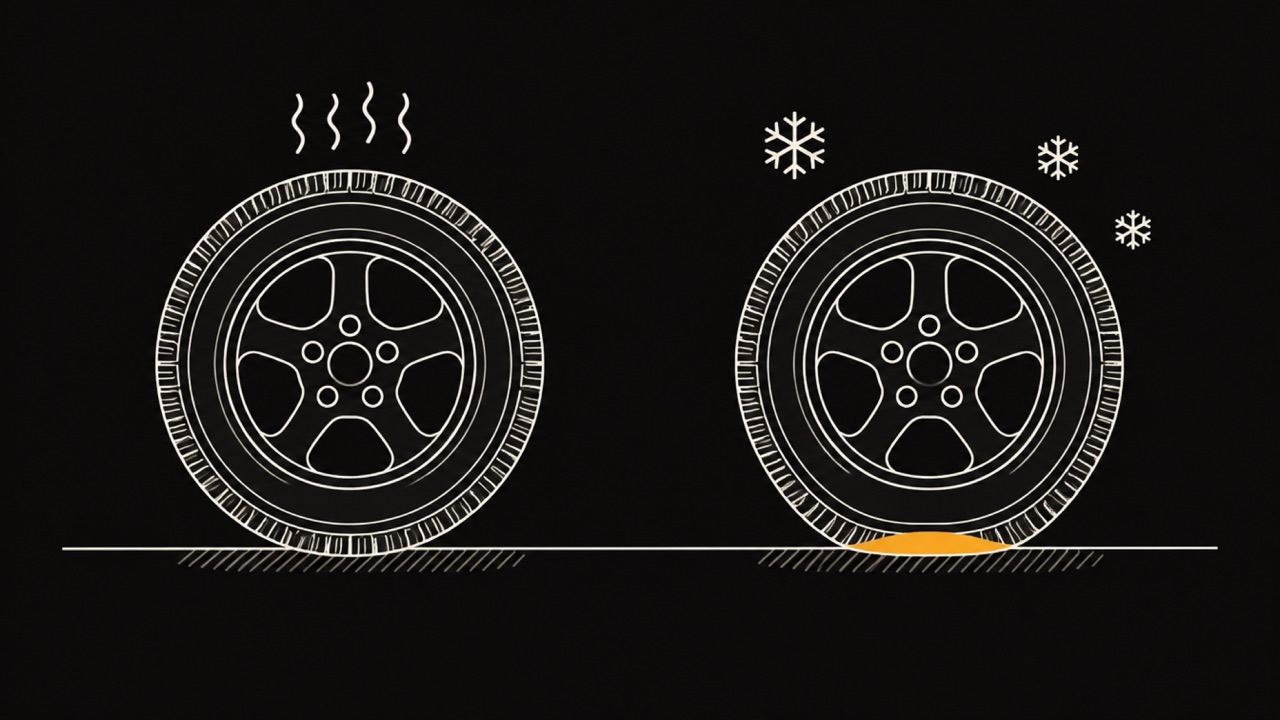
Tire pressure drops about 1 psi for every 10°F the air cools (about 1.7 psi per 10°C), because the air inside the tire contracts; Goodyear puts the drop at 1 to 2 pounds for every 10 degrees. A tire set to 35 psi in a 70°F garage reads about 31 psi on a 30°F morning, with no leak at all (example calculation below). The fix is to measure before driving, with the tires cold, and add air to the pressure on the driver's door placard, not to the maximum printed on the sidewall.
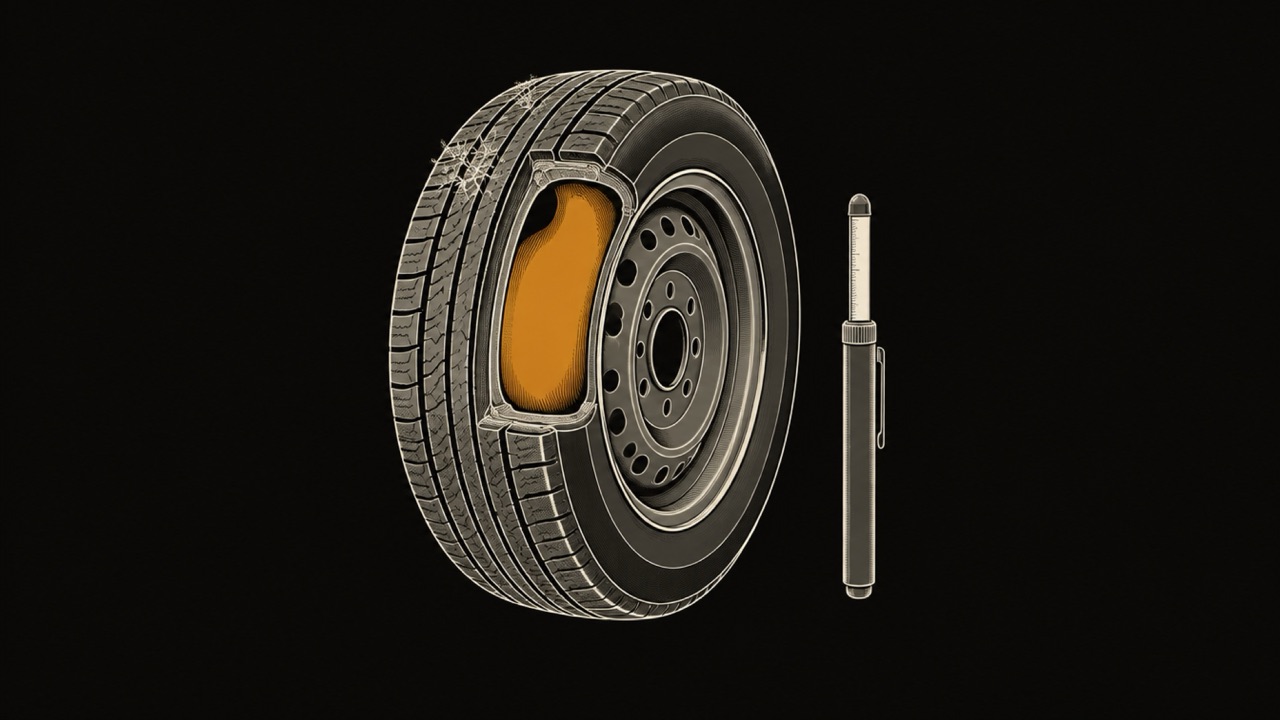
Tire pressure in cold weather drops by a predictable amount as the outside air cools. Goodyear says tires lose 1 to 2 pounds of pressure for every 10 degrees of temperature drop, and gain the same when it gets hotter. Continental gives 1 to 2 psi, or 0.07 to 0.14 bar, for every 10°C.
The figure follows from the ideal gas law. Inside a tire, the volume barely changes, so the pressure follows the temperature, measured from absolute zero as NASA Glenn Research Center explains. Worked through for a typical car tire at 35 psi, that gives a little under 1 psi per 10°F, or about 1.7 psi per 10°C, just under the low end of Goodyear's range and inside Continental's.
Example calculation: one tire set to 35 psi in a 70°F garage, at sea level, with its volume held constant. Each row is what a gauge would read once the tire has cooled to the outside temperature.
| Outside temperature | Tire pressure | Drop from 70°F |
|---|---|---|
| 70°F (21°C) | 35.0 psi | 0 psi |
| 50°F (10°C) | 33.1 psi | 1.9 psi |
| 30°F (-1°C) | 31.2 psi | 3.8 psi |
| 10°F (-12°C) | 29.4 psi | 5.6 psi |
| -10°F (-23°C) | 27.5 psi | 7.5 psi |
Computed with the ideal gas law (NASA Glenn), constant volume, 14.7 psi atmosphere; close to the 1 to 2 psi per 10 degrees quoted by Goodyear and Continental.
Tire pressure drops in cold weather because the air inside the tire contracts as it cools, so the same amount of air pushes on the tire with less force. Nothing has leaked. When the tire warms up again, on a sunny afternoon or after a few miles of driving, the pressure comes back.
The drop shows up overnight. A tire takes on the temperature of the air around it once the car has been parked for a few hours: Kia's owner's manual, for one, counts a tire as cold after at least three hours parked. A car that leaves a warm garage for a freezing street, or sits outside through the first cold night of autumn, meets the full drop the next morning.
The tire pressure light comes on in cold weather when a tire falls to the warning threshold of the tire pressure monitoring system (TPMS). In the US, federal standard FMVSS 138 requires the light within 20 minutes once a tire is 25 percent below the vehicle maker's recommended cold inflation pressure, or below a minimum of 20 psi for standard passenger tires, whichever is higher. For a placard of 35 psi, the threshold is about 26 psi.
Cold alone rarely gets a correctly inflated tire that far. By the same calculation as above, a tire set to 35 psi at 70°F would have to cool to about -23°F before it reached 26 psi. A tire that started a few psi low gets there on an ordinary cold morning: at 30 psi, the light comes on at about 26°F.
So a pressure light on the first cold morning usually means the tire was already low, and the cold finished the job. That is common: in a 2011 field survey of 6,103 vehicles, NHTSA found that 71.1 percent of model year 2004 to 2011 passenger vehicles had at least one tire underinflated by at least 1 psi, and 12.4 percent had one more than 25 percent low.
The light often goes off after a few miles because driving warms the tires, and a warm tire reads 4 to 6 psi above its cold pressure, per Kia's owner's manual. The light going out does not mean the pressure is right.
| Pressure set at 70°F | Light comes on at about |
|---|---|
| 35 psi (at the placard) | -23°F (-31°C) |
| 33 psi (2 psi low) | -5°F (-21°C) |
| 31 psi (4 psi low) | 15°F (-9°C) |
| 30 psi (5 psi low) | 26°F (-4°C) |
Computed with the ideal gas law from the 25 percent threshold of 49 CFR 571.138; constant volume, 14.7 psi atmosphere.
The cold reading is the right one. The pressure on the door placard is a cold pressure, which is why the federal standard calls it the recommended cold inflation pressure. Cold means the car has been parked for at least three hours or driven less than 1 mile, in the wording of Kia's owner's manual.
A hot reading runs higher: the same manual says warm tires normally read 4 to 6 psi above the cold pressure, and warns against letting air out of a warm tire to match the placard, because the tire would then be underinflated once it cools. Measured after a drive to the pump, a tire at 39 psi may simply be a correct 35 psi tire that is warm.
The right tire pressure in cold weather is the same number as in summer: the one on the placard in the driver's door jamb, measured cold. Goodyear and Continental both point to the vehicle maker's recommendation, in winter as the rest of the year.
Two numbers are easy to confuse. The pressure molded on the tire sidewall is the tire's maximum, or rated, inflation pressure, as FMVSS 138 calls it: the most the tire can carry, not a target. And there is no reason to add a few psi on top of the placard for the cold: if the tires are set to the placard while cold, the cold has already been accounted for, and the extra air only overinflates them on the next warm day.
Low tire pressure in cold weather is fixed with air, a gauge and the right timing. Here is a plan for a car whose light came on during the first cold snap.
Low tire pressure costs fuel, a little at a time. fueleconomy.gov says underinflated tires can lower gas mileage by 0.2 percent for every 1 psi drop in the pressure of all four tires. Four tires left 4 psi low after the first cold snap cost about 0.8 percent of fuel economy (example calculation).
That is a small part of the winter loss. A cold engine, cold fluids and short trips cost more, as the guide to why gas mileage gets worse in winter explains, but tire pressure is the part that costs nothing to fix.
Tracking tire pressure through the winter means writing down four numbers, one per tire, each time you check. A single soft tire is what triggers the light, and an average of four hides it. A note of the date also shows which tire keeps losing more than the others, which is how a slow leak shows itself.
WrenchTime, an iPhone app for car and motorcycle maintenance, records tire pressure on a diagram of the vehicle: front left, front right, rear left and rear right, in the pressure unit you use, with the latest readings on the vehicle card. A tire pressure check is one of its 59 maintenance procedures, so you can schedule a recurring tire pressure check the way you schedule an oil change.
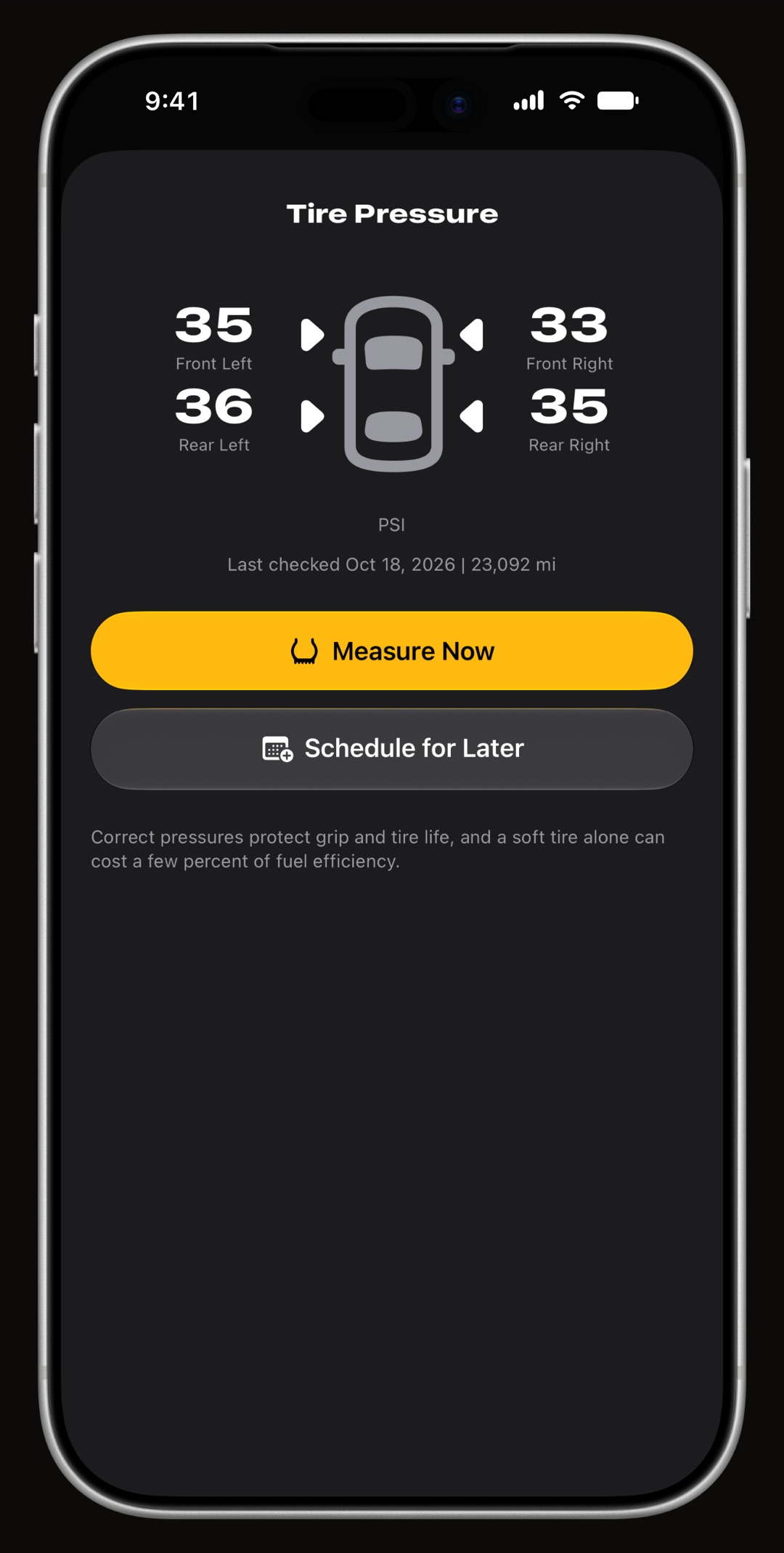
Log this winter's readings tire by tire and set the next check before the next cold snap. Download WrenchTime on the App Store: the free version covers 1 vehicle with 2 maintenance entries per month, and WrenchTime Pro removes the limits. Fill-ups and fuel economy sit in the same app, so a winter dip in mileage and a soft tire can be read side by side.
No. Inflate to the pressure on the driver's door placard, measured with the tires cold. That number is a cold pressure, so it already accounts for the tire warming up as you drive. Adding more for the cold only overinflates the tire on the next warm afternoon.
Yes. Tire pressure drops about 1 psi for every 10°F the air cools, and Goodyear and Continental both quote 1 to 2 psi per 10 degrees. A tire set to 35 psi in a 70°F garage reads about 31 psi at 30°F (example calculation). The air did not leak; it contracted.
Driving warms the tires, and a warm tire reads 4 to 6 psi higher than a cold one, per Kia's owner's manual. The light goes out because the warm reading crosses back over the threshold, not because the pressure is right. Check and inflate the tires cold.
It depends on the placard. For a car whose door placard says 35 psi, 27 psi is close to the 26 psi point where federal rules require the TPMS light. Drive gently to the nearest air pump and inflate to the placard pressure.
Cold tire pressure is the pressure measured before the tire has warmed up: after the car has been parked for at least three hours or driven less than 1 mile, per Kia's owner's manual. The pressure on the door placard is a cold pressure.
The sensors read the pressure; the pressure itself is what drops. Under FMVSS 138 the TPMS light must come on within 20 minutes once a tire is 25 percent below the placard pressure. A light on a cold morning usually means a tire was already a few psi low.
More from the blog
Tires
Rotate every 5,000 to 8,000 miles or at the interval in the manual; balance when a tire is mounted, a weight is lost or the car vibrates. Plus AWD, EV and Tesla rules.
Road trips
Check tires, battery, brakes, fluids, lights and wipers and the emergency kit one to two weeks before you leave, so a shop has time to fix what you find.
Fuel economy
Driving habits beat every product: smooth driving and lower highway speeds save the most, tires, oil and roof racks come next, and gadgets do nothing.
Free to download. One vehicle, real features, no ads. Your garage will thank you.
Download WrenchTime on the App Store