Brakes
How often do you need to change brake fluid?
Every 2 to 3 years for most cars, whatever the mileage, with manufacturer intervals, the federal boiling points and a test-before-you-pay checklist side by side.
Tires
Rotate your tires every 5,000 to 8,000 miles (about 8,000 to 13,000 km), or at the interval in your owner's manual if it is shorter, which for many cars means every oil change or every other one. Balancing is not a fixed-mileage job: have the wheels balanced whenever a tire is mounted or remounted on its rim, a wheel weight falls off, the wheel takes a hard pothole or curb hit, or you feel a vibration at highway speed. Rotating a tire does not by itself change its balance, so a car that drives smoothly does not need a rebalance at every rotation.
How often to rotate and balance tires has two different answers, because the two services fix two different problems. Rotation is a schedule item: it evens out tread wear, and wear builds with distance, so it is due by the mile. Balancing is a condition item: a wheel goes out of balance when something changes on it, such as a new tire, a lost weight or an impact, so it is due when that happens.
For rotation, the US regulator and the big tire makers agree on a narrow range. NHTSA tells drivers to rotate every 5,000 to 8,000 miles, or sooner if uneven wear appears, if the vehicle manufacturer recommends it. Michelin says every 5,000 to 7,000 miles, or every other oil change (updated 2026), and Bridgestone gives 5,000 to 7,000 miles when the vehicle manufacturer gives no figure.
For balancing, Discount Tire suggests balancing about every 5,000 to 6,000 miles even without a vibration, and United Tires every 5,000 to 7,000 miles or at every other rotation (2025). The owner's manual overrides every number in the table below: carmakers set their own intervals, and they differ by thousands of miles and sometimes add a time limit.
| Source | Rotation interval | Balancing guidance |
|---|---|---|
| NHTSA | 5,000 to 8,000 miles, or sooner if uneven wear appears | Not specified |
| Michelin (updated 2026) | 5,000 to 7,000 miles, or every other oil change | Often done alongside rotation; no interval given |
| Bridgestone | 5,000 to 7,000 miles when the vehicle manufacturer gives no figure | Not specified |
| Toyota, 2022 Corolla (via AAA) | 5,000 miles or 6 months | Not specified |
| Subaru, 2013 Forester (via AAA) | 7,500 miles or 7.5 months | Not specified |
| Goodyear (via AAA) | 3,000 to 6,000 miles | Not specified |
| Tesla Model Y service manual (2025) | 6,250 miles (10,000 km) or a 2/32 in (1.5 mm) tread depth difference, whichever comes first | Not part of the rotation procedure |
| United Tires (2025) | 5,000 to 7,000 miles, or every six months | Every 5,000 to 7,000 miles, or at every other rotation |
| Discount Tire | Not covered here | About every 5,000 to 6,000 miles, and whenever a vibration appears |
Sources: NHTSA, Michelin, Bridgestone, AAA Via, Tesla, United Tires, Discount Tire, all accessed October 2026. Your owner's manual overrides every row.
Tire rotation means moving each wheel and tire to a different position on the car, so that every tire spends time in the spots that wear it fastest and the four wear evenly. Wheel balancing means spinning each wheel and tire on a machine and clipping or sticking small weights to the rim until it turns without a heavy spot. Wheel alignment is a third, separate service: it sets the angles of the wheels relative to the car and to each other.
The three are often sold together, which is why they get confused, but each answers a different symptom. Uneven wear between front and rear calls for rotation, a vibration that grows with speed calls for balancing, and a car that pulls to one side or a steering wheel that sits off center calls for an alignment check.
| Service | What it fixes | When you need it |
|---|---|---|
| Tire rotation | Front and rear tires wearing at different rates | Every 5,000 to 8,000 miles, or at the manual's interval |
| Wheel balancing | Vibration from a heavy spot in the wheel and tire | New or remounted tire, lost weight, hard impact, vibration |
| Wheel alignment | Pulling, an off-center steering wheel, wear on one edge of the tread | After an impact, new suspension parts, or when the car pulls |
No, tires do not need to be balanced every time they are rotated. A rotation moves the whole assembly, so the balance travels with it. As Car Talk put it, rotating the tires doesn't affect the balance, because you're just moving the tires, rims and all, from one place on the car to another. The same column names the cases that do call for a rebalance: a tire taken off its rim and remounted, or a weight knocked off by a big pothole or a curb.
That said, a rotation is a convenient moment for a balance check, because the wheels are already off the car. United Tires suggests balancing every 5,000 to 7,000 miles or at every other rotation (2025), and Discount Tire about every 5,000 to 6,000 miles. Accepting a balance at every other rotation is reasonable; paying for one at every rotation on a car that drives perfectly smoothly is optional, not required.
A rotation can reveal a balance problem that was already there. Front wheels transmit vibration through the steering wheel, rear wheels through the seat and floor, so a wheel that was slightly out of balance at the back can make itself felt once it moves to the front. That is the wheel asking for a balance, not the rotation causing one.
Tires need balancing when the car shows one of the signs below, whatever the mileage since the last balance. Discount Tire notes that an imbalance is usually felt at highway speeds, about 45 mph and up, and Car Talk that a huge pothole or a curb can knock a weight off the wheel.
If a vibration survives a fresh balance, the cause is somewhere else. Discount Tire warns that bent or damaged wheels and out-of-round tires can feel just like a balance problem; worn brakes, worn suspension parts and alignment are the other usual suspects. A vibration only under braking points to the brakes; one that changes when turning points to suspension or wheel bearings; a car that pulls points to alignment. A shop with a road-force balancer can also measure a tire that is round on the balancer but not under load.
Rotate AWD tires at the interval in the manual, which is usually in the same 5,000 to 7,500 mile range as other cars, and treat that interval as a hard limit rather than a suggestion. An all-wheel drive system connects the front and rear axles, and if the tires on one axle wear faster their rolling diameter shrinks; the drivetrain then has to make up the difference all the time, which loads the center differential or coupling.
Owner's manuals for AWD cars such as Subarus ask for four tires matched in size, type and degree of wear, and dealer and shop guidance puts the tolerance at around 2/32 in (about 1.6 mm) of tread depth difference: 2/32 in for Subaru, 2/32 to 3/32 in for Honda and Acura SH-AWD, as collected by Rick's Free Auto Repair Advice. Past that limit, replacing one damaged tire can mean replacing all four, or having a new tire shaved down to match. Regular rotation is what keeps the four within the limit.
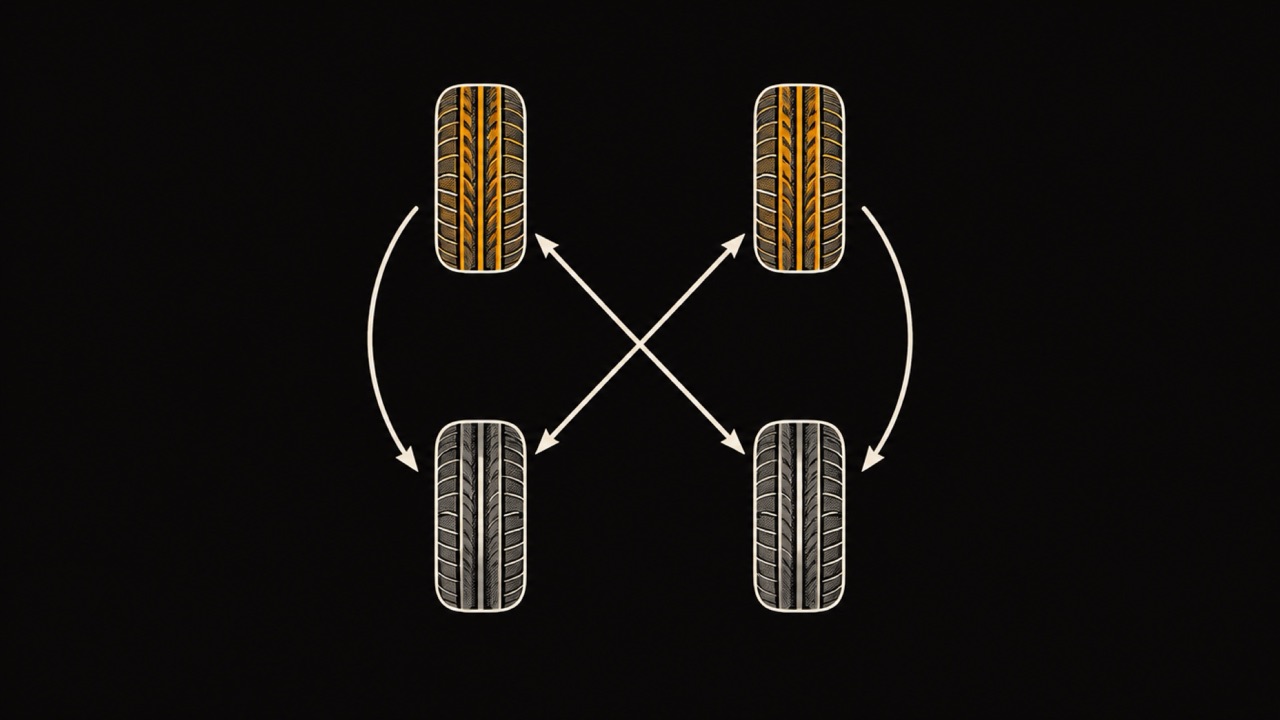
AWD and 4WD vehicles are usually rotated in an X pattern, each tire moving diagonally to the other axle, in what Michelin calls a crisscross pattern, unless the manufacturer specifies otherwise. Check the manual for the exact tread-depth tolerance of your own car, because it differs by make and system.
Tesla specifies a tire rotation every 6,250 miles (10,000 km) or whenever the tread depth difference between tires reaches 2/32 in (1.5 mm), whichever comes first, according to the Model Y service manual (2025). The same manual says to replace a tire at 4/32 in (3 mm) of tread or less.
Other electric cars follow their own manuals, but the reason for discipline is the same. EVs are heavy for their size and deliver full torque from a standstill, so the driven axle can wear its tires faster than on a comparable gasoline car. No independent figure for how much faster holds up across models, so the practical rule is to measure: check tread depth at every rotation and rotate sooner if the axles drift apart. Hybrids follow the same logic as any car with the same drivetrain; the hybrid car maintenance guide covers the rest of their schedule.
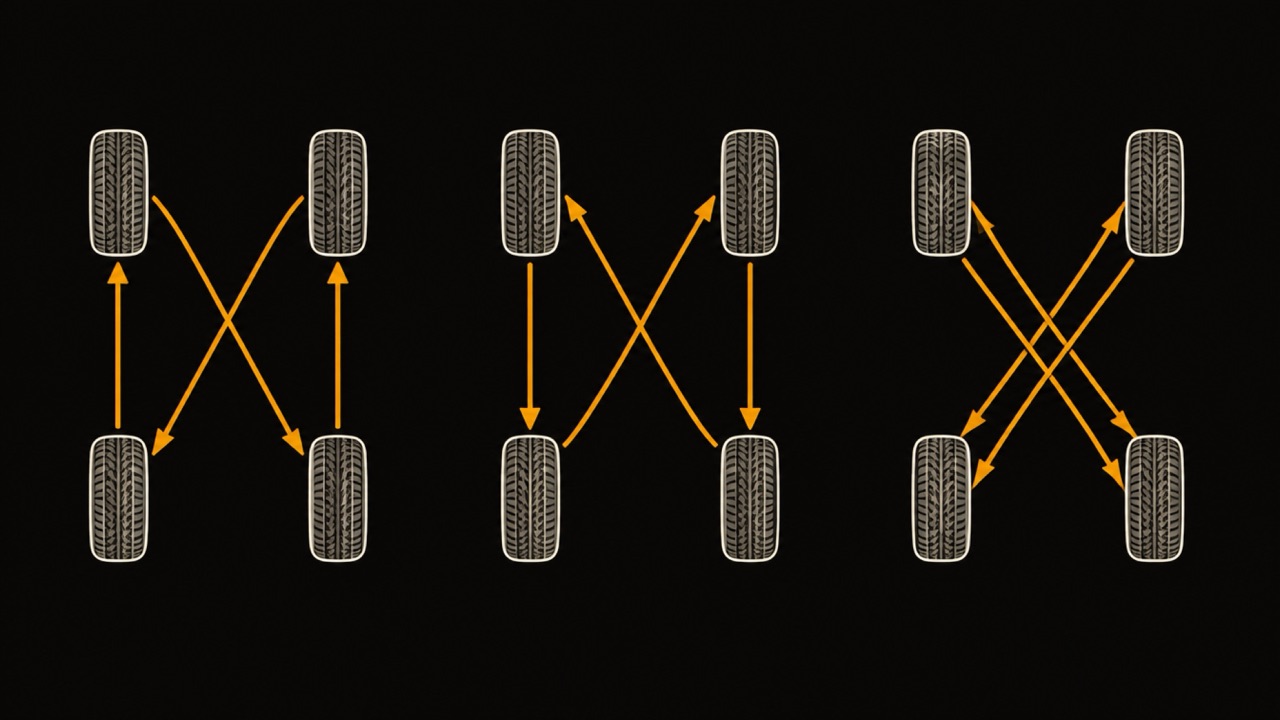
The right tire rotation pattern depends on which wheels drive the car and on the tires themselves. Front-wheel drive cars wear their front tires fastest, because the fronts both steer and drive, so the pattern sends the worn fronts straight back and brings the rears forward crossed. Rear-wheel drive cars do the opposite. Michelin and Bridgestone describe the patterns in the table below.
A directional tire is built to roll in one direction only, marked by an arrow on the sidewall, so it can only move front to back on the same side of the car. A staggered setup uses a different tire size front and rear and may not allow rotation at all, so the manual decides. A full-size matching spare can join a five-tire rotation; a temporary spare never can, in Bridgestone's words: never include a temporary spare tire in the rotation.
| Vehicle or tire | Pattern | How the tires move |
|---|---|---|
| Front-wheel drive | Forward cross | Fronts straight back; rears cross to the opposite side at the front |
| Rear-wheel drive | Rearward cross | Rears straight forward; fronts cross to the opposite side at the back |
| All-wheel and four-wheel drive | X pattern | Each tire moves diagonally to the other axle, unless the manual says otherwise |
| Directional tires | Front to back | Same side only, front to rear and rear to front |
| Staggered sizes | Often none | May not rotate at all; follow the manual |
| Full-size matching spare | Five-tire rotation | The spare enters the rotation; a temporary spare never does |
Sources: Michelin, Bridgestone, accessed October 2026.
A tire rotation is finished only when the tires are back at the right pressure and the wheels are tight. Bridgestone lists both as part of the job, and NHTSA adds the habit that keeps them right between rotations.
Rotating tires more often than needed does no harm to them; it only costs time and money. Even 3,000 miles is within a tire maker's range: Goodyear recommends 3,000 to 6,000 miles, as reported by AAA Via. Most drivers can follow the 5,000 to 8,000 mile range or the manual instead.
Rotating too rarely is the real cost. Michelin lists the results of skipping rotations as uneven tread depth, lower grip and a shorter tire lifespan, plus road noise and vibration. On an AWD car it can also push the tread depth difference past the manufacturer's limit, which can turn one damaged tire into four new ones.
Time matters as well as distance. Toyota's 6-month and Subaru's 7.5-month limits for the cars listed by AAA mean a car driven 4,000 miles a year is still due twice a year, and many owners line rotations up with oil changes for the same reason: AAA suggests a rotation at every oil change, Michelin at every other one.
The simplest way to never miss a tire rotation is to tie it to a job you already do: every oil change, or every other one, depending on your oil interval. That works as long as the two intervals stay close; with long-life synthetic oil they can drift apart, and the tires lose.
The more reliable way is to log each rotation with its date and odometer reading and set the next one by mileage and by date, whichever comes first, so a low-mileage car still gets rotated on time. Note the pattern used, whether the wheels were balanced, any weight replaced and the tread depths, and keep the receipt. Those notes become part of the car's service history; the guide to car maintenance records covers what a usable record needs.
The whole article in six lines.
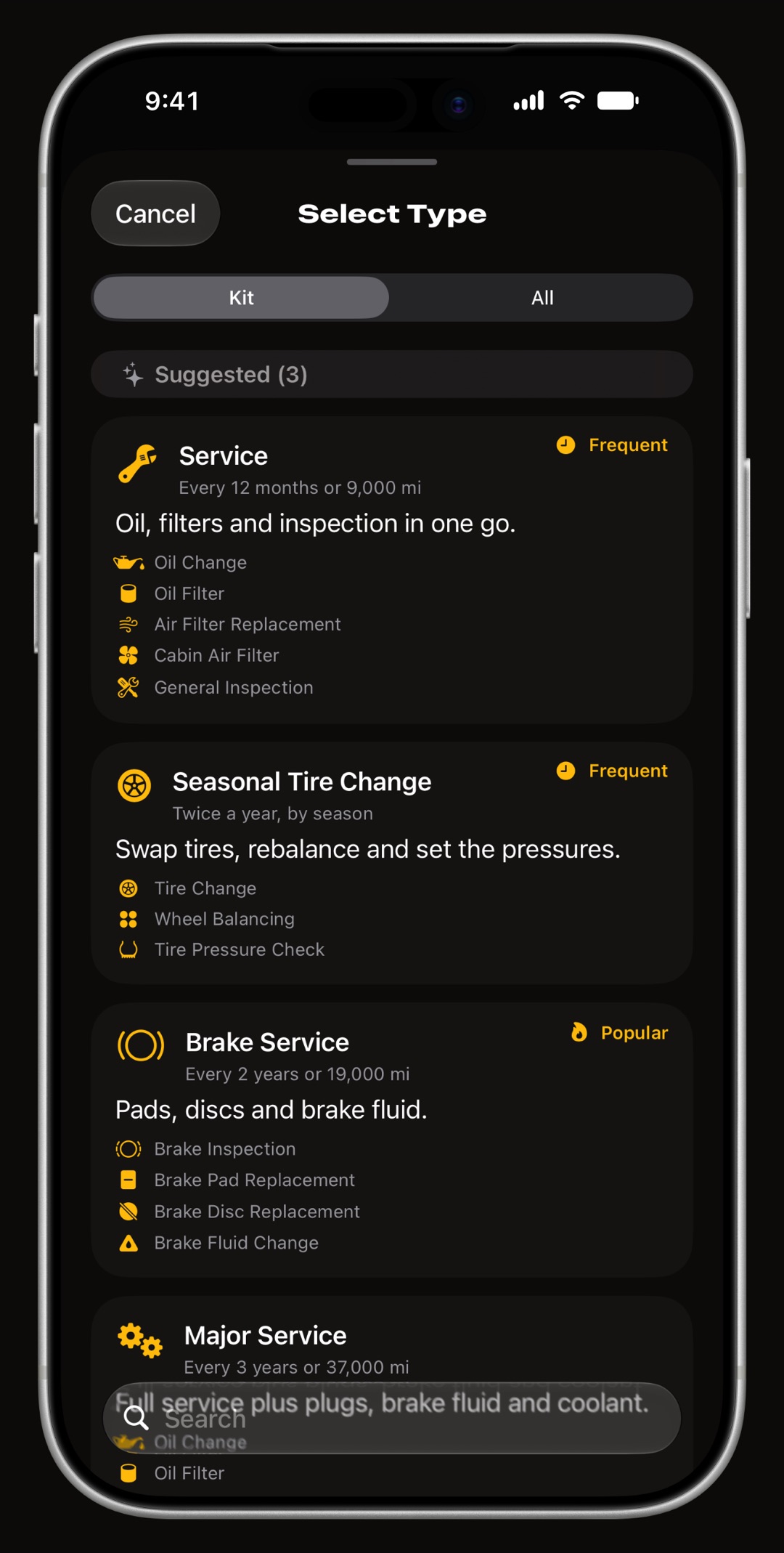
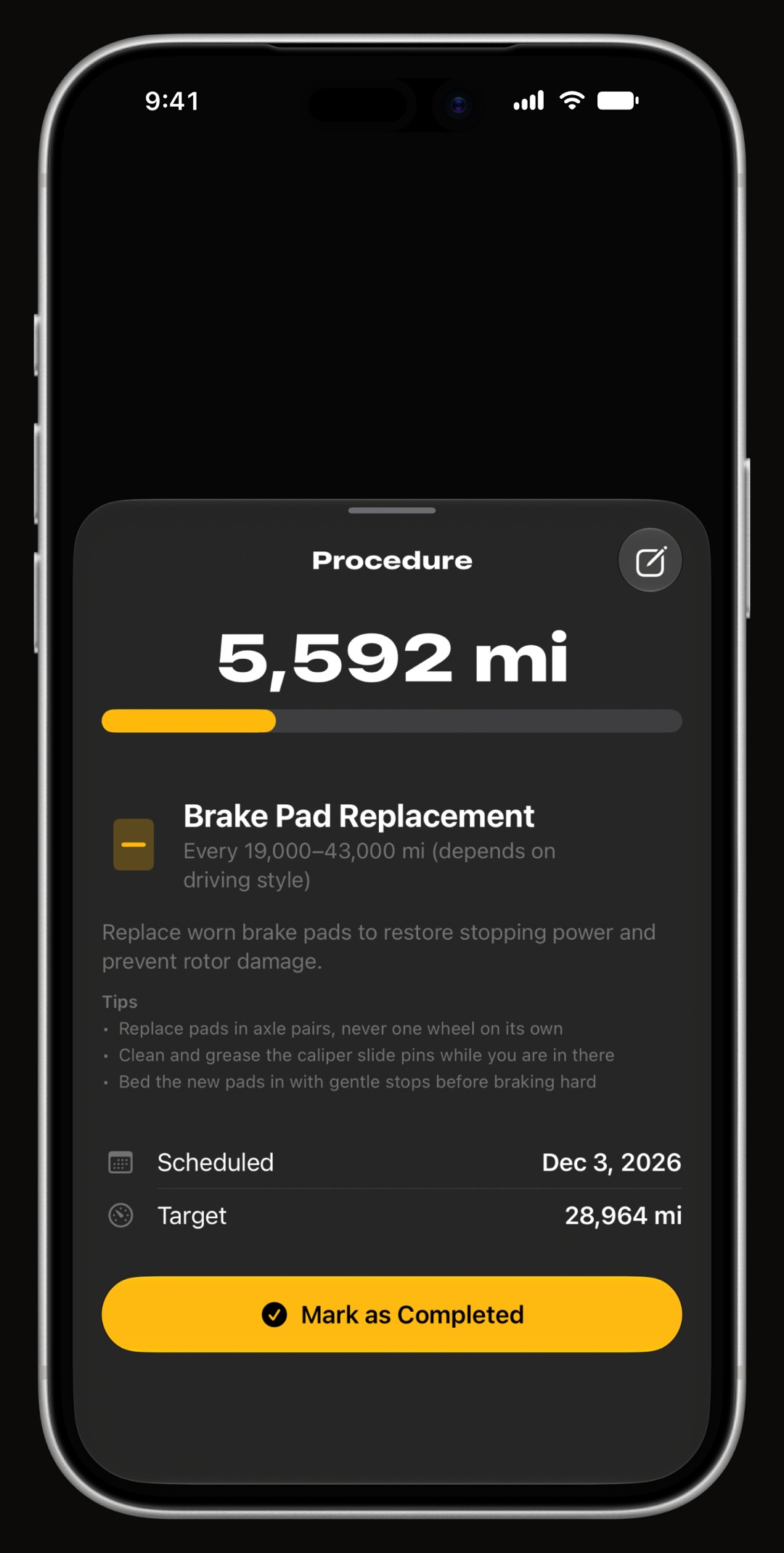
WrenchTime, an iPhone app for maintenance, fuel, charging and mileage on cars and motorcycles, lists tire rotation and wheel balancing among its 59 procedures, and its Tire Rotation kit puts both in one entry. Log the job with the date, the odometer and the cost, add a note on the pattern or the tread depths, and schedule the next one in the same step, by distance, by date or both; WrenchTime treats whichever comes first as the one that matters and sends a reminder by date or by odometer reading. Motorcycles are not rotated, since their front and rear tires differ in size, so on a motorcycle the same log tracks tire changes instead.
The free version covers 1 vehicle with 2 maintenance entries and 3 fuel entries per month, with CSV and PDF export included, and WrenchTime Pro removes the limits. The guide to iPhone car maintenance apps covers what a maintenance log should do, and the coolant change intervals article is the same question for the cooling system. Download WrenchTime on the App Store.
No. A rotation moves the wheel and tire together, so the balance moves with them, as Car Talk put it. Balance the wheels when a tire is mounted or remounted, a weight is knocked off by a pothole or curb, or you feel a vibration at highway speed. A balance check at every other rotation is reasonable.
Rotating at 3,000 miles is early but does no harm: Goodyear's own recommendation is 3,000 to 6,000 miles, as reported by AAA Via. Most drivers can follow NHTSA's 5,000 to 8,000 mile range or the interval in the owner's manual, whichever is shorter.
No. Rotating tires more often than needed does not damage them; it only costs time and money. Rotating too rarely is what causes problems: Michelin lists uneven tread depth, lower grip and a shorter tire life, and on an AWD car the tread depths can drift past the manufacturer's tolerance.
Rotate AWD tires at the manual's interval, typically 5,000 to 7,500 miles, using an X pattern unless the manufacturer says otherwise. Dealer guidance for many AWD systems allows only about 2/32 in of tread depth difference between tires, and regular rotation keeps all four within that limit.
Tesla specifies a rotation every 6,250 miles (10,000 km) or whenever the tread depth difference between tires reaches 2/32 in (1.5 mm), whichever comes first, according to its Model Y service manual. Tesla also says to replace a tire at 4/32 in (3 mm) of tread or less.
Balancing evens out the weight around each wheel and tire so it spins without vibrating; alignment sets the angles of the wheels relative to the car. A vibration that grows with speed points to balance. A car that pulls to one side, or a steering wheel that sits off center, points to alignment.
More from the blog
Brakes
Every 2 to 3 years for most cars, whatever the mileage, with manufacturer intervals, the federal boiling points and a test-before-you-pay checklist side by side.
Road trips
Check tires, battery, brakes, fluids, lights and wipers and the emergency kit one to two weeks before you leave, so a shop has time to fix what you find.
Fuel economy
Driving habits beat every product: smooth driving and lower highway speeds save the most, tires, oil and roof racks come next, and gadgets do nothing.
Free to download. One vehicle, real features, no ads. Your garage will thank you.
Download WrenchTime on the App Store