Mileage
What is the best mileage tracker app?
MileIQ, Everlance, TripLog, Driversnote, Stride and WrenchTime compared on free limits, prices, how a trip starts on its own, and what each one is for.
Mileage and taxes
An IRS compliant mileage log is a record, made at or near the time of each trip, that shows the date, the destination, the business purpose and the miles driven for every business trip, plus your total miles for the year. The IRS does not require a specific form: a paper logbook, a spreadsheet or an app all qualify if those details are there. In 2026 the date on each trip matters more than usual, because the business mileage rate rose from 72.5 cents to 76 cents per mile in July.
IRS Publication 463 says car expenses must be backed by adequate records showing the amount, time, place and business purpose of each use. For a vehicle, that means the mileage for each business use, the total miles for the year, and the date you started using the car for business, written in "an account book, diary, log, statement of expense, trip sheets, or similar record."
A record kept on a computer counts as an adequate written record, according to Publication 463. That makes a spreadsheet or an app just as valid as a paper logbook, provided every business trip carries the five fields below and the year closes with a total mileage figure.
| Field | What to write | Why the IRS cares |
|---|---|---|
| Date | The day of the trip | Proves timing and, in 2026, decides which mileage rate applies |
| Start and destination | Street address, client name or job site | Shows where you went and that the drive was not a commute |
| Business purpose | "Site visit, Hale kitchen remodel", not "work" | The purpose is what makes the miles deductible |
| Miles driven | Trip distance, or start and end odometer readings | The figure you multiply by the standard mileage rate |
| Vehicle | Which car, if you drive more than one for business | Mileage and the first-year rate choice are tracked per vehicle |
Source: IRS Publication 463, Recordkeeping chapter.
An IRS mileage log template needs one row per business trip and six columns: date, from and to, business purpose, odometer at start, odometer at end, and miles. A free printable mileage log PDF, a spreadsheet or a notebook ruled by hand all work, as long as the columns match what Publication 463 asks for.
A good template also closes each week with a total of business miles and closes the year with the odometer readings from the first and last day. Filling in the odometer columns lets anyone check the miles column, and it ties each trip to the vehicle's actual reading rather than to an estimate.
| Date | From and to | Business purpose | Odometer start | Odometer end | Miles |
|---|---|---|---|---|---|
| Mon, Jul 6, 2026 | Office to 14 Oak St (Hale residence) | Kitchen remodel site visit | 41,250 | 41,262 | 12 |
| Mon, Jul 6, 2026 | 14 Oak St to Northside Lumber | Pick up cabinet hardware for Hale job | 41,262 | 41,271 | 9 |
| Mon, Jul 6, 2026 | Northside Lumber to office | Return from supplier | 41,271 | 41,283 | 12 |
| Day total | Office, site, supplier, office | Hale job, one site visit and one supply run | 41,250 | 41,283 | 33 |
A mileage log is timely when it is written at or near the time of the trip. Publication 463 states that "a timely kept record has more value than a statement prepared later when there is generally a lack of accurate recall," and that a log kept on a weekly basis, accounting for use during the week, is considered a timely kept record.
Rebuilding a year of business miles in one sitting before filing is the most common mileage log mistake. A total estimated in April is not tied to specific trips, dates or purposes, so an examiner has nothing to check it against and can reject it. A weekly log is the practical minimum; a daily one is safer.
Yes, in some cases. Publication 463 allows sampling: you can keep an adequate record for part of the tax year and use it to prove business use for the whole year, but you must show by other evidence that the sampled period is representative of how you used the car all year. A season of unusual driving does not qualify.
Publication 463 also relaxes the purpose column for repeat routes. A sales representative who calls on customers along an established route can record the length of the route once, then the date of each trip at or near the time, plus the total miles for the year, without writing a purpose for every trip.
Business miles are miles driven for your trade or business: visiting clients, driving between job sites, picking up supplies, going to a business meeting. Publication 463 treats driving between your home and your main or regular place of work as personal commuting, and says you "can't deduct commuting expenses no matter how far your home is from your regular place of work."
When one drive mixes business and personal stops, log only the business portion. Publication 463 adds that if you do not go directly from one workplace to another for a personal reason, you can deduct no more than the direct trip would have cost.
The IRS set two business mileage rates for 2026. According to the IRS standard mileage rates page, the business rate is 72.5 cents per mile from January through June 2026 and 76 cents per mile from July through December 2026. The medical rate rose from 20.5 to 23.5 cents, and the charitable rate stayed at 14 cents. The rate history, the GSA federal rate and when the next rate is due are in the guide to the IRS mileage rate.
Because the rate changed mid-year, a 2026 mileage log needs a date on every trip. A log that only says "8,000 business miles" cannot be split between the two rates, while a dated log can. The worked example below uses 5,000 miles in the first half and 3,000 miles in the second.
| Period (2026) | Business | Medical | Charitable |
|---|---|---|---|
| January 1 to June 30 | 72.5 | 20.5 | 14 |
| July 1 to December 31 | 76 | 23.5 | 14 |
Source: IRS, Standard mileage rates, checked September 2026. The 2025 business rate was 70 cents per mile.
Multiply the business miles driven in each half of 2026 by that half's rate, then add the two results. With 5,000 business miles from January through June and 3,000 from July through December, the deduction is $3,625 plus $2,280, or $5,905 in total at the standard mileage rate.
Applying one rate to all 8,000 miles gives the wrong answer in both directions: $5,800 at 72.5 cents understates the deduction by $105, and $6,080 at 76 cents overstates it by $175. Only a log with a date on every trip supports the correct split.
| Period | Business miles | Rate per mile | Deduction |
|---|---|---|---|
| January to June | 5,000 | $0.725 | $3,625 |
| July to December | 3,000 | $0.76 | $2,280 |
| Full year | 8,000 | Split by date | $5,905 |
Self-employed people deduct car expenses on Schedule C or Schedule F, according to IRS Topic 510. Most employees cannot deduct unreimbursed mileage; Topic 510 lists Armed Forces reservists, qualified performing artists and fee-basis government officials as the employees who claim car expenses on Form 2106.
To use the standard mileage rate for a car you own, you must choose it in the first year the car is available for use in your business; in later years you can switch between the standard rate and actual expenses. For a leased car, the standard rate must be used for the entire lease. The standard rate is not allowed if you use five or more cars for business at the same time.
All three mileage log formats are acceptable to the IRS if each business trip carries its date, destination, purpose and miles. The practical difference is how likely each format is to be kept up, trip by trip, for twelve months, and how easily it can be totaled and split at the July rate change.
Whatever the format, keep a copy you control. With an app, check that the log can be exported as a CSV or PDF file, because the IRS can ask for it three years after you file.
| Format | Strengths | Weak spots |
|---|---|---|
| Paper logbook or printable mileage log PDF | Cheap, works anywhere, easy to hand to an examiner | Easy to forget, slow to total, can be lost |
| Spreadsheet (Excel or Google Sheets template) | Automatic totals, easy to split by date range | Still typed by hand, often filled in weeks later |
| GPS mileage app | Records date, route and distance as you drive | You still add the business purpose; export copies you control |
Keep a mileage log for at least 3 years from the date you file the return that claims the deduction, according to Publication 463; a return filed early counts as filed on the due date. If you depreciate the car, Publication 463 also requires records of its business use for each year of the recovery period, which can run longer.
Store a copy of each year's log somewhere other than the phone or notebook it was written in, together with the odometer readings from the first and last day of the year. Many owners simply keep mileage records for as long as they own the vehicle.
The rules above, in six lines. This is general information, not tax advice: for your own situation, talk to a tax professional.
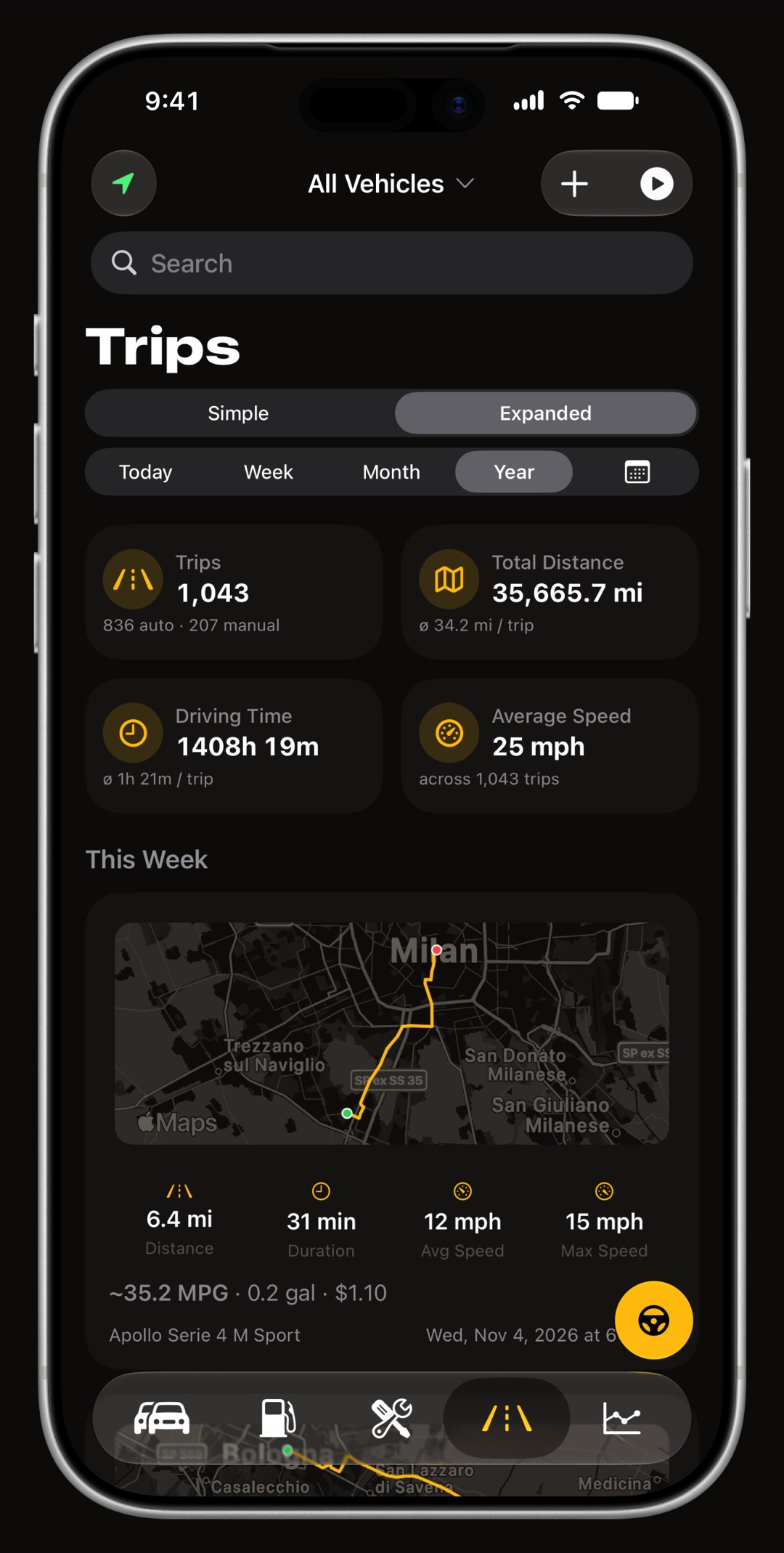
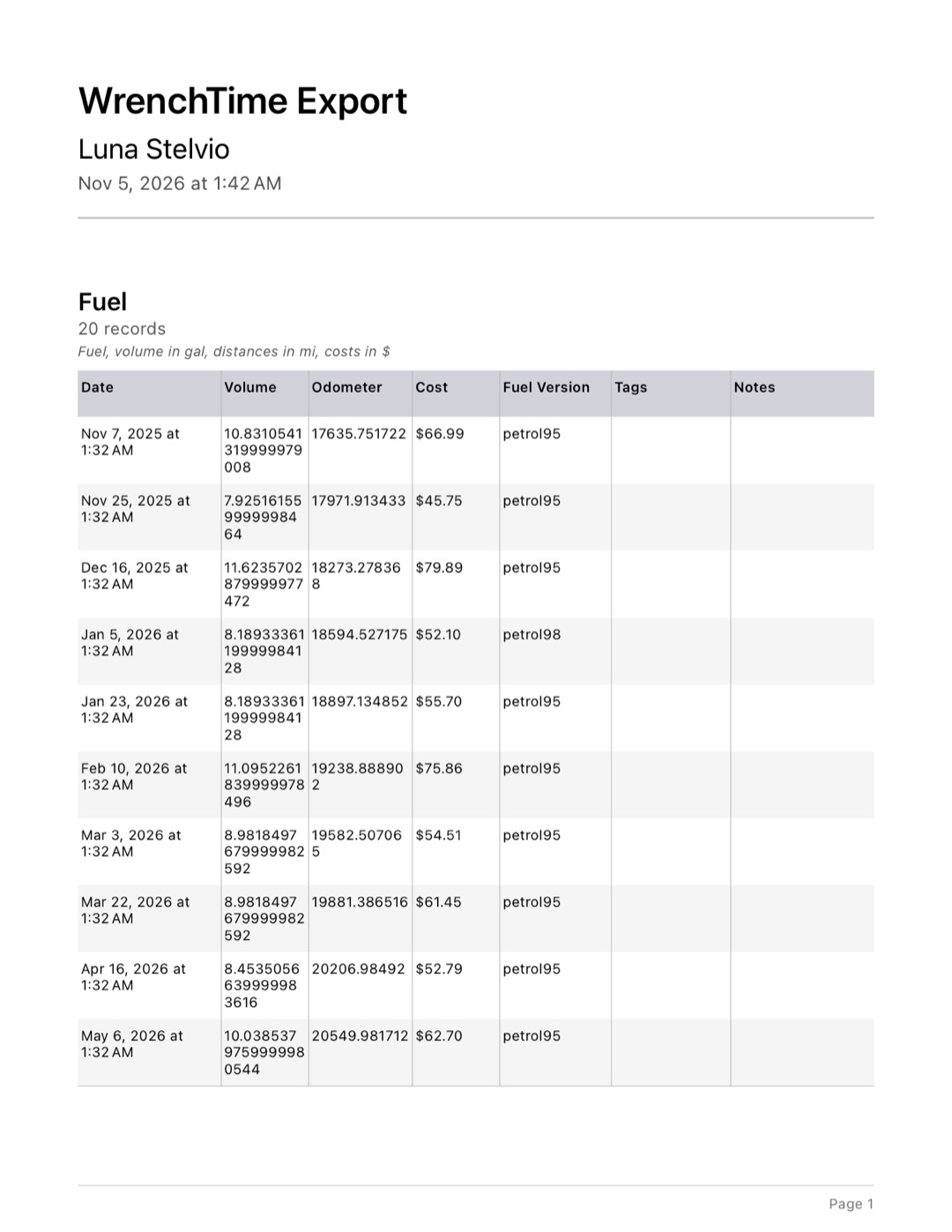
WrenchTime is not a tax product and does not decide what is deductible; it records the raw facts a mileage log is built from. Pair your car stereo over Bluetooth once and each trip records itself with its date, start and end addresses, distance and duration, and adds its distance to the vehicle's odometer with a full audit trail. The automatic mileage tracker guide explains how detection works.
Add a Business tag to a trip and the client or job in its note, and the business purpose is written on the day you drive. At tax time, the per-vehicle PDF export lists each trip's start and end with date and address, distance, tags and notes, with totals, and can be narrowed to the Business tag. Trip history is kept indefinitely unless you shorten it in Settings, Data & iCloud.
CSV and PDF export are included in the free version, which records up to 10 trips per week for 1 vehicle; WrenchTime Pro removes those limits. If you ever switch to the actual expense method, the guide to car maintenance records covers which receipts to keep alongside the log.
No. The IRS publishes no official mileage log form. A paper logbook, a spreadsheet or an app all work, as long as each business trip shows the date, destination, business purpose and miles, and you can show total miles for the year.
It is risky. IRS Publication 463 says a record made at or near the time of the trip has more value than a statement prepared later. A log rebuilt months afterwards from memory is much easier to reject in an audit, so log trips daily or at least weekly.
You must be able to show total miles for the year, not only business miles. Writing down the odometer reading on the first and last day of the year is the simplest proof of that total. Per-trip odometer readings are optional if you record each trip's distance.
At least 3 years from the date you file the return claiming the deduction, according to IRS Publication 463. If you depreciate the car, keep business-use records for each year of the recovery period. Many owners keep them for as long as they own the vehicle.
Generally no. Driving between your home and your main or regular place of work is personal commuting, however far it is. Trips from your workplace to a client, a job site or a supplier usually count as business miles.
The IRS business rate is 72.5 cents per mile from January 1 to June 30, 2026, and 76 cents per mile for the rest of 2026, starting July 1. Date every trip in your log so each mile is claimed at the right rate.
More from the blog
Mileage
MileIQ, Everlance, TripLog, Driversnote, Stride and WrenchTime compared on free limits, prices, how a trip starts on its own, and what each one is for.
Fuel economy
Divide the miles between two full tanks by the gallons it took to refill, then average over at least three tanks by totals, never by per-tank figures.
Service records
Keep every invoice and parts receipt with the date, mileage and work done, for as long as you own the car, because no outside report can rebuild that history.

Free to download. One vehicle, real features, no ads. Your garage will thank you.
Download WrenchTime on the App Store