Mileage and taxes
What an IRS compliant mileage log needs
Date, destination, business purpose and miles for every business trip, written at or near the time, plus total miles for the year and the right 2026 rate.
Mileage and taxes
The IRS standard mileage rate for 2026 is 72.5 cents per business mile from January 1 to June 30 and 76 cents per mile from July 1 to December 31, after the IRS raised it midyear because of higher fuel prices. The medical and military moving rate rose from 20.5 to 23.5 cents, and the charitable rate stayed at 14 cents, which is fixed by law. As of November 17, 2026, the 2027 rate has not been announced; the last four annual rates were released between December 14 and December 29.

The IRS standard mileage rate is the amount per mile the IRS lets you deduct, or an employer reimburse tax free, instead of adding up the real costs of a car. For 2026 there are two business rates: 72.5 cents per mile for driving from January 1 to June 30, set by IRS release IR-2025-128 on December 29, 2025, and 76 cents per mile from July 1 to December 31.
The medical rate, which also covers moving for active-duty members of the Armed Forces and certain members of the intelligence community, is 20.5 cents per mile in the first half of 2026 and 23.5 cents in the second. The charitable rate is 14 cents per mile for the whole year, according to the IRS standard mileage rates page.
The rates apply to a car, van, pickup or panel truck, and the IRS states that they apply to fully electric and hybrid vehicles as well as gasoline and diesel ones. The date of the drive decides which rate applies, so a 2026 log needs a date on every trip.
| Period (2026) | Business | Medical and military moving | Charitable |
|---|---|---|---|
| January 1 to June 30 | 72.5 | 20.5 | 14 |
| July 1 to December 31 | 76 | 23.5 | 14 |
Sources: IRS, Standard mileage rates (reviewed July 28, 2026); Announcement 2026-11, Internal Revenue Bulletin 2026-29.
The IRS raised the 2026 business mileage rate from 72.5 to 76 cents because of fuel prices. Announcement 2026-11, published in the Internal Revenue Bulletin of July 13, 2026, says the change "results from recent increases in the price of fuel" and lifts the medical and moving rate from 20.5 to 23.5 cents at the same time.
The new rates apply to expenses paid or incurred on or after July 1, 2026, and to mileage allowances paid to employees for those expenses. Miles driven before July 1 keep the rates of Notice 2026-10, the January notice. The charitable rate did not move, because section 170(i) of the tax code fixes it at 14 cents per mile.
A midyear change is rare but not new. In 2022 the IRS did the same thing for the same reason: Announcement 2022-13 raised the business rate to 62.5 cents and the medical and moving rate to 22 cents for driving on or after July 1, 2022, citing "recent increases in the price of fuel".
The IRS business mileage rate has risen every year since 2023: 65.5 cents in 2023, 67 cents in 2024, 70 cents in 2025, then 72.5 and 76 cents in 2026. From 2023 to the second half of 2026 that is an increase of 10.5 cents per mile, according to the rates listed on the IRS standard mileage rates page.
The charitable rate has stayed at 14 cents throughout, because it is written into the law rather than recalculated. The medical and moving rate moves with fuel and other running costs, which is why it fell from 22 cents in 2023 to 20.5 cents in early 2026 before rising to 23.5 cents in July.
| Year | Business | Medical and moving | Charitable | Source |
|---|---|---|---|---|
| 2023 | 65.5 | 22 | 14 | IR-2022-234, December 29, 2022 |
| 2024 | 67 | 21 | 14 | IR-2023-239, December 14, 2023 |
| 2025 | 70 | 21 | 14 | IR-2024-312, December 19, 2024 |
| 2026, January to June | 72.5 | 20.5 | 14 | IR-2025-128, December 29, 2025 |
| 2026, July to December | 76 | 23.5 | 14 | Announcement 2026-11, IRB 2026-29 (July 13, 2026) |
Sources: IRS, Standard mileage rates; IRS releases IR-2022-234, IR-2023-239, IR-2024-312 and IR-2025-128; IRB 2026-29.
As of November 17, 2026, the IRS has not published the 2027 standard mileage rate. The 76-cent business rate applies to driving through December 31, 2026.
The IRS has announced each of the last four annual rates between December 14 and December 29: on December 29, 2022, December 14, 2023, December 19, 2024 and December 29, 2025. Mid to late December 2026 is therefore the likely window for the 2027 rate. Past annual rates were published as an IRS news release and a notice in the Internal Revenue Bulletin.
The IRS does not publish a forecast, and neither does this page. According to IR-2025-128, the business rate comes from an annual study of the fixed and variable costs of operating a car, the medical and moving rate from the variable costs alone, and the charitable rate from the statute.
To calculate a 2026 mileage deduction or reimbursement, multiply the business miles driven before July 1 by 72.5 cents, multiply the miles driven from July 1 by 76 cents, and add the two. Business parking fees and tolls are added on top, because IRS Publication 463 allows them in addition to the standard mileage rate.
Example calculation, with invented figures: a self-employed driver logs 6,000 business miles in 2026, 3,500 of them from January to June and 2,500 from July to December. The two halves give $2,537.50 and $1,900.00, so the deduction at the standard mileage rate is $4,437.50.
| Period | Business miles | Rate per mile | Amount |
|---|---|---|---|
| January 1 to June 30 | 3,500 | $0.725 | $2,537.50 |
| July 1 to December 31 | 2,500 | $0.76 | $1,900.00 |
| Full year | 6,000 | Split by date | $4,437.50 |
Self-employed people and business owners can deduct business miles at the standard mileage rate. Most employees cannot: IRS Topic 510 states that "most employees cannot deduct unreimbursed car expenses", and Notice 2026-10 explains that Public Law 119-21 of July 4, 2025 made that disallowance permanent.
Some employees can still deduct unreimbursed travel as an adjustment to income: members of a reserve component of the Armed Forces, certain performing artists, state or local government officials paid on a fee basis and, for certain expenses, eligible educators. For every other employee, the rate matters through reimbursement, not through the tax return.
Commuting never counts. Publication 463 treats driving between home and your main or regular place of work as a personal commuting expense, whatever the distance. The medical rate covers driving for medical care, and the 14-cent charitable rate covers driving in service of a charitable organization.
This page explains the published rates and rules; how they apply to one person's return is a question for a tax professional.
The federal mileage reimbursement rate is the amount the General Services Administration (GSA) pays federal employees who use their own vehicle on official travel. For travel on or after July 1, 2026, the GSA rate for a privately owned automobile is 76 cents per mile, the same figure as the IRS business rate, and 23.5 cents when a government automobile was authorized and available but the employee chose to drive their own.
For private employers, the IRS rate decides how a mileage reimbursement is taxed. Under an accountable plan, a reimbursement arrangement that requires employees to account for their miles, Publication 463 says an allowance at or below the federal rate is not included in box 1 of Form W-2, while any amount above it is. Under a nonaccountable plan, the whole reimbursement is reported as wages.
| Vehicle | When it applies | Rate per mile |
|---|---|---|
| Automobile | A privately owned automobile was authorized, or no government automobile was available | $0.76 |
| Automobile | A government automobile was authorized and available, but the employee drove their own | $0.235 |
| Automobile | Work-related move or relocation | $0.235 |
| Motorcycle | Official travel | $0.74 |
Source: GSA, Privately owned vehicle mileage reimbursement rates (updated October 23, 2026).
The standard mileage rate is one of two methods; the other is deducting the business share of actual costs, such as fuel, oil, repairs, tires, insurance, registration and depreciation. IRS Topic 510 suggests figuring the deduction both ways, when you qualify for both, to see which gives the larger deduction. The choice also matters later, because the standard rate has to be chosen in the car's first business year.
For a car you own, the standard mileage rate must be chosen in the first year the car is available for use in your business; after that you can switch between methods. For a leased car, it must be used for the entire lease. Publication 463 rules it out when you use five or more cars at the same time, or after claiming MACRS, section 179 or special depreciation on the car.
Part of the rate stands for depreciation: 35 cents of each business mile in 2026, according to Notice 2026-10, which reduces the car's basis. Whether the rate beats your real costs depends on the car and the miles; the guide to what your car really costs per mile shows how to work out your own figure.
Every deduction or tax-free reimbursement at the IRS rate rests on a record of each business trip, and in 2026 the date of each trip also decides its rate. Publication 463 accepts a written log, diary or trip sheet and says a record kept on a computer counts as adequate; what matters is that each trip carries its date, destination, purpose and miles, recorded at or near the time of the drive.
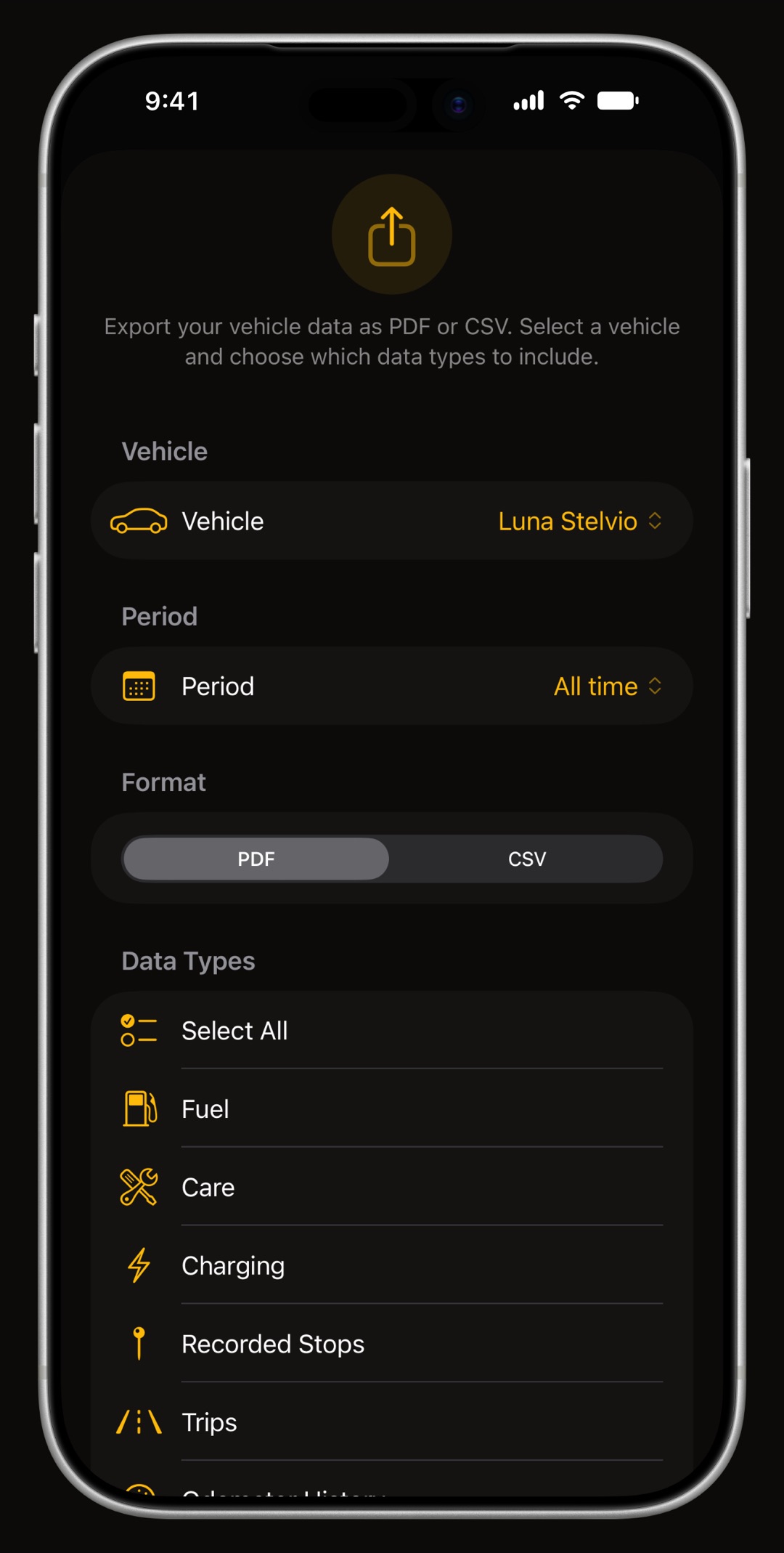
WrenchTime, an iPhone app for car and motorcycle logs, records trips on its own once a car stereo is paired over Bluetooth, with the date, route, distance and duration of each drive. Trips take tags and notes, and the CSV and PDF export per vehicle can be narrowed to a period and to tags, so a year of business-tagged drives leaves the phone in one file.
WrenchTime does not apply the IRS rate or total a deduction: that stays with you or your tax preparer. For a side-by-side look at apps that do, see how mileage tracker apps compare.
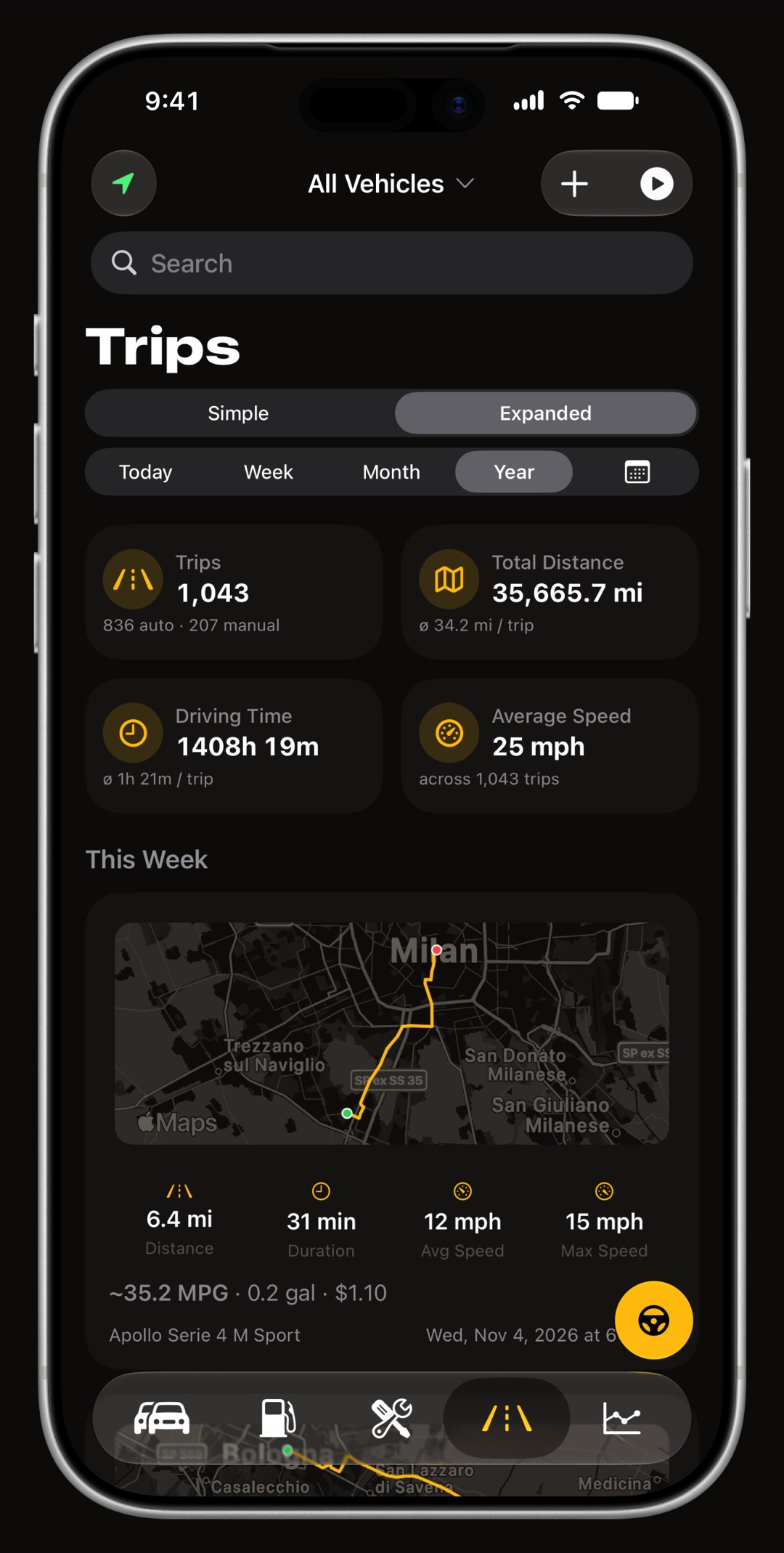
The 2026 rate change makes the date of every trip part of the deduction. WrenchTime records each drive with its date and distance without a tap, adds it to the vehicle's odometer and keeps a tag and a note on the trip for its business purpose. The automatic mileage tracker guide explains how detection works.
The free version covers 1 vehicle and 10 recorded trips a week, with CSV and PDF export included; WrenchTime Pro removes those limits.
The IRS business mileage rate is 72.5 cents per mile from January 1 to June 30, 2026, and 76 cents from July 1 to December 31, 2026. Medical and military moving rose from 20.5 to 23.5 cents in July; charity stayed at 14 cents. Date every trip so each mile gets the right rate.
Federal employees who drive their own car on official travel are reimbursed 76 cents a mile from July 1, 2026, or 23.5 cents when a government automobile was authorized and available and they chose their own, according to GSA. The IRS business rate from July 1 is also 76 cents.
As of November 17, 2026, the 2027 rate has not been announced. The IRS released the 2023 to 2026 rates on December 29, 2022, December 14, 2023, December 19, 2024 and December 29, 2025, so mid to late December 2026 is the likely window.
You pick one method for a car: the standard mileage rate already covers fuel, so gas receipts are not added on top, although business parking and tolls are. The IRS suggests figuring the deduction both ways when you qualify for both, to see which is larger.
Most employees cannot. Unreimbursed employee travel can no longer be itemized, and a 2025 law made that permanent. Armed Forces reservists, certain performing artists, fee-basis state or local officials and, for certain expenses, eligible educators can still deduct it as an adjustment to income. Others rely on reimbursement.
Yes. The IRS says its 2026 standard mileage rates apply to fully electric and hybrid vehicles as well as gasoline and diesel ones, for a car, van, pickup or panel truck. The same 72.5 and 76 cent business rates apply.
More from the blog
Mileage and taxes
Date, destination, business purpose and miles for every business trip, written at or near the time, plus total miles for the year and the right 2026 rate.
Running costs
AAA's 2026 average is about 86 cents a mile. What it includes, the formula for your own car, and why the figure moves with mileage, vehicle type and powertrain.
Mileage
MileIQ, Everlance, TripLog, Driversnote, Stride and WrenchTime compared on free limits, prices, how a trip starts on its own, and what each one is for.

Free to download. One vehicle, real features, no ads. Your garage will thank you.
Download WrenchTime on the App Store