Mileage and taxes
What an IRS compliant mileage log needs
Date, destination, business purpose and miles for every business trip, written at or near the time, plus total miles for the year and the right 2026 rate.
Mileage and taxes
The HMRC mileage rate for the 2026 to 2027 tax year is 55p per business mile for the first 10,000 miles in a car or van and 25p for every mile after that, 24p for a motorcycle and 20p for a bicycle. The 55p figure replaces 45p, which applied to the first 10,000 miles up to 5 April 2026. As of 17 November 2026, GOV.UK gives no rate beyond the 2026 to 2027 tax year, and a government review of the rates is pending.
HMRC's approved mileage rates are the amount per business mile that an employer can pay for the use of your own vehicle without tax being due, and the flat rates a self-employed person can claim instead of adding up running costs. For 2026 to 2027, cars and vans get 55p for the first 10,000 business miles in the tax year and 25p for each mile after that, according to the GOV.UK travel, mileage and fuel rates page, updated on 21 May 2026.
Motorcycles are 24p a mile at every distance and bicycles 20p. Passengers add 5p per passenger per business mile for carrying fellow employees on journeys that are also work journeys for them; only payments made specifically for carrying passengers count, and there is no relief if you receive less than 5p or nothing.
The tax year starts on 6 April, so the 10,000-mile count belongs to one tax year at a time.
| Vehicle | First 10,000 business miles | Each mile after 10,000 | First 10,000 before 6 April 2026 |
|---|---|---|---|
| Cars and vans | 55p | 25p | 45p |
| Motorcycles | 24p | 24p | 24p |
| Bicycles | 20p | 20p | 20p |
Source: GOV.UK, Travel, mileage and fuel rates and allowances (updated 21 May 2026).
HMRC's rate for cars and vans rose from 45p to 55p a mile for the first 10,000 business miles. The GOV.UK policy paper Increasing mileage rates, published on 17 June 2026, says the measure "will have retrospective effect from 6 April 2026 for tax year 2026 to 2027".
The 25p rate for miles beyond 10,000 did not change, and neither did the rates for motorcycles and bicycles. The paper applies the increase both to approved mileage allowance payments from employers and to the simplified mileage rates of the self-employed.
Because it is backdated, a business mile driven in April 2026 is paid at the new rate, not the old one.
The 2026 rise is the first change in the figures on the HMRC page for a long time: the table lists 45p for the first 10,000 miles under the heading 2011 to 2026, with 25p after and 24p for motorcycles, and only the first-10,000 rate for cars and vans has moved since.
The government has also committed to a review of these rates beyond 2026 to 2027, with the outcome to be announced at a 2026 Budget, according to the same policy paper.
| Tax year | Cars and vans, first 10,000 miles | Cars and vans, after 10,000 | Motorcycles | Source |
|---|---|---|---|---|
| 2011 to 2026 | 45p | 25p | 24p | GOV.UK, rates and allowances page |
| 2026 to 2027 | 55p | 25p | 24p | GOV.UK, Increasing mileage rates (17 June 2026) |
Sources: GOV.UK, Travel, mileage and fuel rates and allowances; GOV.UK, Increasing mileage rates (17 June 2026).
As of 17 November 2026, GOV.UK publishes the approved mileage rates for the 2026 to 2027 tax year only. The 55p and 25p rates apply to driving to the end of the 2026 to 2027 tax year, and no rate for 2027 to 2028 is published on the pages checked for this guide.
What is on record is a commitment: the government "has already committed to a review of these rates beyond 2026 to 2027", with the outcome to be announced at a 2026 Budget. Neither this page nor HMRC forecasts what that review will decide.
The advisory fuel rates for company cars work on a different clock. HMRC reviews them quarterly, on 1 March, 1 June, 1 September and 1 December, so the next review falls on 1 December 2026.
To calculate an approved amount, multiply the first 10,000 business miles of the tax year by 55p, multiply every mile after that by 25p, and add the two. Use of more than one vehicle in a year is totalled together, and the GOV.UK rules for tax give a worked case: 12,000 business miles in a car is 10,000 at 55p plus 2,000 at 25p, an approved amount of £6,000.
Example calculation, with invented figures: a driver logs 14,000 business miles in the 2026 to 2027 tax year. The first 10,000 miles give £5,500 and the remaining 4,000 give £1,000, so the approved amount is £6,500.
| Band | Business miles | Rate per mile | Amount |
|---|---|---|---|
| First 10,000 miles | 10,000 | £0.55 | £5,500 |
| Miles after 10,000 | 4,000 | £0.25 | £1,000 |
| Tax year | 14,000 | Split by band | £6,500 |
Employers can pay employees up to the approved rate, and self-employed people claim the same flat rates as simplified expenses. The GOV.UK rules for tax say employers can pay up to the approved amount each year without reporting to HMRC.
If the employer pays less than the approved amount, no report or tax is needed and the employee can claim Mileage Allowance Relief on the unused balance. If the employer pays more, the excess is taxable and must be reported on form P11D or added to pay and taxed through payroll.
The self-employed use simplified expenses for vehicles: the same 55p, 25p and 24p flat rates, with parking and other travel costs such as train fares claimed on top. Cars designed for commercial use, such as black cabs, do not qualify.
This page explains the published rates and rules; how they apply to one person's tax is a question for HMRC or an accountant.
Advisory fuel rates are what a company can repay an employee for business miles in a company car, and they are separate from the approved mileage rates. From 1 September 2026, HMRC's advisory fuel rates run from 14p to 27p a mile for petrol, 15 pence to 22p for diesel and 11 pence to 20p for LPG, depending on engine size.
For a fully electric company car the rate is 7p a mile with a home charger and 15 pence with a public charger. HMRC reviews all of these quarterly, so they can change on 1 December 2026.
| Fuel | Engine size | Rate per mile |
|---|---|---|
| Petrol | 1400cc or less | 14p |
| Petrol | 1401cc to 2000cc | 17p |
| Petrol | Over 2000cc | 27p |
| Diesel | 1600cc or less | 15p |
| Diesel | 1601cc to 2000cc | 16p |
| Diesel | Over 2000cc | 22p |
| LPG | 1400cc or less | 11p |
| LPG | 1401cc to 2000cc | 13p |
| LPG | Over 2000cc | 20p |
| Electric | Home charger | 7p |
| Electric | Public charger | 15p |
Source: GOV.UK, Advisory fuel rates (updated 21 August 2026).
Flat rates are one of two ways for a self-employed driver to claim vehicle costs; the other is claiming the actual costs of running the vehicle. The simplified expenses page recommends the simplified expenses checker to compare the flat rate with your actual costs before you choose.
You do not have to use flat rates for every vehicle, but once you use them for a vehicle you must keep using them while it is used for your business. You cannot use simplified expenses for a vehicle you have already claimed capital allowances on, or one you have included as an expense in your business profits.
Whether the flat rate beats your real costs depends on the car and the miles; the guide to what your car really costs per mile shows how to work out your own figure.
Every claim at the approved rate rests on a list of your business trips, and in 2026 to 2027 the order of the trips matters too, because the first 10,000 miles of the tax year are paid at 55p and the rest at 25p. A dated log with the date, destination, purpose and miles of each trip is what lets you total them and see where the 10,000th mile falls.
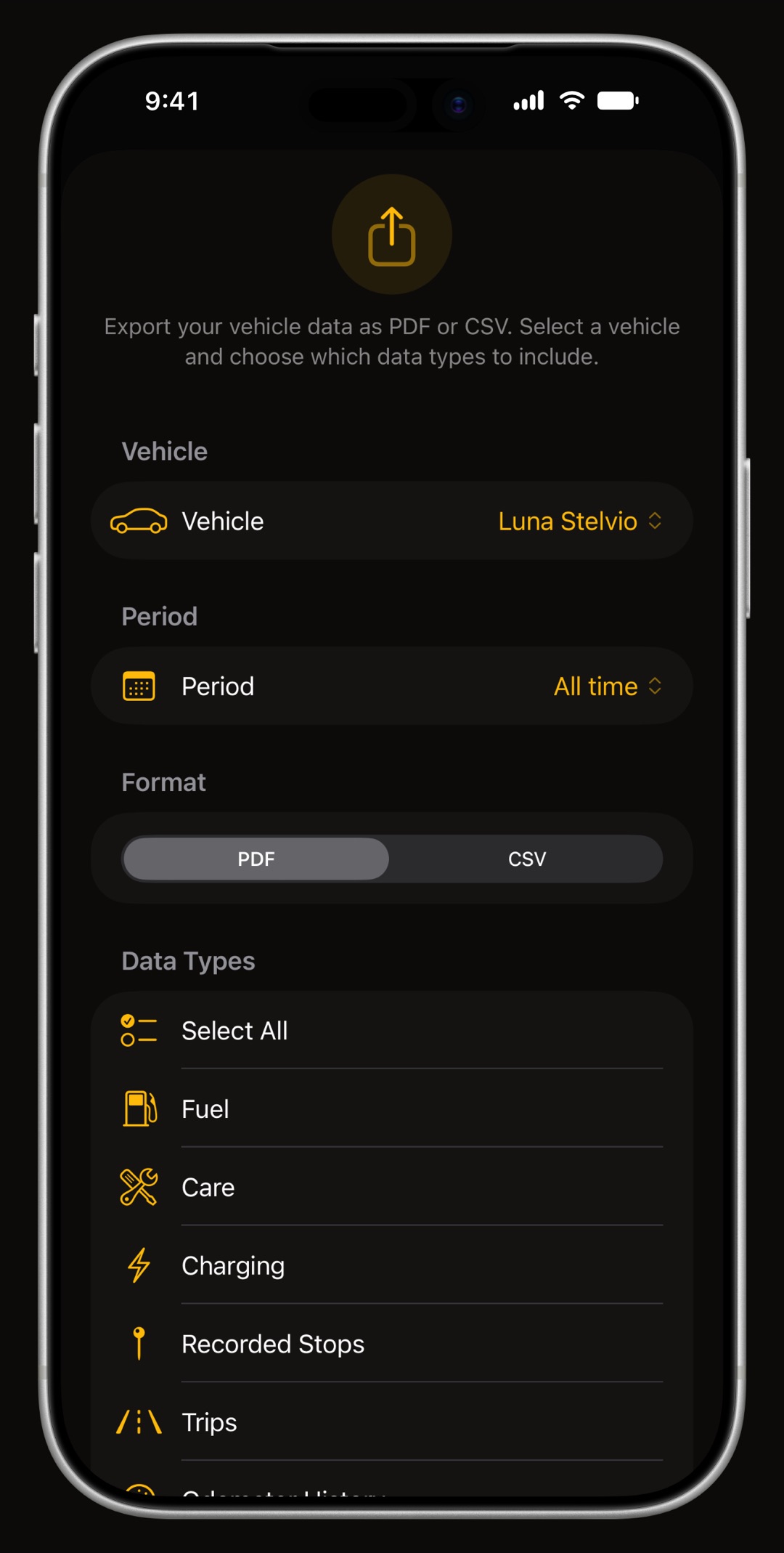
WrenchTime, an iPhone app for car and motorcycle logs, records trips on its own once a car stereo is paired over Bluetooth, with the date, route, distance and duration of each drive. Trips take tags and notes, and the CSV and PDF export per vehicle can be narrowed to a period and to tags, so a year of business-tagged drives leaves the phone in one file.
WrenchTime does not apply the HMRC rate or total a claim: that stays with you or your accountant. For a side-by-side look at apps that do, see how mileage tracker apps compare.
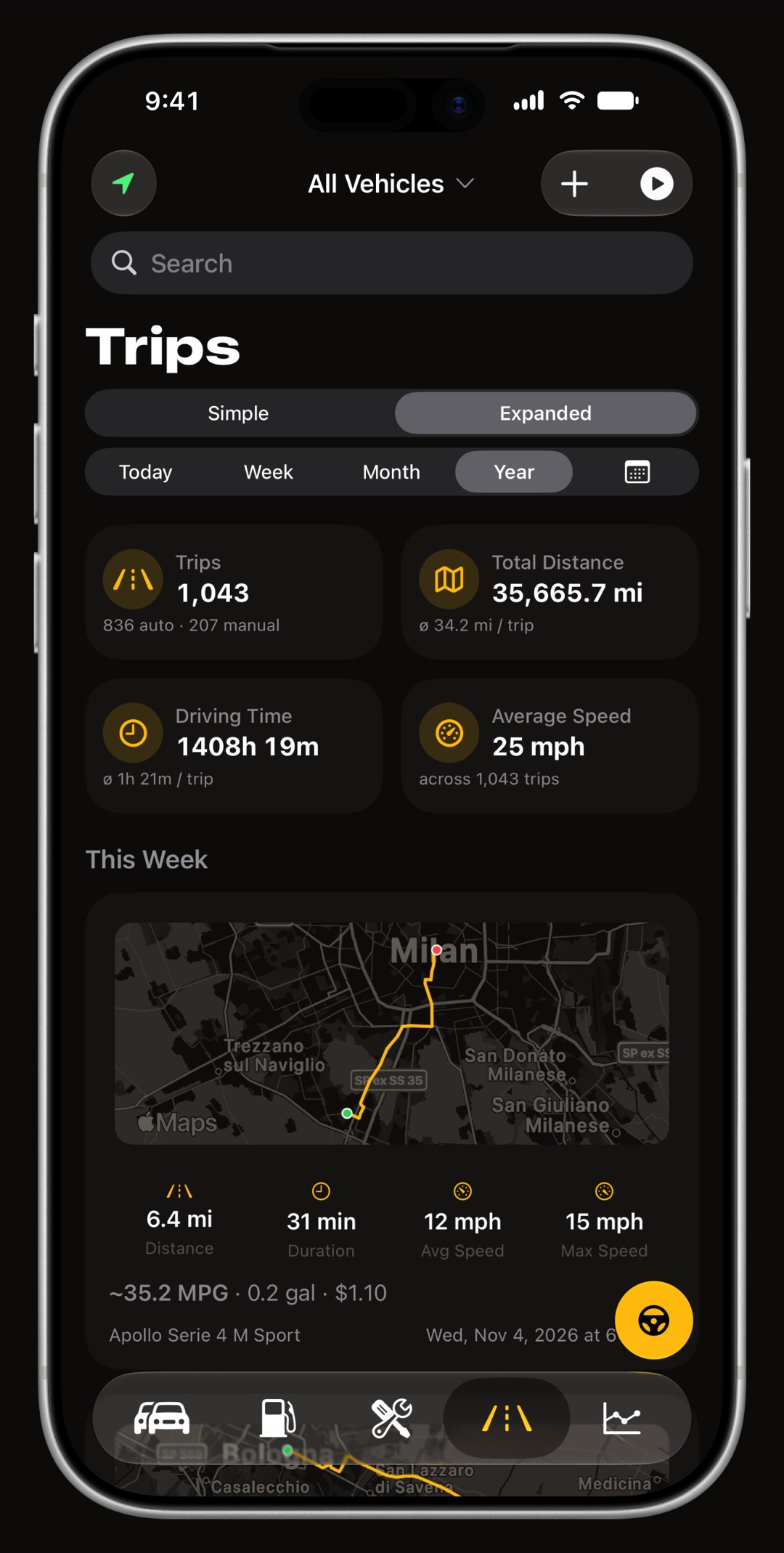
The 10,000-mile threshold makes the date of every trip part of the claim. WrenchTime records each drive with its date and distance without a tap, adds it to the vehicle's odometer and keeps a tag and a note on the trip for its business purpose. The automatic mileage tracker guide explains how detection works.
The free version covers 1 vehicle and 10 recorded trips a week, with CSV and PDF export included; WrenchTime Pro removes those limits.
For the 2026 to 2027 tax year HMRC's approved rate is 55p per business mile for the first 10,000 miles in a car or van and 25p after that. Motorcycles are 24p and bicycles 20p. The first-10,000 rate was 45p until 5 April 2026, and the new rate is backdated to 6 April.
The advisory electricity rate for a fully electric company car is 7p a mile with a home charger and 15 pence with a public charger from 1 September 2026. For your own car, the approved rates are listed by vehicle type, not fuel: 55p then 25p for cars and vans.
As of 17 November 2026, GOV.UK gives approved mileage rates for 2026 to 2027 only. The government has committed to a review of the rates beyond that year, with the outcome to be announced at a 2026 Budget. The advisory fuel rates are reviewed quarterly, next on 1 December 2026.
Self-employed drivers choose per vehicle between flat-rate simplified expenses and actual costs. HMRC suggests using its simplified expenses checker to compare them. Once you use flat rates for a vehicle, you keep using them while it is in business use, and parking and other travel can be claimed on top.
If your employer pays less than the approved amount, no tax is due on the payments and you can claim Mileage Allowance Relief on the unused balance. If they pay more, the excess is taxable and goes on form P11D or through payroll. The approved amount is your business miles multiplied by the rates.
Yes, employers can pay 5p per passenger per business mile for carrying fellow employees in a car or van on journeys that are also work journeys for them. Only payments specifically for carrying passengers count, and there is no relief if you receive less than 5p or nothing.
More from the blog
Mileage and taxes
Date, destination, business purpose and miles for every business trip, written at or near the time, plus total miles for the year and the right 2026 rate.
Running costs
AAA's 2026 US average is about 86 cents a mile. What it includes, the formula with a UK example in pence, why the figure moves with mileage, vehicle type and powertrain, and HMRC's mileage rates.
Mileage
MileIQ, Everlance, TripLog, Driversnote, Stride and WrenchTime compared on free limits, prices, how a trip starts on its own, and what each one is for.

Free to download. One vehicle, real features, no ads. Your garage will thank you.
Download WrenchTime on the App Store