Trouble codes
Check engine light flashing: what to do
What a flashing check engine light means, why you should stop driving, what causes it, why it can flash then stop, and what the repair costs.
Trouble codes
The P0300 code means "Random/Multiple Cylinder Misfire Detected": the engine computer saw misfires in more than one cylinder, or could not pin them on a single one. Worn spark plugs are the most common cause according to Kelley Blue Book, but ignition coils, injectors, vacuum leaks, low fuel pressure and low compression set it too. Codes P0301 to P0308 name the cylinder; P0300 alone points at something the cylinders share. A flashing check engine light means the misfire can damage the catalytic converter, so slow down and get service soon.
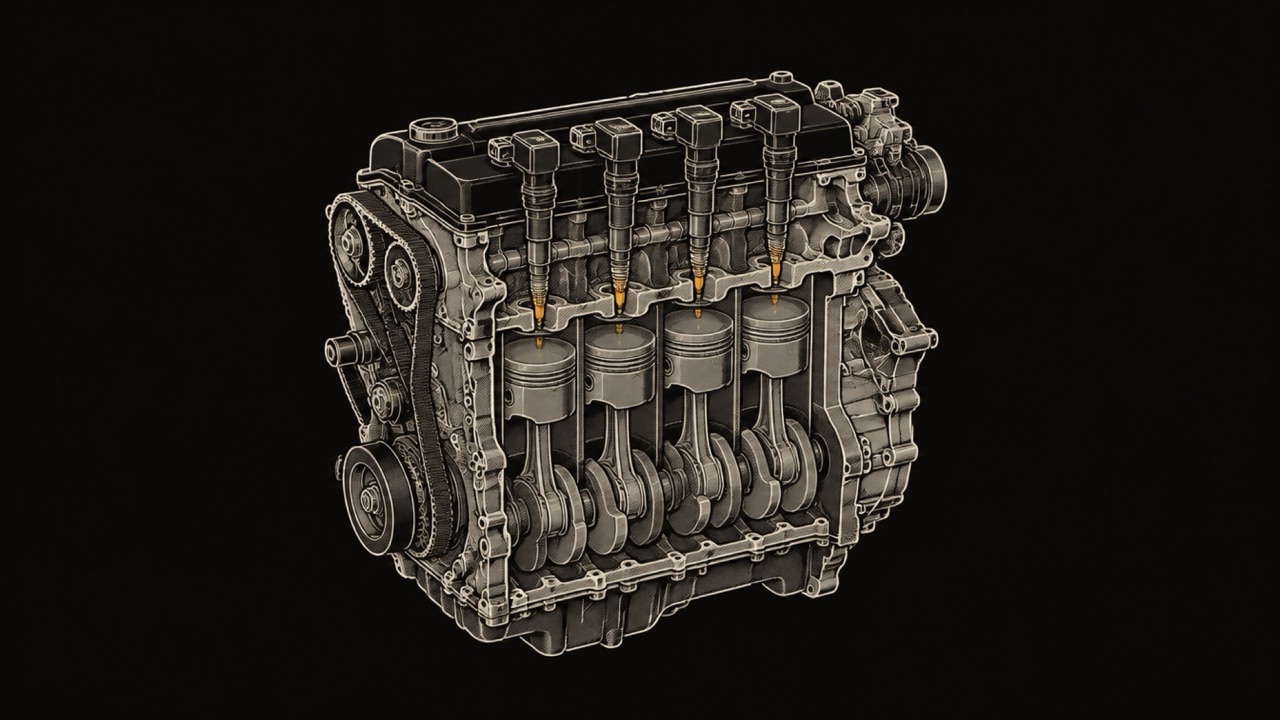
The P0300 code is "a generic powertrain code indicating random or multiple-cylinder misfires", in the words of diagnostic data provider Identifix (February 2025). It means the engine computer has detected misfires across several cylinders, or cannot consistently attribute the misfire to one cylinder.
A misfire is a cylinder that fails to burn its charge. California's OBD-II regulation, which federal rules adopt in its 2013 version, defines it as "lack of combustion in the cylinder due to absence of spark, poor fuel metering, poor compression, or any other cause" (13 CCR 1968.2). That definition is the short list of what to check: spark, fuel and compression.
The P stands for powertrain, and P0300 is a generic code, so it means the same thing on every make. The rest of the code family is in the next section.
P0301 to P0308 each name one cylinder, and P0300 names none. "The final numeral of the code sequence of P030X will indicate which cylinder has misfired", according to Kelley Blue Book: P0301 is cylinder 1, P0304 is cylinder 4. The OBD-II rules require the system to identify the specific cylinder that is misfiring, and to store a multiple-cylinder code when two or more cylinders each account for more than 10% of the misfires (13 CCR 1968.2, sections (e)(3.1.2) and (e)(3.1.3)).
P0300 "may appear by itself or alongside one or more cylinder-specific codes", Identifix notes. The combination is the first clue for a diagnosis. P0300 with P0302 points at cylinder 2 first, its plug, coil or injector. P0300 on its own, with misfires wandering between cylinders, usually points at something the cylinders share, and Identifix lists those shared causes too: fuel pressure, vacuum leaks, the air flow sensor and worn spark plugs.
A car detects a misfire through the crankshaft. "The PCM detects a misfire by monitoring crankshaft-speed changes during individual combustion events", according to Identifix: a cylinder that does not fire fails to push the crankshaft, which slows for an instant.
The OBD-II rules make the check continuous, from no later than the end of the second crankshaft revolution after the engine starts (13 CCR 1968.2, section (e)(3.3.1)).
The same regulation sets two levels of misfire. Misfire counted over 200 revolution windows that would damage the catalytic converter makes the check engine light "blink once per second at all times while misfire is occurring". Misfire counted over 1000 revolution windows that would raise emissions stores a pending code, and the light comes on steadily if it happens again on a later drive.
The light can go out by itself after three driving cycles in a row with no misfire under engine conditions like those of the original fault, under section (e)(3.4.6). These are federal rules too: 2017 and later vehicles must meet the 2013 version of California's OBD requirements in 13 CCR 1968.2, with some exceptions (40 CFR 86.1806-17).
Worn spark plugs cause most P0300 codes. "The most common and relevant cause of a P0300 code is spark plugs that are damaged or worn", according to Kelley Blue Book. Identifix (February 2025) adds ignition coils and plug wires, injectors, the fuel pump and filter, fuel quality, air flow sensor faults, vacuum leaks, a restricted exhaust, crank or cam sensors, a weak battery, engine software, and mechanical faults such as valve problems, a failed head gasket or low compression.
| Cause | Why it can affect several cylinders (explanation) | What to check |
|---|---|---|
| Worn or damaged spark plugs | All plugs age at the same rate, so several cylinders start to misfire together | Plug condition and gap, the last change in the service record |
| Ignition coils or plug wires | One weak coil sets a cylinder code; a shared coil pack or wires can spread it | Any P0301 to P0308 code beside P0300, coil and wire condition |
| Vacuum leak or air flow sensor fault | Unmeasured air leans out the mixture in every cylinder at once | Cracked hoses, intake gaskets, the air flow sensor |
| Low fuel pressure or clogged injectors | A weak pump or filter starves every cylinder, worse under load | Fuel pressure, injector condition, fuel quality |
| Crank or cam sensor | A poor signal disturbs the timing the computer uses for every cylinder | Other sensor codes stored with P0300 |
| Low compression or a head gasket | A mechanical fault in the engine itself | A compression test once the cheaper causes are ruled out |
Sources: Kelley Blue Book, Identifix (February 2025).
With a steady check engine light and no symptoms, a car with P0300 may be driven gently to a shop, though Kelley Blue Book notes that with symptoms a tow may be the safest option, and Identifix advises diagnosing it promptly because an active misfire can damage the catalytic converter. With a flashing light, the misfire has reached the level the OBD-II rules tie to catalytic converter damage (13 CCR 1968.2), and that changes the answer.
Owner's manuals say the same in plainer words. The 2016 Ram 1500 manual warns: "If the MIL is flashing, severe catalytic converter damage and power loss will soon occur. Immediate service is required." The 2013 Buick Encore manual says to reduce speed, avoid hard acceleration and steep uphill grades, and if the light keeps flashing, stop, turn the engine off for at least 10 seconds and restart; if it still flashes, see the dealer as soon as possible.
The full routine for a blinking light is in what a flashing check engine light means.
The cost of fixing a P0300 code depends on the cause, and spark plugs, the most common cause according to Kelley Blue Book, are among the cheaper repairs. The table lists the 2025 US averages from the CarMD Vehicle Health Index (CarMD, April 2026), where the average check engine repair reached a record $554, up 33%.
A misfire left alone costs more. In the same CarMD data a catalytic converter averaged $1,511, about 5.1 times the $299 for spark plugs and 3.1 times the $480 for an ignition coil and plugs together (example calculation from the CarMD averages).
| Repair | Average cost (2025) | Rank among the ten most common check engine repairs |
|---|---|---|
| Ignition coil | $256 | 5th |
| Spark plugs | $299 | 10th |
| Mass air flow sensor | $346 | 4th |
| Ignition coil and spark plugs | $480 | 3rd |
| Fuel injectors | $572 | 7th |
| Catalytic converter | $1,511 | 1st |
Source: CarMD 2026 Vehicle Health Index, April 22, 2026.
Fixing a P0300 code means finding which of spark, fuel, air or compression is failing, cheapest checks first. The order below follows the causes Kelley Blue Book and Identifix list.
Yes. P0300 is a generic powertrain code (Identifix), so a Chevy, a Ford, a Nissan and a Toyota all use it for random or multiple cylinder misfires, and P0301 to P0308 always name the cylinder.
What differs between makes is the likely cause, because engines differ in their ignition, fuel and intake parts. The diagnosis order stays the same: read every code, then check spark, air, fuel and compression.
Spark plugs should be replaced at the interval in the owner's manual, which depends on the plug type. "In the past, experts recommended changing spark plugs every 30,000 miles or so", according to Kelley Blue Book (2020), while extended-life plugs can last up to 100,000 miles (about 160,000 km).
Kelley Blue Book names rough idling with misfires as a sure sign the plugs need changing. Since worn plugs are also the most common cause of P0300, a plug change logged with its date and odometer reading is the first thing to look up when the code appears.
With a Bluetooth OBD-II adapter, WrenchTime reads P0300 and any cylinder code beside it, describes each in plain language, and shows the freeze frame the car saved at the first fault. Every scan is kept with its date and odometer reading, so after the repair you can see whether the misfire code comes back.
Spark plugs are one of the procedures in the Care tab, with a reminder by date or odometer for the next change. Trouble Codes is part of WrenchTime Pro; the free version covers 1 vehicle. The OBD-II code reader for iPhone guide shows how it works.
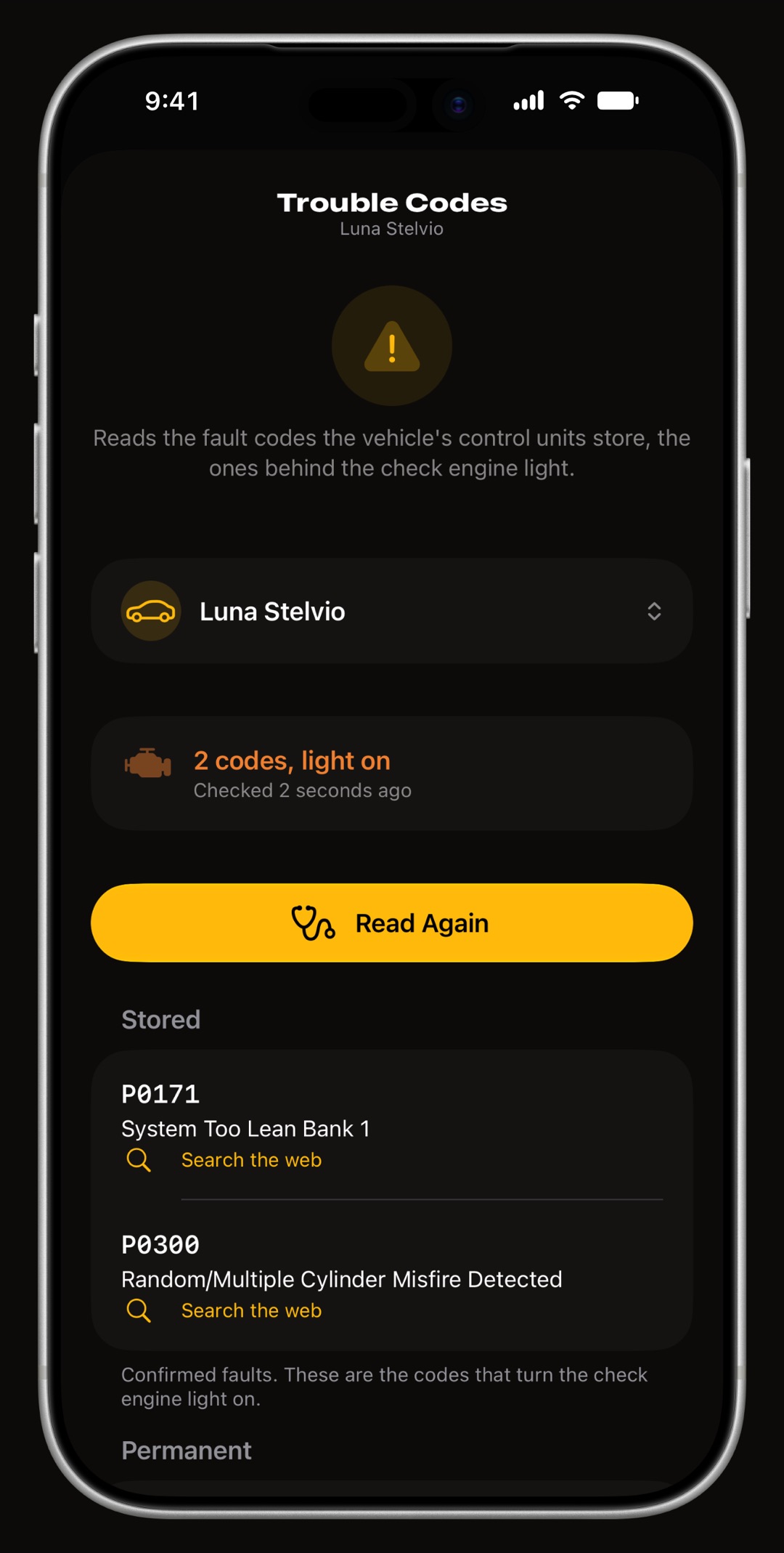
P0301 names cylinder 1 as the one misfiring; P0300 means misfires in random or multiple cylinders, or ones the computer could not tie to one cylinder. The last digit of P030X is the cylinder number, so P0302 is cylinder 2, according to Kelley Blue Book.
Yes. Worn or damaged spark plugs are the most common cause of P0300 according to Kelley Blue Book. All the plugs in an engine wear together, so several cylinders can start to misfire. Ignition coils, plug wires and injectors are the next things to check.
Yes. Identifix lists vacuum leaks and air flow sensor faults among the causes of P0300. A leak lets in air the engine does not measure, which can lean out the mixture in several cylinders at once rather than in one.
With a steady light and no symptoms, gentle driving to a shop is possible, but Kelley Blue Book notes a tow may be safest with symptoms. With a flashing light, the misfire is strong enough to damage the catalytic converter under the OBD-II rules, and owner's manuals say to reduce speed and get service as soon as possible.
It depends on the cause. CarMD's 2025 US averages are $299 for spark plugs, $256 for an ignition coil, $480 for a coil and plugs, $572 for fuel injectors, and $1,511 for a catalytic converter if a misfire was ignored long enough to damage it.
The check engine light can go out by itself after three driving cycles in a row with no misfire under similar engine conditions, under the OBD-II rules in 13 CCR 1968.2. The cause should still be found and fixed, because a misfire that returns can damage the catalytic converter.
More from the blog
Trouble codes
What a flashing check engine light means, why you should stop driving, what causes it, why it can flash then stop, and what the repair costs.
Trouble codes
What the P0420 code means, what usually causes it, whether you can keep driving, what the repair costs and when the catalytic converter is under warranty.
Diagnostics
Every way to turn the light off, what each one erases, and why a reset can still fail an emissions test.
Free to download. One vehicle, real features, no ads. Your garage will thank you.
Download WrenchTime on the App Store