OBD2
OBD2 readiness monitors: the full list
Every OBD2 readiness monitor and what it checks, how many can be incomplete at an emissions test by model year, and the drive cycles states publish to get them ready.
Trouble codes
The P0420 code means "Catalyst System Efficiency Below Threshold (Bank 1)": the engine computer compared the oxygen sensors before and after the catalytic converter and decided the converter on bank 1 no longer cleans the exhaust well enough. A failed converter is the most common cause, but exhaust leaks, ageing oxygen sensors and misfires can set it too. With a steady light and no other symptoms the car can often be driven a short distance to be diagnosed; a flashing light means reduce load and get service right away. On 1995 and newer US vehicles (the warranty is US federal law, so check the warranty booklet elsewhere) the converter is covered by the federal emissions warranty for 8 years or 80,000 miles.
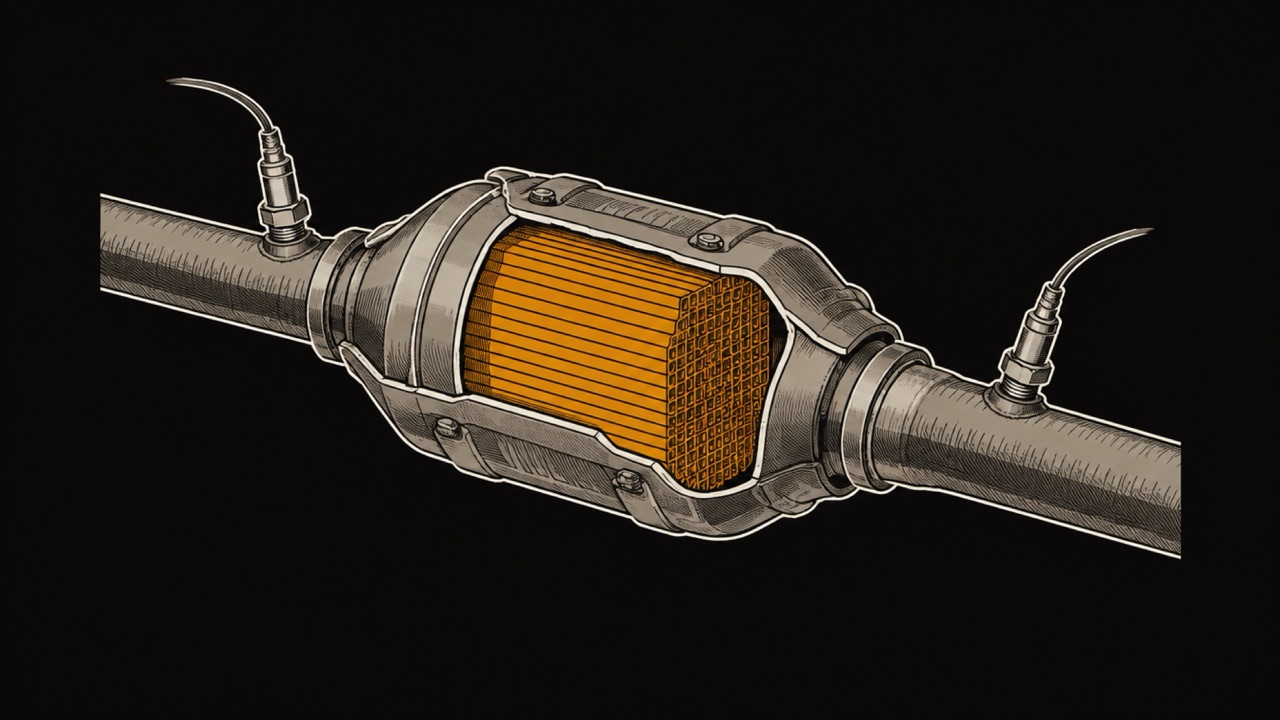
The P0420 code is the generic OBD2 trouble code for "Catalyst System Efficiency Below Threshold (Bank 1)", as diagnostic data provider Identifix words it (September 2025). The catalytic converter is the part of the exhaust that turns harmful gases into less harmful ones, and the engine computer has judged that the converter on bank 1 is doing that job below the level it was programmed to accept.
Bank 1 is the side of a V6 or V8 engine that holds cylinder number one, and bank 2 is the other side, according to Identifix. A straight four or six cylinder engine has only one bank, so on those engines a catalyst code is always bank 1 (AA1Car). P0430 is the same fault on the bank 2 converter of a two-bank engine.
The letter P stands for powertrain and the 0 that follows marks a standardised SAE code rather than a manufacturer-specific one, according to Haynes. The rest of the decoding, and the routine for reading any code, is in how to use an OBD2 scanner.
A car checks its catalytic converter with two sensors in the exhaust. Sensor 1, the upstream one, sits closest to the engine; sensor 2, the downstream one, sits in or behind the converter (AA1Car). The engine computer reads both and uses them to estimate how much oxygen the converter can still store, according to Samarins (2022).
A working converter stores oxygen, so the signal after it stays much steadier than the signal before it. As the converter loses that capacity, the downstream signal starts to follow the upstream one. When the estimate falls below the standard value, or the two readings fall outside expected parameters, the computer sets P0420 and turns on the check engine light (Samarins; Identifix, 2025).
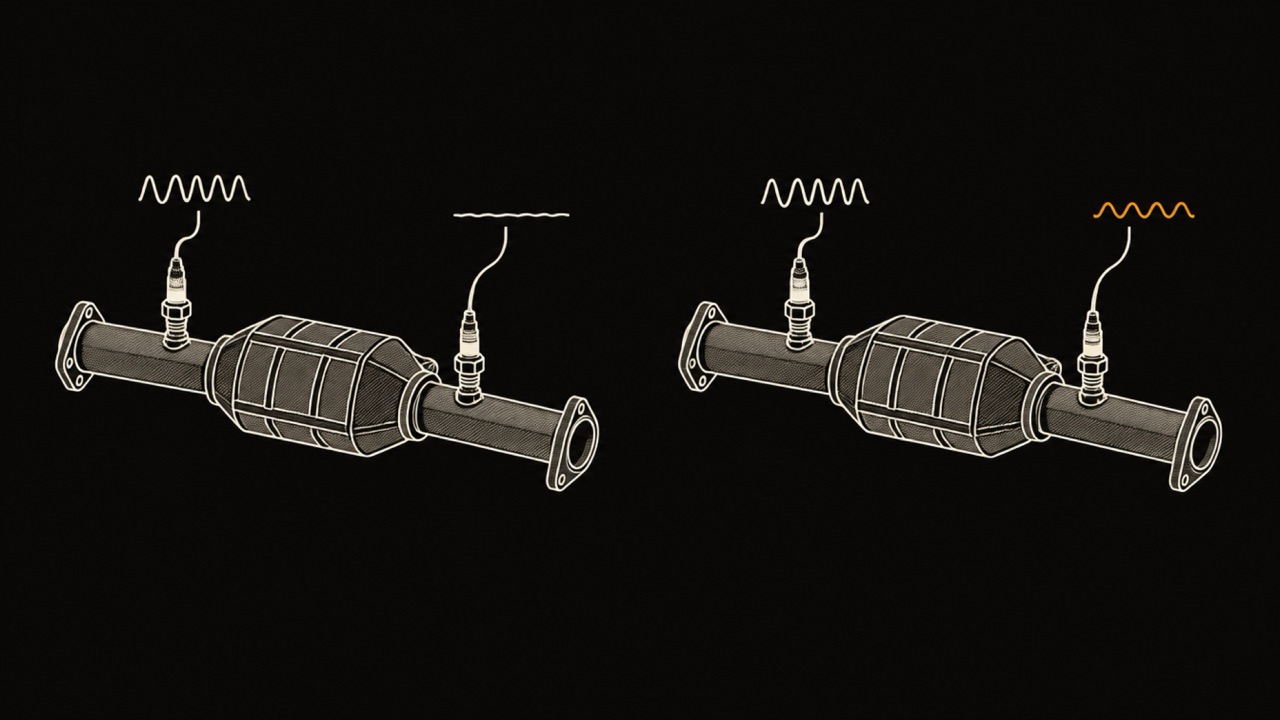
A failed catalytic converter causes most P0420 codes, according to Samarins, but it is not the only part that can set the code. Identifix lists a defective oxygen sensor, an exhaust leak, a cracked exhaust manifold, a leaking fuel injector, the wrong fuel type, a faulty coolant temperature sensor or thermostat, a bad spark plug or misfire, high fuel pressure and outdated engine software.
| Cause | Why it sets P0420 | What to check |
|---|---|---|
| Failed catalytic converter | The most common cause: the converter no longer stores enough oxygen | Rule out the other causes below before replacing it |
| Exhaust leak or cracked manifold | Both sources list exhaust leaks; Identifix also lists a cracked manifold | Cracks in the manifold or pipes, loose joints and gaskets near the sensors |
| Ageing front air/fuel sensor or another defective oxygen sensor | The code is set from these two sensors' readings | Other sensor codes, and a front sensor much older than the rear one |
| Misfire or worn spark plugs | Misfiring can damage the converter (US EPA) | Misfire codes such as P0300, and the spark plug change interval |
| Engine burning oil or coolant | Wears the converter out early | Oil and coolant levels that drop between services |
| Outdated engine software | Listed as a cause by both sources | Service bulletins for the exact model |
Sources: Samarins (2022), Identifix (September 2025).
With only P0420 stored, a steady check engine light and no drivability symptoms, a car can often be driven a short distance to be diagnosed, according to Identifix (September 2025). That is a short-term answer, not a reason to ignore the code: whatever is wearing the converter keeps wearing it.
A flashing check engine light, a misfire, a sharp loss of power or an exhaust that overheats is different. Identifix advises reducing load and getting the car serviced immediately. The reason is the converter itself: the US EPA warns that misfiring can lead to catalytic converter damage.
The cost of fixing a P0420 code depends on what caused it. An oxygen sensor costs a few hundred dollars; a catalytic converter costs one to several thousand. The table below lists the published US figures, all in US dollars, which come from two sources measuring different things: AAA gives the range of what owners pay, Identifix an average.
| Repair | Cost | Source |
|---|---|---|
| Catalytic converter replacement, parts and labour | $1,000 to $4,000 | AAA |
| Catalytic converter replacement, published average | $2,301 to $2,473 | Identifix (2025) |
| Catalytic converter part alone | $300 to $2,500 | AAA |
| Oxygen sensor replacement, published average | $454 to $550 | Identifix (2025) |
| Each failed oxygen sensor replaced with a converter | About $300 | AAA |
Sources: AAA, Identifix (September 2025). Labor at $160 to $200 per hour (AAA).
On 1995 and newer US cars and light trucks, the catalytic converter is covered for 8 years or 80,000 miles (about 129,000 km), whichever comes first. The US EPA lists it with the engine computer and the onboard diagnostic computer as the three specified major emission control components, which the manufacturer must repair or replace free if they fail from a defect in materials or workmanship.
The EPA also says original converters are designed to last the life of a properly tuned and maintained vehicle (EPA fact sheet). The EPA's warranty fact sheet adds a condition: skipping spark plug changes at the scheduled interval can lead to misfiring and converter damage, and the manufacturer may deny coverage when the lack of maintenance caused the failure. Proof of maintenance is not required to make a claim, but the manufacturer may ask for it, which is why keeping your maintenance records pays off.
This warranty is US federal law (Identifix cites 40 CFR 85.2103) and applies to US vehicles. In the UK and elsewhere outside the United States, the coverage is whatever the vehicle's warranty booklet states.
Yes. P0420 is a standardised SAE code, the 0 after the P says so (Haynes), so a Vauxhall, a Honda, a Toyota and a Ford all use it for the same fault: low catalyst efficiency on bank 1.
What differs between makes is the fix. Manufacturers sometimes publish service bulletins that recommend a cheaper repair than a new converter, such as a software update, according to Samarins. Before paying for a converter, ask a dealer or shop to check the bulletins for the exact model and year.
In the US, emissions inspection rules are set by each state, and with P0420 stored the vehicle may fail emissions testing, according to Identifix. Clearing the code does not get around it: clearing codes resets the readiness monitors, and EPA guidelines allow only one monitor to be not ready on a 2001 or newer vehicle, according to the New York DMV. The same logic applies to the MOT emissions test in the UK: do not clear codes just before a test.
The Ohio EPA (a US state agency) advises not clearing codes after a repair when possible: if the repair was right, the check engine light turns off by itself as the car completes its drive cycle. If the codes were cleared or the battery disconnected, it advises two or three days of motorway and town driving before the test. The full rules are in readiness monitors and the drive cycle.
Fixing a P0420 code means finding why the converter looks weak, then repairing that cause. The order below follows the causes Samarins and Identifix list, cheapest checks first.
The whole article in five lines.
With a Bluetooth Low Energy ELM327 adapter or the OBDLink MX+, WrenchTime reads the stored, pending and permanent codes, describes generic codes like P0420 in plain language, and shows the freeze frame and the readiness monitors in the same scan. Every scan is saved with its date and odometer reading, and codes can be cleared once the repair is done, only with the engine off and after two confirmations. The OBD-II code reader for iPhone guide walks through it.
Trouble Codes is part of WrenchTime Pro. Log the repair in the vehicle's maintenance history in WrenchTime too: dated service records are what you can show if the manufacturer asks whether scheduled maintenance was done. Download WrenchTime on the App Store.
Fix what caused it, not only the converter. Read every stored code first, repair any misfire, check for exhaust leaks and the oxygen sensors, and ask for manufacturer service bulletins, which sometimes give a cheaper repair. Replace the converter only after the rest is ruled out, and fix the root cause so the new one does not fail too.
A failed catalytic converter causes most P0420 codes, according to Samarins. Exhaust leaks, an ageing front air/fuel sensor, another defective oxygen sensor, misfires and outdated engine software can set the same code, which is why a shop checks those before replacing the converter.
It depends on the cause. AAA puts a catalytic converter replacement at $1,000 to $4,000 for parts and labour, and Identifix publishes an average of $2,301 to $2,473. When an oxygen sensor is the cause, Identifix lists $454 to $550 for the replacement.
With a steady check engine light, only P0420 and no drivability symptoms, the car can often be driven a short distance to be diagnosed, according to Identifix. If the light flashes, the engine misfires or loses power, reduce load and get it serviced right away, because misfires can damage the converter.
Bank 1 is the side of a V6 or V8 engine that holds cylinder number one; bank 2 is the other side, and its converter code is P0430. A straight four or six cylinder engine has only one bank, so on those engines a catalyst code is always bank 1.
On 1995 and newer US vehicles (it is US federal law, so check the warranty booklet elsewhere), the EPA lists catalytic converters among the parts covered for 8 years or 80,000 miles, whichever comes first, for defects in materials or workmanship. The manufacturer may deny coverage if skipped scheduled maintenance, such as spark plug changes, caused the failure.
More from the blog
OBD2
Every OBD2 readiness monitor and what it checks, how many can be incomplete at an emissions test by model year, and the drive cycles states publish to get them ready.
Diagnostics
Plug in with the ignition off, switch to on without starting the engine, read and write down every code, and look each one up before clearing anything.
Service records
Keep every invoice and parts receipt with the date, mileage and work done, for as long as you own the car, because no outside report can rebuild that history.
Free to download. One vehicle, real features, no ads. Your garage will thank you.
Download WrenchTime on the App Store