Motorcycle oil
How often should you change motorcycle oil?
Every few thousand miles or once a year, whichever comes first, with your owner's manual setting the exact figure and hard riding or storage shortening it.
Engine oil
Change your oil when your owner's manual or the car's oil life monitor says, at the distance or the time limit, whichever comes first. Many automakers now set 7,500 or even 10,000 miles and six or 12 months, according to Consumer Reports (2026), which calls the old every-3,000-miles rule outdated. Change it sooner under severe driving: Toyota's 2014 guidance for its 0W-20 engines cut the interval from 10,000 to 5,000 miles for towing, long idling or short trips in freezing weather.
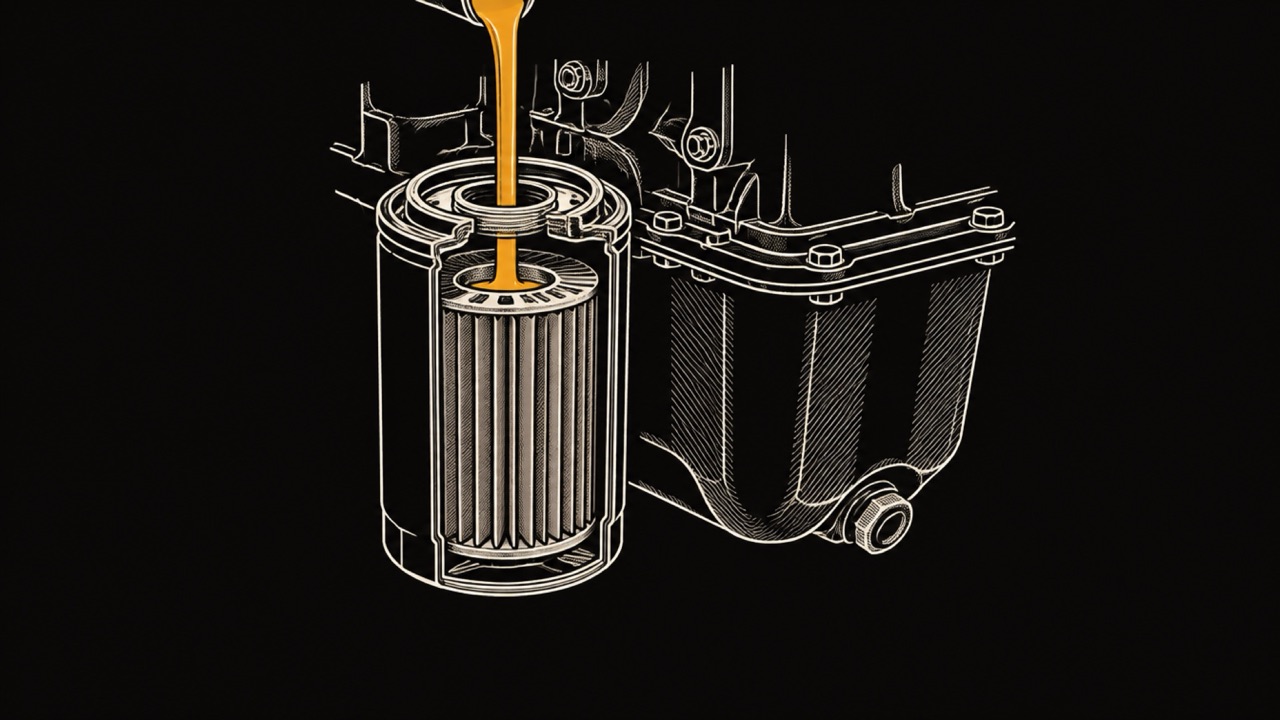
How often to change oil is set by the car's maker, not by the oil change shop. Consumer Reports (updated September 2026) says many automakers now specify 7,500 or even 10,000 miles and six or 12 months between changes, roughly 12,000 to 16,000 km, and calls the old every-3,000-miles rule outdated because engines and oils have improved.
Every oil change interval has two limits, a distance and a time, and the oil is due at whichever arrives first. Oil wears out with heat and distance, but it also ages with time, collecting moisture and impurities, which is why a car that sits still reaches its date. A car that covers 25,000 miles a year meets the distance limit; a car that covers 4,000 meets the date.
The interval in the manual assumes the oil the manual specifies. Hyundai's 2025 Sonata owner's manual states it plainly: the normal interval is based on the recommended oil specification, and if that oil is not used, the engine oil goes on the severe schedule. This article is about cars; for two wheels, see how often to change motorcycle oil.
How often you are supposed to change your oil depends less on the bottle than on what the engine was designed for. A viscosity grade such as 0W-20 describes how thick the oil is cold and hot, and the manual names the grade and the specification the engine needs. The interval is attached to that combination, which is why the same synthetic oil gets a different interval in two different engines.
Using the specified grade also matters at the pump. fueleconomy.gov says the recommended grade can improve gas mileage by 1% to 2%, and that a thicker grade than the engine was designed for can lower it by 1% to 2%, the size of the penalty depending on how far the grade is off. It also advises looking for oil marked Energy Conserving on the API symbol.
| Oil situation | What the source says | Source | Why it matters |
|---|---|---|---|
| Engine that specifies 5W-30 | 5,000 miles under normal use (2010-2014 Toyota models such as the 2010-2011 Camry V6 and the Yaris) | Toyota Tech Tip, 2014 | Older engines that call for 5W-30 kept the shorter interval |
| Engine that requires 0W-20 synthetic | 10,000 miles under normal use for most such Toyota models, 2010-2014 | Toyota Tech Tip, 2014 | The longer interval belongs to the engine, not to the oil alone |
| 0W-20 used where it is only an option | Stays at 5,000 miles even when 0W-20 is used | Toyota Tech Tip, 2014 | Upgrading the oil does not rewrite the schedule |
| Synthetic oil in a low-mileage car | Do not go past the maker's time limit, typically six months or a year | Consumer Reports, 2026 | Synthetic still ages with time |
| High-mileage oil | Made for engines past 75,000 miles; the interval still follows the manual | Valvoline | An older engine may also move to the severe schedule |
| Oil that does not meet the specification | Use the severe-service schedule | Hyundai owner's manual, 2025 | The normal interval assumes the recommended oil |
Sources: Toyota Tech Tip T-TT-0262-13 (February 2014, filed with NHTSA), Consumer Reports (2026), Valvoline, Hyundai, all accessed November 2026. No opened source gives a separate figure for synthetic blend oil: the manual decides.
Carmakers publish their oil change intervals in the owner's manual and the warranty and maintenance guide, and the numbers differ by brand, model and model year. The table below collects what the documents opened for this article say, with the year of each document. Use it to see the range, then look up the schedule for the exact car.
Two patterns show in these schedules. Where a maker publishes both figures, as Toyota does for its 0W-20 engines and Subaru does, the severe interval is about half the normal one. And every interval pairs a distance with a time: some makers state the time limit in the schedule itself, others, like Ford, build it into an oil life monitor that counts down on the dashboard.
| Maker | Normal interval | Severe or special conditions | Document and year |
|---|---|---|---|
| Toyota (engines requiring 0W-20) | 10,000 miles | 5,000 miles, regardless of oil used | Tech Tip T-TT-0262-13, 2010-2014 models, 2014 |
| Toyota (5W-30 engines) | 5,000 miles | 5,000 miles | Tech Tip T-TT-0262-13, 2014 |
| Subaru, 2015 model year on | 6,000 miles or 6 months | 3,000 miles and 3 months | Subaru of America announcement, 2014 |
| Subaru, 2014 model year | 7,500 miles or 6 months, oil and filter | Not stated on the page | Subaru customer support |
| Ford | Set by the Intelligent Oil Life Monitor, with estimates of up to a full 12 months or 10,000 miles | May call for a change at 7 months or 4,000 miles with significant idling | Ford support |
| GM (some 2010-2012 four-cylinder models) | Set by the oil life monitor | Oil and filter at least once a year in any case | Owner's manual, as reported in 2013 |
| Honda | Set by the Maintenance Minder | Service Due Soon message at 15% oil life | Honda Canada |
| Hyundai | Normal schedule in the manual | Severe schedule for the listed conditions and after 10 years or 100,000 miles | 2025 Sonata owner's manual |
Sources: Toyota, Subaru of America (March 2014), Subaru support, Ford, Gardner Business Media (2013, on GM), Honda Canada, Hyundai, accessed November 2026.
For most modern cars, yes: the 3,000-mile oil change is a habit, not a requirement. Consumer Reports calls the every-3,000-miles-or-three-months rule outdated, and none of the normal schedules in the carmaker table above is that short. Toyota's 2014 guidance gave its 0W-20 engines 10,000 miles, and Subaru's normal interval is 6,000.
The cost of the habit adds up. Consumer Reports puts the saving at $600 over two years and 30,000 miles at $100 a change. The arithmetic behind it: 30,000 miles is ten changes at 3,000 miles and four at 7,500 miles, six fewer visits to the shop.
The 3,000-mile figure still survives in one place: severe service. Subaru's severe interval for 2015 and later models is 3,000 miles and 3 months, according to a Subaru of America announcement from March 2014. A car that only makes short winter trips may genuinely need the short interval, and the manual says when.
Follow the oil life monitor if the car has one, and treat the manual's time limit as a ceiling it cannot extend. An oil life monitor is the car computer's estimate of how much useful life the oil has left, calculated from how the car is driven. Honda says its Maintenance Minder calculates from speed, temperature and how long the car runs under more severe conditions, and shows Service Due Soon at 15% oil life.
Ford describes its Intelligent Oil Life Monitor as counting from 100% to 0% while weighing engine temperature, idling and towing. A car that idles a lot may be told to change oil at 7 months or 4,000 miles, and the estimate may or may not reach a full 12 months or 10,000 miles.
A monitor only knows what it is told. Honda notes that the Minder has no sensors for wear caused by heavy trailer towing, and Hyundai says its system works only with the recommended oil and must be reset at every oil change, or its reading may not be accurate.
If you don't drive much, change the oil on the time limit in the manual, usually every 6 or 12 months, even though the car has not covered the distance. Consumer Reports gives the example of a driver covering 6,000 miles a year on a car with a 7,500-mile interval: that car should still have its oil changed twice a year.
GM's owner's manuals for the 2010-2012 four-cylinder Chevrolet Equinox, GMC Terrain, Buick Regal and LaCrosse tell owners to change the oil and filter at least once per year, while the oil life monitor may not ask for service that often, as Gardner Business Media reported in 2013. Ford's monitor estimate may or may not reach a full 12 months or 10,000 miles.
Example calculation: a car driven 4,000 miles a year on a 10,000-mile, 12-month schedule reaches the 12-month limit at about 4,000 miles, so the oil is due on the date with 6,000 miles of the distance limit unused. Low annual mileage also tends to mean short trips, and short trips are on Hyundai's and Toyota's severe-service lists. Logged engine data on how long a car takes to warm up shows why: a short trip below freezing can end before the engine is warm.
Severe service is the set of driving conditions under which a maker shortens its maintenance intervals; Toyota and Subaru halve the oil interval. The list is longer than most drivers expect, and ordinary commuting in traffic qualifies. Hyundai's 2025 Sonata manual gives one of the most complete lists, and Toyota's 2014 Tech Tip names its own Special Operating Conditions, under which oil is replaced every 5,000 miles regardless of the oil used.
Age counts too. Hyundai's 2025 Sonata manual tells owners to use the severe maintenance schedule after more than 10 years or 100,000 miles, whatever the driving. The same manual notes that some oil consumption is normal, so an older engine needs its level checked regularly.
| Condition | Named by | Why it matters |
|---|---|---|
| Repeated trips under 5 miles (8 km), or under 10 miles (16 km) in freezing weather | Hyundai; Toyota (short trips under 32°F) | The engine never gets hot enough to boil off water and fuel that collect in the oil |
| Extensive idling or long low-speed driving | Hyundai; Toyota | The engine runs for hours while the odometer barely moves |
| Heavy traffic and frequent stop-and-go | Hyundai | Same as idling: engine hours without miles |
| Towing a trailer, a camper or roof loads | Hyundai; Toyota | Higher load means higher oil temperature |
| Dusty, muddy, unpaved or gravel roads, off-road driving | Hyundai; Toyota | Dust that gets past the air filter ends up in the oil |
| Salt-spread roads or very cold weather | Hyundai | Cold starts and corrosion load the oil and the engine |
| Repeated mountain driving | Hyundai | Sustained climbing and engine braking raise temperature |
| Taxi, patrol or other commercial use | Hyundai | Many engine hours and many short cycles |
| Frequent high speed or hard acceleration | Hyundai | Higher oil temperature and shear |
| Oil that is not the recommended type or grade | Hyundai | The normal interval assumes the specified oil |
Sources: Hyundai 2025 Sonata owner's manual, Toyota Tech Tip T-TT-0262-13 (2014), accessed November 2026. The reasons in the last column are general workshop knowledge, not quotes from either document.
Change synthetic oil at the interval the manual gives for that engine, which can be longer than for conventional oil only when the maker says so. Toyota extended its interval to 10,000 miles for most vehicles that require 0W-20 synthetic, but engines where 0W-20 is only an option to a thicker grade stay at 5,000 miles even if 0W-20 is used, according to its 2014 Tech Tip.
Synthetic oil also ages. A mechanic quoted by Consumer Reports warns not to stretch synthetic oil past the maker's time limit, typically six months or a year for a car that covers few miles or makes many short trips. Consumer Reports adds that synthetic costs two to four times as much as conventional oil.
Synthetic does protect better in the lab. AAA found in 2017 that synthetic oils performed an average of 47 percent better than conventional oils across eight industry-standard ASTM tests, while noting that only a limited number of vehicles specifically require synthetic. AAA put the average change at $38 for conventional and $70 for synthetic, a $32 difference per change.
A high mileage oil change is an ordinary oil change done with an oil formulated for older engines. Valvoline, which sells it, says many experts recommend high-mileage oil after 75,000 miles, and formulates its products with seal conditioners to reduce oil consumption and leaks in engines past that mark. That is the maker's description of its own product, and the oil still has to match the grade in the manual.
High-mileage oil does not change how often the oil is due. What changes with age is the schedule: Hyundai's 2025 Sonata manual moves the car onto its severe maintenance schedule after 10 years or 100,000 miles. An older engine that burns or seeps oil also needs its level checked more often, whatever is in it.
Change the oil filter at every oil change. The carmakers' own schedules pair the two: Subaru's 2014 schedule lists engine oil and engine oil filter replacement together every 6 months or 7,500 miles, GM's manuals for several 2010-2012 models call for oil and filter at least once a year, and Hyundai's manual tells owners to have the engine oil and filter changed together.
The filter holds the dirt, metal and soot the oil has carried out of the engine. Pouring fresh oil through an old filter starts the new oil's life with the old oil's debris in its path. If a manual ever schedules the filter differently, the manual wins; otherwise change both together.
Check the oil level at least once a month, or ideally every other fill-up, as Consumer Reports advises. Most automakers recommend checking with the engine cool. Pull the dipstick, wipe it, push it fully back in, pull it again and read where the oil sits between the two marks. If it is low, add no more than half a quart at a time and check again.
Some oil consumption is normal. Hyundai's manual says it is normal for engine oil to be consumed during driving and asks owners to check the level regularly, because its oil life system assumes the oil is being topped up normally. Toyota keeps a 5,000-mile visit on its 10,000-mile oil schedule partly so the fluid levels, engine oil included, are checked and adjusted.
The colour on the dipstick is a weaker signal than the level. Consumer Reports notes that used oil can look brown or black, so dark oil alone does not mean the oil is due. A level that keeps dropping between changes, or oil that looks milky, is a reason to have the engine checked rather than just topped up.

Hybrids need oil changes, because they have a gasoline engine; electric cars do not, because they have no engine oil. Toyota's 2014 Tech Tip lists the 2010-2014 Prius with 0W-20 synthetic oil and a 10,000-mile interval under normal use, the same as its other 0W-20 engines. The engine in a hybrid often runs in short bursts, so the severe-service list deserves a second look.
An electric car still has fluids and a schedule of its own, from brake fluid to coolant for the battery. The EV maintenance schedule covers what an electric car needs, and hybrid car maintenance covers the rest of a hybrid's list.
Here is an example for a car on a 10,000-mile, 12-month normal schedule, driven 8,000 miles a year, most of it short trips through a cold winter. The short winter trips put it on the severe schedule for those months, so the plan halves both limits to 5,000 miles or 6 months, the same halving Toyota and Subaru apply to their severe schedules. Adjust the numbers to the car's own manual.
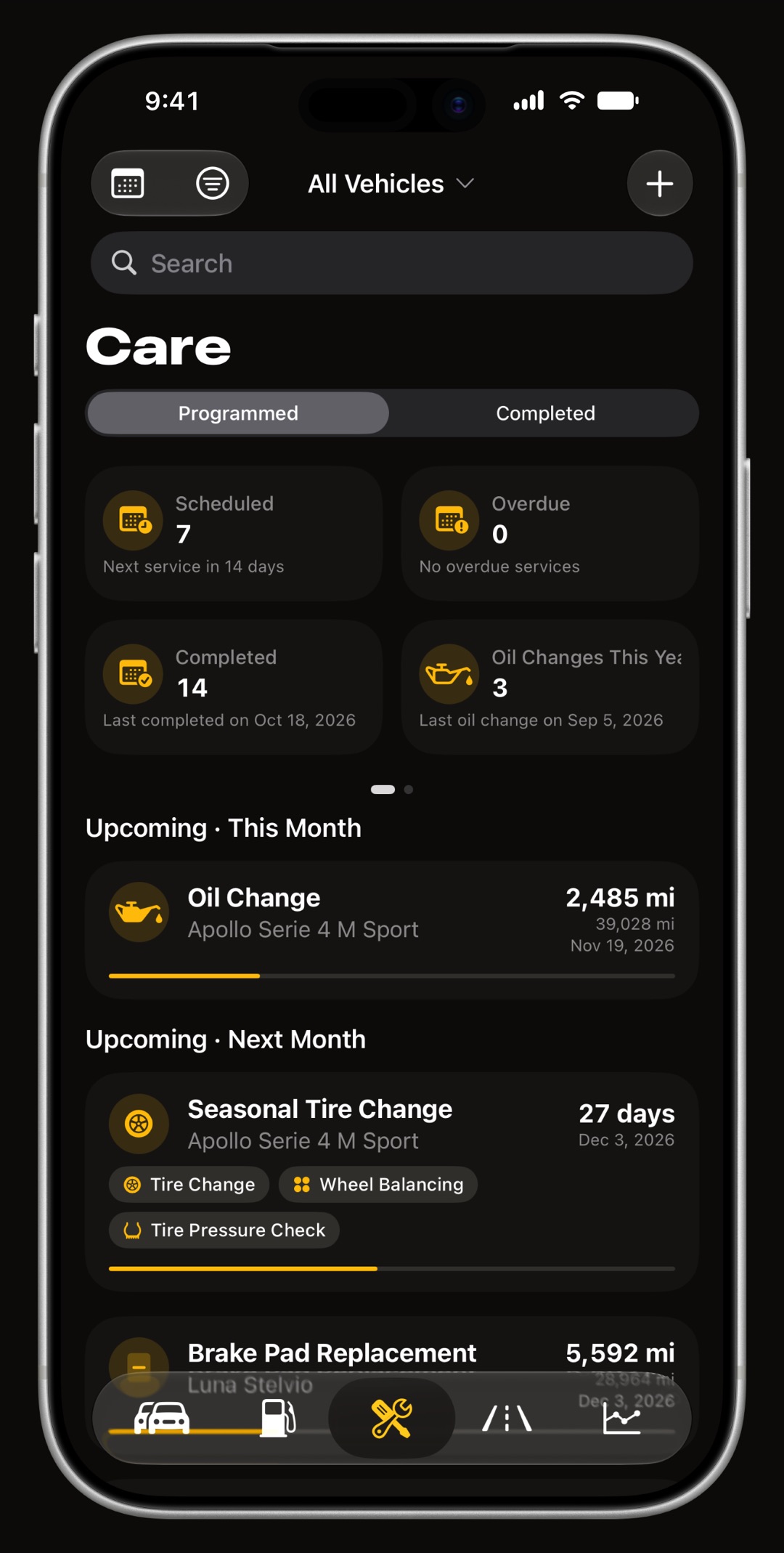
WrenchTime, a maintenance and fuel log for iPhone, schedules a job by date, by distance or both and treats whichever comes first as the one that matters, and its vehicle card shows an oil life bar worked out from the distance and time since the last oil change. Keeping each receipt is covered in which car maintenance records to keep.
An oil change is due at a date or a mileage, whichever arrives first, so a reminder that tracks only one of them misses half the rule. In WrenchTime the oil change and the oil filter are procedures in the Care tab, scheduled by date, by distance or both, with a reminder that fires on the date or at the odometer reading, a few days ahead if you choose. Make it a recurring series and completing one change queues the next.
Completing it records the date, the odometer, the cost and the invoice, which is the service record a buyer or a warranty claim asks for. The free version covers 1 vehicle and 2 maintenance entries a month, enough for oil changes on one car. The guide on how to schedule maintenance and reminders in WrenchTime walks through the screens.
Change it when the oil life monitor reaches the change point or the manual's interval arrives, in miles or in months, whichever comes first. Consumer Reports (2026) says many automakers set 7,500 or 10,000 miles and six or 12 months, and sooner under severe driving such as short trips, towing or long idling.
It is an oil change with an oil blended for older engines, usually with seal conditioners meant to reduce leaks and oil consumption. Valvoline says many experts recommend it after 75,000 miles. It does not change the interval, but age can: Hyundai's 2025 Sonata manual moves the car onto its severe schedule after 10 years or 100,000 miles.
Yes, if the car covers less than its distance limit in a year and the manual's time limit is 12 months. Some GM manuals call for oil and filter at least once a year, and Ford's monitor estimate tops out at 12 months. A car with a 6-month limit, like a 2015 or later Subaru, needs two.
Change the oil filter with every oil change. Subaru, GM and Hyundai schedule the oil and the filter together. The filter holds the debris the old oil carried, so fresh oil pushed through an old filter starts its life with that dirt in its path.
Only if the manual says so for that engine. Toyota's 2014 guidance extended intervals to 10,000 miles on engines that require 0W-20 synthetic, but kept 5,000 miles on engines where 0W-20 is only an option, even when it is used. Putting synthetic oil in a car does not rewrite its schedule.
It is the car computer's estimate of how much useful life the oil has left, calculated from how the car is driven rather than measured in the oil. Honda shows Service Due Soon at 15%, and Ford counts down from 100% to 0%. Reset it after every oil change so it starts from fresh oil.
More from the blog
Motorcycle oil
Every few thousand miles or once a year, whichever comes first, with your owner's manual setting the exact figure and hard riding or storage shortening it.
Service records
Keep every invoice and parts receipt with the date, mileage and work done, for as long as you own the car, because no outside report can rebuild that history.
Cooling system
Every 2 years or 30,000 miles for older green coolant, five to ten years or 100,000 miles and more for long-life types, whichever comes first, with the manufacturer numbers side by side.
Free to download. One vehicle, real features, no ads. Your garage will thank you.
Download WrenchTime on the App Store