Driving dynamics
G force meter for cars: what it measures
What a g force meter for cars reads, how to calculate g yourself, and how many g normal driving, a sports car and Formula One really pull.
Riding
Most motorcycles can lean between 25 and 50 degrees before a foot peg or another part touches the road, according to a 2015 SAE paper by Carter, Rose and Pentecost, citing Bartlett. Harley-Davidson rates its FLTRXP police model at 34 degrees right and 33 left and the Police Pan America at 42 degrees each way, measured to SAE J1168, while MotoGP riders lean up to 65 degrees. On a flat road, 45 degrees of lean means 1 g of cornering force.
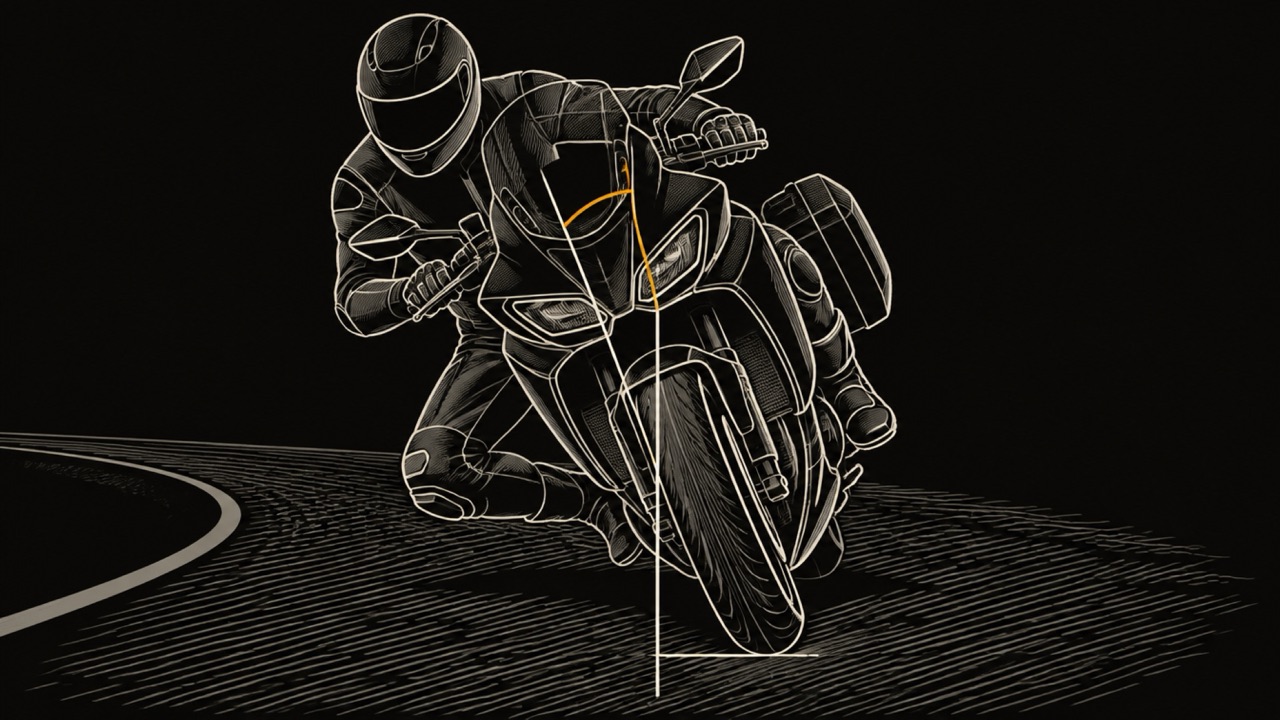
Motorcycle lean angle is the angle between the bike's centre line and the vertical as it goes through a bend. The maximum lean angle is set by the first hard part that touches the road: a foot peg, a footboard, an exhaust, a stand or the frame.
The maximum lean angle of most motorcycles falls between 25 and 50 degrees, according to Carter, Rose and Pentecost (SAE International, 2015), who cite Bartlett.
Some manufacturers publish the figure. The two Harley-Davidson police spec sheets checked here list lean angle measured to the SAE J1168 procedure, separately for the right and the left side, and the two sides can differ by a degree.
| Motorcycle | Maximum lean angle | Source |
|---|---|---|
| Most motorcycles | 25 to 50 degrees | Carter, Rose and Pentecost, SAE 2015, citing Bartlett 2011 |
| Harley-Davidson FLTRXP police model (MY26) | 34 degrees right, 33 degrees left | Harley-Davidson spec sheet, SAE J1168 |
| Harley-Davidson Police Pan America (2027) | 42 degrees right, 42 degrees left | Harley-Davidson spec sheet, SAE J1168 |
| MotoGP race bike | Up to 65 degrees | MotoGP.com, September 2026 |
Sources: Carter, Rose and Pentecost, SAE Int. J. Trans. Safety, 2015; Harley-Davidson spec sheets for the MY26 FLTRXP police model and the 2027 Police Pan America; MotoGP.com.
A motorcycle leans in a bend so that gravity balances the sideways force the tyres push into the road. The required lean grows with speed and shrinks with a wider curve. The standard equation, reported by Fricke and Cossalter and tested by Carter, Rose and Pentecost (SAE, 2015), is tan(lean) = v² / (g x r): speed squared over gravity times the radius of the curve.
The equation gives the lean relative to gravity. On a flat road that is also the lean relative to the road. On a banked curve it is not: Carter and his co-authors note that road banking, called superelevation, typically does not exceed 6 or 7 degrees, which takes that much off the lean measured against the road surface.
The simple equation rests on three assumptions that real riding breaks: the speed is steady, the rider leans exactly as much as the motorcycle, and the tyres have no width. A real tyre rolls onto its shoulder as the bike leans, moving the contact patch inward, so the actual lean is larger than the formula says, which the paper found the basic equations consistently underestimate, and a rider who hangs off the inside needs a little less.
On a flat road, the cornering force in g, the lateral acceleration, equals the tangent of the lean angle. A 30 degree lean is about 0.58 g, 45 degrees is exactly 1 g, and 60 degrees is about 1.73 g. The relation is steep at the top: the last 15 degrees from 45 to 60 add more cornering force than the first 30 degrees.
The example calculation below applies tan(lean) = v² / (g x r) to a flat curve with a 250-foot (76 m) radius, the curve Carter, Rose and Pentecost use in their own examples. Their figures match it: a bike that can lean 25 degrees reaches 42 mph before something scrapes, and 50 degrees corresponds to 67 mph. The speeds are physics on one stated curve, not targets for any road.
The 60 and 65 degree rows need more grip than the paper allows for: Carter and his co-authors cite a peak friction of 1.2 between motorcycle tyres and dry tarmac, from Lambourn, so anything beyond 1.2 g, about 50 degrees, is past that figure. What a g-force reading means in everyday driving is in our guide to the g force meter for cars.
| Lean angle | Cornering force (g) | Speed (mph) | Speed (km/h) |
|---|---|---|---|
| 20 degrees | 0.36 g | 37 mph | 59 km/h |
| 30 degrees | 0.58 g | 46 mph | 75 km/h |
| 35 degrees | 0.70 g | 51 mph | 82 km/h |
| 40 degrees | 0.84 g | 56 mph | 90 km/h |
| 45 degrees | 1.00 g | 61 mph | 98 km/h |
| 50 degrees | 1.19 g | 67 mph | 107 km/h |
| 60 degrees | 1.73 g | 80 mph | 130 km/h |
| 65 degrees | 2.14 g | 90 mph | 144 km/h |
Example calculation with tan(lean) = v² / (g x r), from Carter, Rose and Pentecost (SAE, 2015). Real lean is larger because tyres have width; rows above 1.2 g exceed the peak friction Carter et al. cite for motorcycle tyres on dry tarmac.
Most riders use far less lean than their motorcycle allows. Watanabe and Yoshida found that novice riders used a maximum of 15 degrees to 25 degrees and experienced riders 34 to 40 degrees, as cited by Carter, Rose and Pentecost (SAE, 2015). Experienced riders approach the limits of many bikes; novices stop well short of them.
Bernt Spiegel, in his book The Upper Half of the Motorcycle, proposed that, without training, people accept only about 20 degrees of lean, the angle runners and animals use on natural ground. A 2020 paper presented at the IFZ International Motorcycle Conference by Pless, Will, Neukum and Scherer cites measurements showing that beginners sometimes reach up to 40 degrees in normal conditions.
The same paper cites an analysis of fatal crashes by Bauer: 45% of the killed motorcyclists in that sample crashed while cornering with no obvious external cause, no rider exceeded 20 degrees of roll, and none of the crashes would have happened if the rider had leaned to 35 degrees or less. In that sample, the riders who crashed had used little of the lean available to them.
On a closed track in the same 2020 study, all but one of the ten riders showed a median above 30 degrees in U-turns at a speed they chose themselves, and the researchers found no single lean threshold shared by every rider: each rider's comfortable range was different.
| Riders | Lean angle | Source |
|---|---|---|
| Novice riders, maximum used | 15 to 25 degrees | Watanabe and Yoshida 1973, cited by Carter et al. 2015 |
| Experienced riders, maximum used | 34 to 40 degrees | Watanabe and Yoshida 1973, cited by Carter et al. 2015 |
| Riders killed while cornering, Bauer sample | Never above 20 degrees | Bauer et al., cited by IFZ 2020 |
| Track riders in U-turns, median | Above 30 degrees for all but one rider | IFZ 2020 |
Sources: Carter, Rose and Pentecost, SAE 2015; Pless, Will, Neukum and Scherer, IFZ International Motorcycle Conference 2020.
Three limits decide how fast a motorcycle can take a bend, according to Carter, Rose and Pentecost (SAE, 2015): the friction between tyres and road, the geometric limit where a peg or the tyre's own shape stops further lean, and the rider's willingness to approach either one.
For many motorcycles the geometric limit comes first. On a flat 250-foot curve, the paper puts the friction-limited speed at 67 mph with a friction coefficient of 1.2, while a bike that can lean only 25 degrees starts scraping at 42 mph. The suspension also compresses in a bend, which reduces ground clearance, although the paper notes that the effect was small on the motorcycle its authors had tested before.
Grip is the second limit, and the 1.2 figure is a peak for dry tarmac: it depends on the road surface and on the tyres, which is one reason to know how long motorcycle tyres last.
MotoGP riders lean their bikes up to 65 degrees when cornering, according to MotoGP.com (September 2026).
Michelin's approach, as ESPN reported in 2024, is to allow more tyre deformation, which increases the amount of rubber in contact with the tarmac. The rider's body does the rest: Aprilia's Marco de Luca told ESPN that "you use your body to lean more than the bike". Hanging off the inside moves the combined centre of gravity inward, so the bike itself needs less lean for the same speed.
A motorcycle lean angle sensor gives a bike's electronics the information they need to know how far it is leaning, so that braking can work differently in a bend than when the bike is upright.
Bosch's Motorcycle Stability Control is one such system: Bosch says it offers brake control even in curves, depending on the vehicle's lean and pitch angles (Bosch Mobility).
You can measure motorcycle lean angle with a phone app or a data logger, or on the dash of bikes that display it. A phone or logger reads lean from its motion sensors, so it has to be mounted firmly on the bike, not in a pocket, and zeroed with the bike upright and still. Read the maximum left and right after the ride, not during it.
WrenchTime, an iPhone app for car and motorcycle owners that I develop, draws lean angle as an instrument of its own on WrenchTime Live: on a motorcycle the card reads lean from the phone's motion sensors after a short calibration with the bike upright, and shows the maximum to the left and to the right.
A lean reading is most useful as a mirror. If your maximum after a twisty ride is 25 degrees while your bike is rated for more than 40, the bike had a large margin left, which is exactly the margin the IFZ crash research found riders did not use.
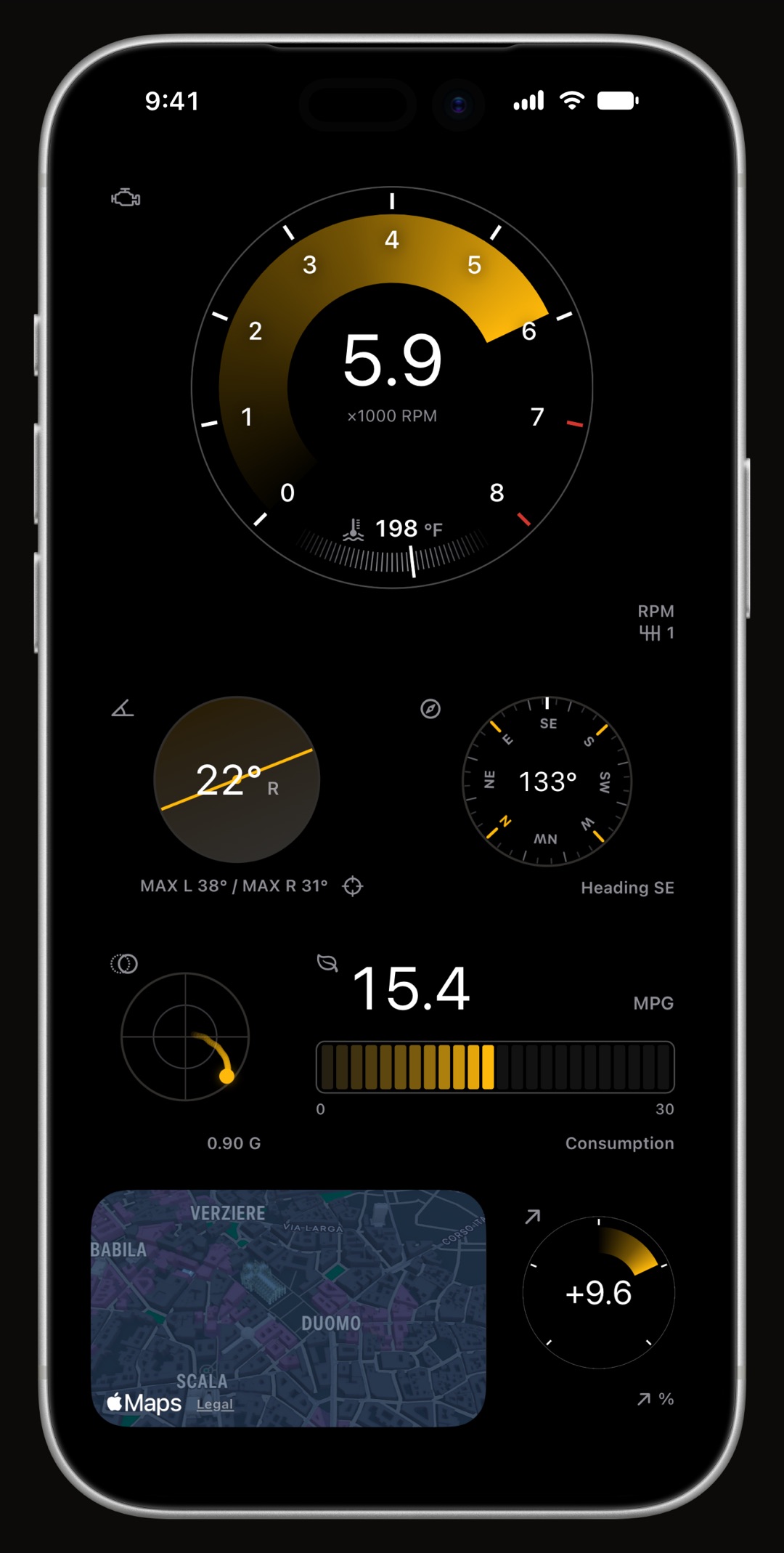
WrenchTime Live puts lean angle, speed, G-force, road grade, compass and altitude on one board you build yourself from 23 instrument types, drawn from the iPhone's own sensors, with any OBD-II reading added when an adapter is paired. The same app keeps the motorcycle's own log: chain maintenance, fork service, valve clearance and the rest of its service history in a motorcycle maintenance app.
The free version covers 1 vehicle and 3 widgets on the first page of the Live dashboard; further pages and more vehicles are part of WrenchTime Pro.
Most motorcycles can lean 25 to 50 degrees before a peg or another part touches the road, according to Carter, Rose and Pentecost (SAE, 2015). Harley-Davidson rates its FLTRXP police model at 33 to 34 degrees, and MotoGP riders lean their bikes up to 65 degrees.
At 30 degrees the cornering force is about 0.58 g, below what many riders use. Experienced riders in Watanabe and Yoshida's study used 34 to 40 degrees, and in a 2020 IFZ track study all but one of ten riders leaned past 30 degrees in U-turns.
45 degrees. On a flat road the cornering force in g equals the tangent of the lean angle, so 45 degrees gives 1 g, 30 degrees about 0.58 g and 60 degrees about 1.73 g, more than the 1.2 peak friction cited for motorcycle tyres on dry tarmac.
Harley-Davidson lists lean angle, measured to SAE J1168, on each model's spec sheet. Of the two checked here, the 2027 Police Pan America is rated 42 degrees each way and the MY26 FLTRXP police model 34 degrees right and 33 left; check the sheet for the exact model and year.
Use a phone app or a data logger that reads lean from its motion sensors, or the dash on bikes that show it. Mount the phone firmly, zero it with the bike upright and still, and read the maximum left and right after the ride, never while riding.
Often they had lean to spare. In a sample of fatal crashes cited at the 2020 IFZ conference, 45% happened while cornering with no obvious external cause, no rider exceeded 20 degrees, and none of those crashes would have happened at 35 degrees or less.
More from the blog
Driving dynamics
What a g force meter for cars reads, how to calculate g yourself, and how many g normal driving, a sports car and Formula One really pull.
Motorcycle tyres
Motorcycle tyre life in miles by tyre type, the age limits makers set, how to read the DOT date code and when the tread is done.
Motorcycle chain
Clean and lube a motorcycle chain every 300 to 500 miles and after rain, check slack every 500 miles, and replace chain and sprockets together at the wear limit.

Free to download. One vehicle, real features, no ads. Your garage will thank you.
Download WrenchTime on the App Store