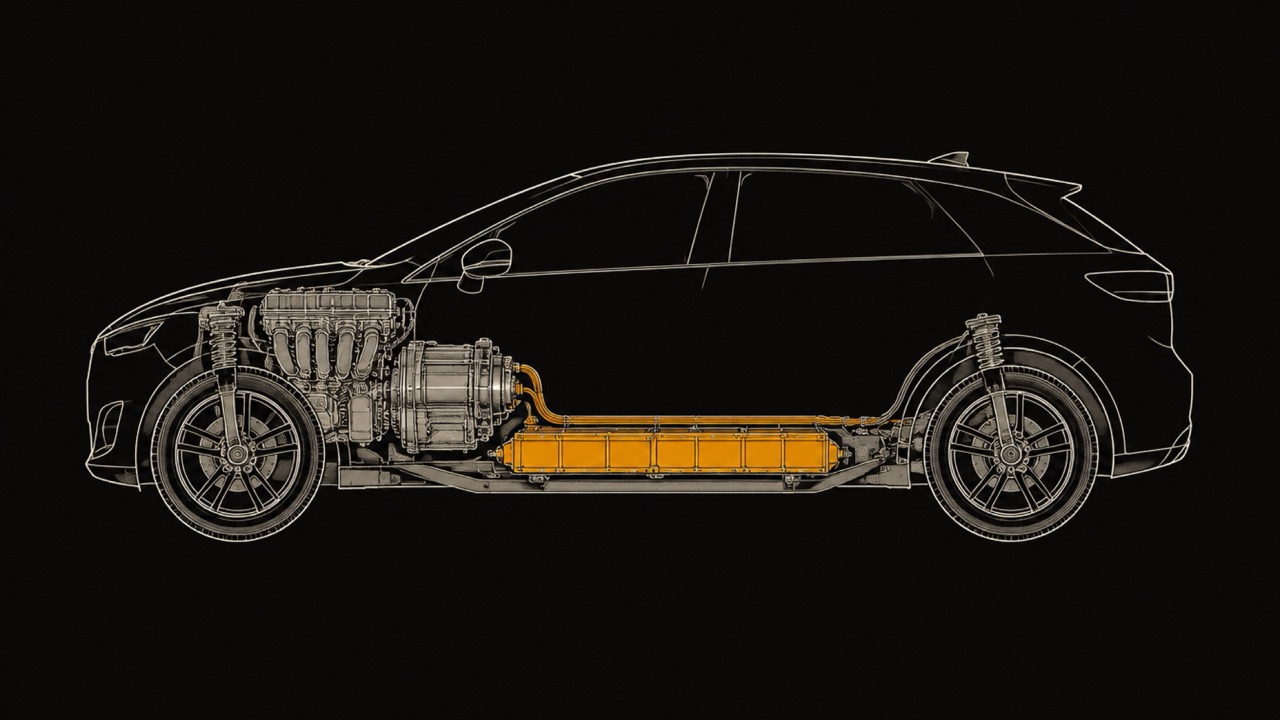
Hybrids
What maintenance does a hybrid car need?
A hybrid needs the same servicing as a petrol car plus a few hybrid-only checks, mainly the battery's cooling intake and the inverter coolant, and it usually costs no more to maintain.
Hybrids
Yes, a hybrid car needs oil changes, because it still has a petrol engine. A hybrid car oil change follows the car's maintenance schedule or oil life monitor, at the distance or the time limit, whichever comes first: Hyundai and Kia hybrid manuals list 8,000 miles or 12 months (5,000 miles or 6 months in severe use), Honda's Maintenance Minder calculates the oil life and asks for a change at least once a year, and Ford's monitor estimates up to 12 months or 10,000 miles. Do not stretch the interval because the engine runs less: a 2023 SAE paper names water and fuel dilution as the biggest concerns for the oil in a hybrid's engine.
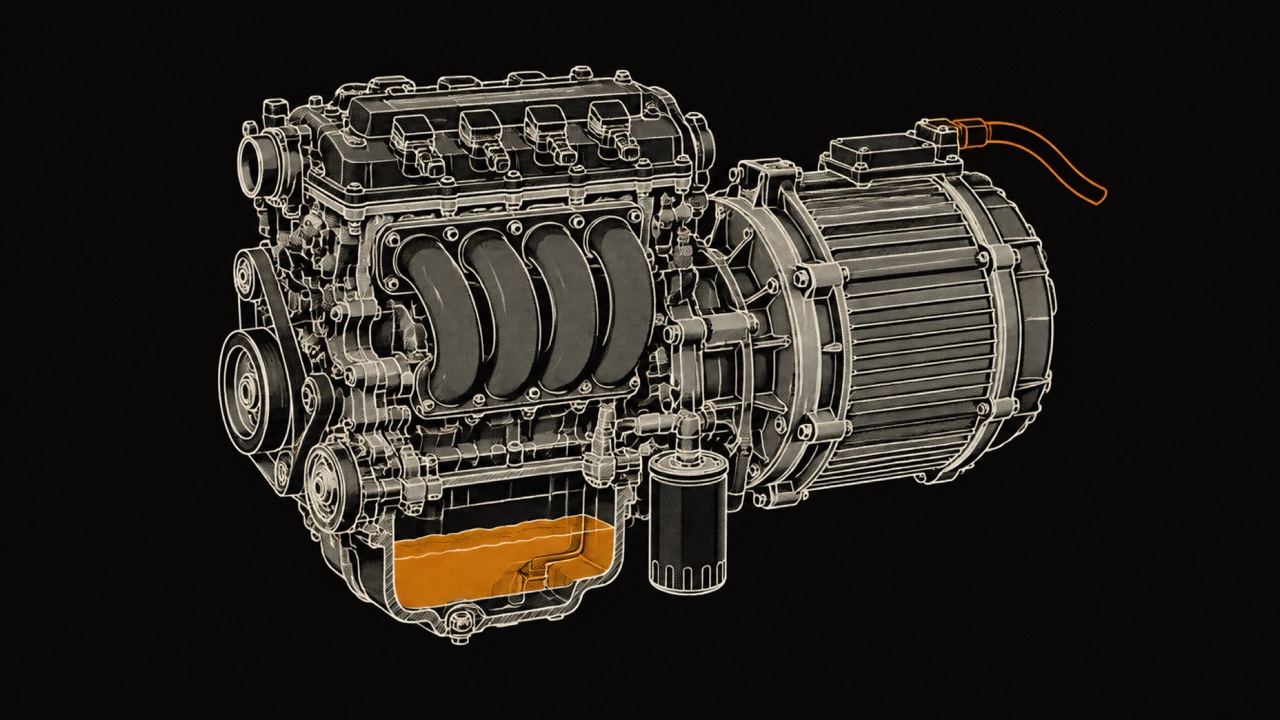
Yes. Hybrid cars need oil changes because they have a petrol engine, with engine oil and an oil filter like any other car. The US Department of Energy's Alternative Fuels Data Center puts it plainly: "Because PHEVs and HEVs have internal combustion engines, maintenance requirements are similar." Electric cars are the ones with no engine oil to change.
AAA (The Auto Club Group, July 2026) agrees on the first point: "Regular oil changes are still necessary in hybrid and PHEV cars, but because the gas engine runs less frequently, oil-change intervals may run longer." The second half of that sentence needs care: the oil life monitor decides how much longer, and the time limit in the manual still applies.
A full hybrid is a car whose petrol engine works with an electric motor and a battery that the car charges by itself. A plug-in hybrid has a larger battery charged from the grid, so its engine can stay off for days. Both have engine oil. The rest of a hybrid's service list, from brakes to battery cooling, is in the guide to hybrid car maintenance.
A hybrid car needs an oil change at the interval in its maintenance schedule, or when its oil life monitor asks, at the distance or the time limit, whichever comes first. The general rule for every car is in how often to change oil on any car. The table collects what the makers' own documents say for their hybrids, with the year of each document. All of them are US-market documents, so the schedule in the manual for your own market is the one that applies.
Two patterns run through these hybrid schedules. Every one except Toyota's 2014 Tech Tip pairs a distance with a time, either in the schedule itself (12 months at Hyundai and Kia) or in the monitor (at least once a year at Honda, estimates that may or may not reach 12 months at Ford).
And where a fixed severe figure is printed, it is 5,000 miles: Hyundai and Kia pair it with 6 months, Toyota's 2014 guidance states the mileage alone. The schedule for the exact car and model year is the one that applies.
| Maker and hybrid | Normal interval | Severe or special conditions | Document and year |
|---|---|---|---|
| Hyundai Santa Fe Hybrid | 8,000 miles or 12 months | 5,000 miles or 6 months | 2023 Santa Fe Hybrid Quick Reference Guide |
| Hyundai hybrid | 8,000 miles or 12 months, full synthetic API SN PLUS or above required | 5,000 miles or 6 months | 2024 hybrid owner's manual, web edition |
| Hyundai plug-in hybrid | 8,000 miles or 12 months | 5,000 miles or 6 months | 2026 plug-in hybrid owner's manual, web edition |
| Kia hybrids and plug-in hybrids with the Smartstream G1.6 T-GDi or G1.6 GDi engine | 8,000 miles or 12 months | 5,000 miles or 6 months | 2025 owner's manuals, web editions |
| Honda Accord Hybrid; Honda CR-V | Set by the Maintenance Minder, at least once every 12 months | Due soon at 15% to 6% oil life, due now at 5% to 1% | 2022 Accord Hybrid and 2023 CR-V Maintenance Minder chapters |
| Ford (oil life monitor, general guidance) | Set by the Intelligent Oil-Life Monitor; estimates may or may not reach 12 months or 10,000 miles | With significant idling, an alert may come at 7 months or 4,000 miles | Ford support pages, read 2026 |
| Toyota hybrids with engines requiring 0W-20: 2010-2014 Prius, 2012-2014 Prius v and Prius c, Prius PHV, 2012-2014 Camry Hybrid, 2011-2014 Highlander Hybrid, 2013-2014 Avalon Hybrid | 10,000 miles | 5,000 miles under special operating conditions | Tech Tip T-TT-0262-13, 2014 |
Sources: Hyundai 2023 Santa Fe Hybrid Quick Reference Guide, 2024 hybrid owner's manual (normal schedule) and 2026 plug-in hybrid owner's manual; Kia 2025 owner's manuals (G1.6 T-GDi, G1.6 GDi); Honda 2022 Accord Hybrid and 2023 CR-V Maintenance Minder chapters; Ford support (Intelligent Oil-Life Monitor, oil life FAQ for the Ford and Lincoln apps); Toyota Tech Tip T-TT-0262-13 (2014, hosted by NHTSA).
A Honda CR-V Hybrid or Accord Hybrid gets an oil change when its Maintenance Minder asks, not at a fixed mileage. An oil life monitor is the car computer's estimate of how much useful life the oil has left. Honda's 2022 Accord Hybrid Maintenance Minder chapter says the system calculates the remaining oil life from engine operating conditions and displays it as a percentage.
Honda's 2023 CR-V Maintenance Minder chapter, the CR-V's own chapter, which does not say "hybrid", sets the thresholds: service is due soon when the oil life reads 15% to 6%, and due now at 5% to 1%. Code A means replace the engine oil; code B means replace the engine oil and the oil filter, together with a set of inspections.
Both Honda chapters carry the same time rule: if no Maintenance Minder message appears more than 12 months after the display is reset, change the engine oil every year anyway. That footnote is the time limit on a Honda hybrid. A CR-V Hybrid or Accord Hybrid whose monitor stays quiet for a year still gets its oil changed.
Toyota's Tech Tip T-TT-0262-13 (February 2014, a bulletin for dealers hosted by NHTSA) set a 10,000-mile oil change interval for most engines that require 0W-20 synthetic oil. The hybrids it lists at 10,000 miles are the 2010 to 2014 Prius, the 2012 to 2014 Prius v and Prius c, the Prius PHV, the 2012 to 2014 Camry Hybrid, the 2011 to 2014 Highlander Hybrid and the 2013 to 2014 Avalon Hybrid. Earlier Camry and Highlander hybrids, where 0W-20 was only an option, stayed at 5,000 miles.
The same Toyota Tech Tip cuts the interval to 5,000 miles, regardless of the oil used, under special operating conditions: driving off-road or on dirt roads, towing a trailer, repeated short trips at temperatures under 0 °C (32 °F), and extensive idling. It also keeps the 5,000-mile service visit on the 10,000-mile schedule, for a tyre rotation and a fluid level check that includes the engine oil.
That Toyota document stops at the 2014 model year. For a RAV4 Hybrid, a Corolla Hybrid, a newer Camry Hybrid or any Toyota hybrid after 2014, the interval is in that car's Warranty and Maintenance Guide, which could not be opened for this article, so no figure is given here. Look up the guide for the exact model and year.
A hybrid's engine starts and stops as the car switches between electric and engine power, and it often runs in short, cool bursts. That duty cycle is hard on oil. Chevron Lubricants (2024) describes two effects of intermittent, start-stop engine running: a "persistent low engine temperature that causes condensation inside the engine", and "unburned fuel passes the piston rings and mixes with the engine oil". Fuel dilution is that second effect: fuel that ends up in the oil and thins it.
Research on hybrid engines points the same way. A 2023 SAE International paper by Growney and colleagues on how hybrid engine operation degrades engine oil states in its abstract, citing earlier work: "The biggest concerns are water and fuel dilution."
Infineum, an oil additive maker, reported in 2025 on a field test of hybrid engine oils: water accumulated when the oil was below 10 °C and the coolant below 40 °C, and fuel dilution reached as high as 20% by mass at ambient temperatures of -30 to -20 °C. In that test, plug-in hybrids that were never charged, to simulate a conventional hybrid, showed more iron wear than those charged normally, and more than petrol cars from an earlier Infineum trial.
Mild hybrids are not exempt. A Stellantis service document from November 2024, case S2418000015 hosted by NHTSA, states that "MHEV vehicles may exhibit the phenomenon of Engine Oil Dilution", which "occurs when the vehicle is often driven for only a few kilometres, especially in low ambient temperature conditions". It recommends driving with the engine running for 60 consecutive minutes once a month, especially in low temperatures.
The other side deserves a fair hearing. AAA (2026) says hybrid intervals "may run longer" because the engine runs less, and Kelley Blue Book (2025) says "a plug-in hybrid vehicle might require less frequent oil changes because of less frequent engine use." The two views meet in the oil life monitor, which counts how the engine actually ran, and in the manual's time limit, which still applies when the monitor stays quiet. Hyundai and Kia keep the same 8,000 miles or 12 months for hybrids and plug-ins.
Severe service is the set of driving conditions under which a maker shortens its maintenance intervals. For a hybrid's oil, the severe figure printed in the Hyundai, Kia and Toyota documents is 5,000 miles, with 6 months added at Hyundai and Kia, while Ford's monitor sets its own figure. Each maker writes its own list, so the severe schedule in the car's own manual is the one to read. These are the conditions the makers name.
Yes. A plug-in hybrid still has a petrol engine, and an engine that runs rarely and briefly is not easier on its oil. Hyundai's 2026 plug-in hybrid owner's manual keeps the same schedule as its hybrids, oil and filter every 8,000 miles or 12 months and every 5,000 miles or 6 months in severe use, with no exemption for the plug-in.
Kia's 2025 owner's manuals for hybrids and plug-in hybrids with the Smartstream 1.6 engines print the same figures, and add that the car may have an Oil Life Management System that predicts oil life from the driver's driving history.
An engine that rarely runs has a problem of its own. An FCA US service document from January 2024, case S2208000020 hosted by NHTSA, says "the engine oil's lubricating properties can be reduced as the vehicle's engine is not operating under its normal engine operating temperatures." The plug-in it covers has a Fuel and Oil Refresh Mode that needs 20 minutes to 2 hours of engine running; if that run time is not met between oil changes, the recommended option is to change the oil and reset the reminder.
Kelley Blue Book (2025) says a plug-in hybrid might require less frequent oil changes because its engine runs less. The manuals answer with the calendar: on a plug-in driven less than 8,000 miles a year, the 12-month limit arrives first, however little the engine ran. How long the battery itself lasts is a separate question, covered in hybrid battery lifespan.
A hybrid car takes the oil grade and specification in its owner's manual, not a special hybrid oil. Mobil states that "Toyota hybrid vehicles do not require different motor oil than non-hybrid vehicles", and recommends its 0W-16 "for select Honda and Toyota engines requiring a 0W-16 viscosity oil". The grade is often printed on the oil filler cap as well.
The specification matters as much as the grade. Hyundai's 2024 hybrid owner's manual states: "Requires API SN PLUS (or above) Full synthetic grade engine oil."
Some oils carry a hybrid label. Mobil's page for Mobil 1 Hybrid 0W-20 says hybrids "generally run at lower operating temperatures as the power source rotates between the engine and battery", and lists API SP and API SQ among the standards the product meets. That is the oil maker's description of its own product: a hybrid label is optional, and the grade and specification in the manual are what count.
Grades keep getting thinner. ENEOS USA, an oil maker, lists its 0W-8 oil for the Camry 2.5 Hybrid from 2024, the Grand Highlander Hybrid from 2023 and the Crown Hybrid from 2022. That is an oil maker's listing, not a Toyota document, so the manual of the car is the reference before buying a bottle.
A hybrid car oil change costs the same as any oil change with the same oil. Kelley Blue Book puts an oil change in the United States at $35 to $75 with conventional oil and $65 to $125 when the car requires synthetic oil, and notes that hybrids, even plug-in hybrids, have a conventional engine that needs periodic oil changes. No source found for this article prices a hybrid's oil change differently.
A hybrid that requires full synthetic oil, as Hyundai's 2024 hybrid manual does, sits in the synthetic range. Example calculation from Kelley Blue Book's prices: one change a year costs $65 to $125, and two changes a year, as on a 6-month severe schedule, cost $130 to $250.
On an 8,000-mile or 12-month schedule, like the one in Hyundai's 2023 Santa Fe Hybrid Quick Reference Guide, the limit that arrives first depends on how far the car goes in a year. The table is an example calculation from that schedule and its severe version, 5,000 miles or 6 months, with the miles spread evenly through the year.
A hybrid driven 6,000 miles a year reaches 12 months at 6,000 miles, so the calendar sets the change, once a year. On the severe schedule the same car reaches 6 months at 3,000 miles, two changes a year. At 12,000 miles a year the 8,000 miles arrive after 8 months, three changes every two years.
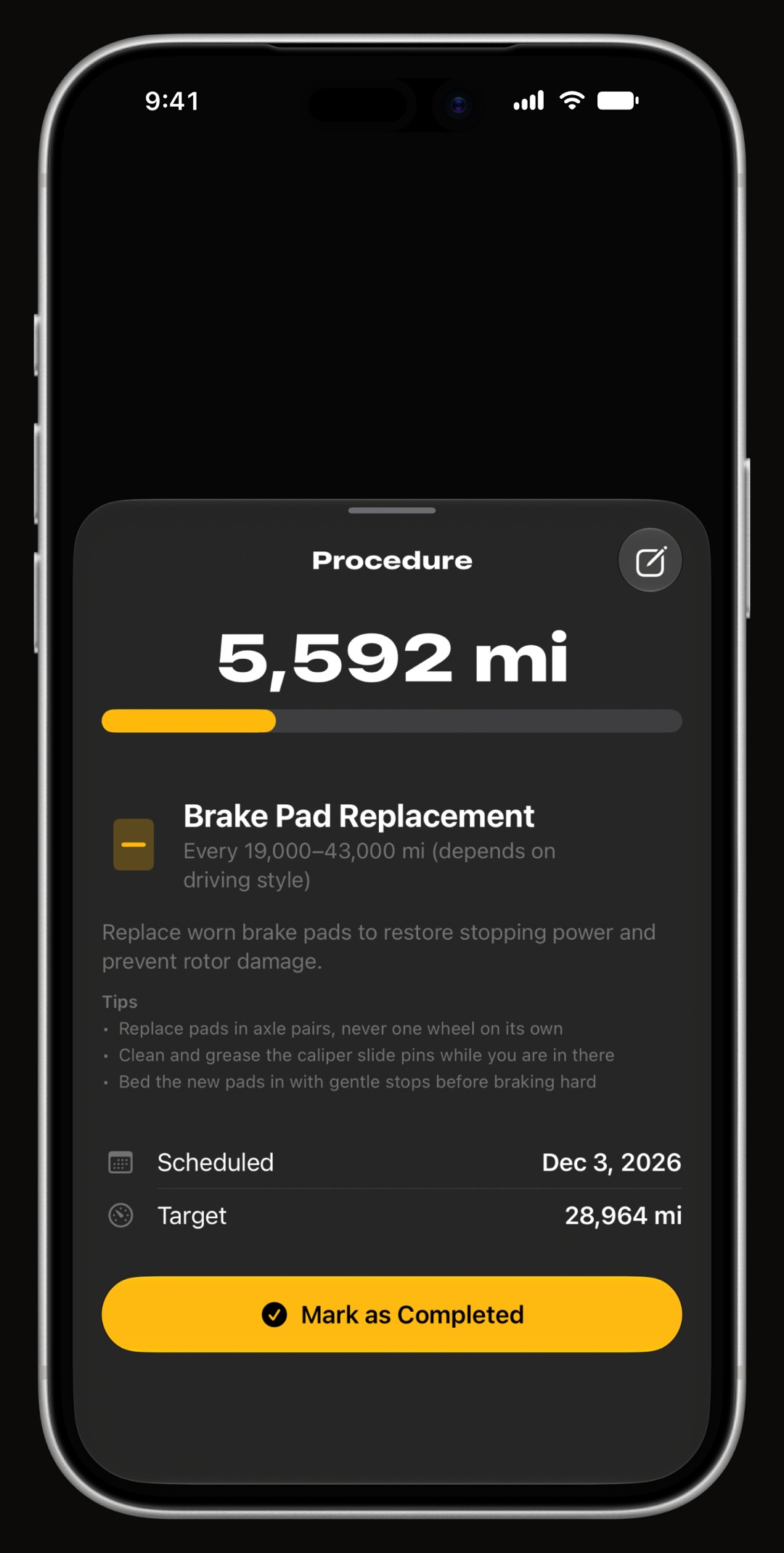
WrenchTime, an iPhone app for vehicle maintenance, fuel and trips, schedules an oil change by date, by distance or both, and treats whichever comes first as the one that matters.
| Miles driven a year | Schedule | Limit reached first | Oil changes a year |
|---|---|---|---|
| 6,000 | 8,000 miles or 12 months | 12 months, at 6,000 miles | 1 |
| 6,000 | 5,000 miles or 6 months (severe) | 6 months, at 3,000 miles | 2 |
| 12,000 | 8,000 miles or 12 months | 8,000 miles, after 8 months | 1.5 (3 every 2 years) |
Example calculation from the schedules in Hyundai's 2023 Santa Fe Hybrid Quick Reference Guide.
In WrenchTime the oil change is a procedure in the Care tab, scheduled by date, by distance or both, with a reminder on the date or at the odometer reading. The vehicle card shows an oil life bar derived from the distance and the time since the last oil change, so a hybrid that is out of months but not out of miles still shows up. Make it a recurring series and completing one change queues the next.
Completing an oil change records the date, the odometer and the cost. WrenchTime counts mild, full and plug-in hybrids among its 11 engine types and hides what does not apply, so an electric car is never offered an oil change. The free version covers 1 vehicle and 2 maintenance entries a month. The guide on how to schedule maintenance and reminders in WrenchTime walks through the screens.
Yes. A hybrid has a petrol engine, and the US Department of Energy notes that hybrids and plug-in hybrids need similar maintenance to conventional cars for that reason. Follow the maintenance schedule or the oil life monitor, by miles and by months, whichever comes first.
At the interval in the car's schedule. Hyundai and Kia hybrid manuals list 8,000 miles or 12 months, and 5,000 miles or 6 months in severe use; Honda and Ford use an oil life monitor, with at least one change a year on a Honda.
Only where the maker says so for that engine. Toyota's 2014 guidance allowed 10,000 miles on engines requiring 0W-20 synthetic, the 2010 to 2014 Prius among them, and cut it to 5,000 miles for towing, extensive idling or repeated short trips below freezing.
Yes. Hyundai's 2026 plug-in hybrid manual keeps the same 8,000 miles or 12 months as its hybrids. An engine that rarely reaches its operating temperature is hard on its oil, so the 12-month limit applies however little the engine ran.
Not by itself. Kelley Blue Book puts a synthetic oil change at $65 to $125 and a conventional one at $35 to $75; a hybrid that requires synthetic oil sits in the first range, like any car that requires it.
No special hybrid oil is required: Mobil states Toyota hybrids take the same oil as non-hybrid Toyotas. What matters is the grade and specification in the manual, often a thin one such as 0W-20 or 0W-16.
More from the blog
Hybrids
A hybrid needs the same servicing as a petrol car plus a few hybrid-only checks, mainly the battery's cooling intake and the inverter coolant, and it usually costs no more to maintain.
Engine oil
Follow the manual or the oil life monitor: often 7,500 to 10,000 miles or 6 to 12 months, whichever comes first, with Toyota, Subaru, Ford, GM, Honda and Hyundai side by side.
Hybrid battery
A hybrid battery usually lasts at least 10 years or 100,000 to 150,000 miles. Lab data, UK warranty terms, replacement costs and the warning signs to watch.

Free to download. One vehicle, real features, no ads. Your garage will thank you.
Download WrenchTime on the App Store