Engine oil
How often should you change your car oil?
Follow the manual or the oil life monitor: often 7,500 to 10,000 miles or 6 to 12 months, whichever comes first, with Toyota, Subaru, Ford, GM, Honda and Hyundai side by side.
Winter
Let a modern car idle for about 30 seconds, then drive off gently: fueleconomy.gov, the US government's fuel economy site, says most manufacturers recommend exactly that, because the engine warms faster on the road than at idle. Fully warming up takes far longer than the idle. In 62 logged cold starts of one Seat Leon (KIT Automotive OBD-II Dataset), the coolant never reached 80 °C within 5 minutes, and needed a median 13.4 minutes of driving at 0 to 10 °C.
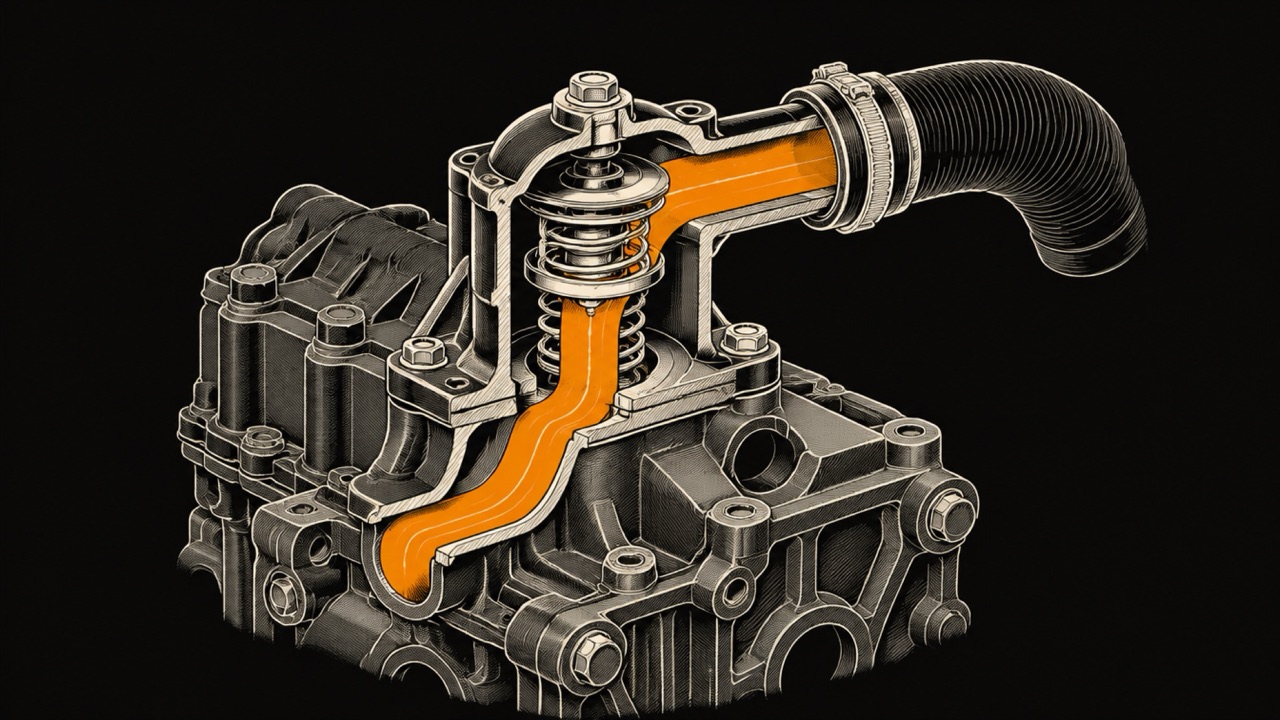
How long you should let your car warm up is about 30 seconds for a modern fuel-injected engine, then drive off gently. Fueleconomy.gov, run by the US Department of Energy and the EPA, says most manufacturers recommend driving off gently after about 30 seconds, and that warming up before a trip lowers fuel economy because idling gets 0 mpg.
Consumer Reports (updated February 2026) gives the reason: an engine is fully lubricated within 20 to 30 seconds, and the fastest way to warm it up is by driving. It calls a minute of running on a cold day smart, mostly for the cabin and the windscreen, and warns against revving the engine hard for the first few minutes.
AAA puts it in everyday terms: idle about as long as it takes to buckle the seatbelt and adjust the mirrors, a little longer in very cold weather. The long idle many drivers remember belongs to older cars without fuel injection, for which AAA still suggests two to three minutes.
| Source | Advice | Condition | Why it matters |
|---|---|---|---|
| fueleconomy.gov (DOE/EPA) | Drive off gently after about 30 seconds | Most cars, any season | Idling gets 0 MPG and warms the engine slowly |
| Consumer Reports, 2026 | About a minute, then drive without hard revving | A cold day | The engine is lubricated within 20 to 30 seconds |
| AAA | As long as it takes to buckle up and set the mirrors | Modern cars | Longer idling wastes fuel and adds emissions |
| AAA | 2 to 3 minutes | Older cars without fuel injection | Carbureted engines run poorly cold |
| National Park Service | No idling; drive at moderate speed | Above 0 °C (32 °F) | Driving warms the engine and the rest of the car |
| National Park Service | Up to 30 seconds | -18 °C to 0 °C (0 °F to 32 °F) | Lets the oil circulate fully |
| National Park Service | Up to 1 to 3 minutes | Below -18 °C (0 °F) | Oil is thicker and defrosting takes longer |
Sources: fueleconomy.gov, Consumer Reports (February 2026), AAA, National Park Service idle-free guidance (April 2025), all accessed November 2026.
An engine takes far longer than 30 seconds to reach operating temperature, the coolant temperature its thermostat holds once it is warm. We measured it in the Automotive OBD-II Dataset published by Marc Weber at the Karlsruhe Institute of Technology (DOI 10.35097/1130, CC BY 4.0): 81 logged trips of one Seat Leon around Karlsruhe and Stuttgart, from July 2017 to April 2018, with coolant, outside temperature and speed.
Our analysis counts a trip as a cold start when the coolant read 35 °C or less at engine start, which 62 of the 81 did, and groups them by the outside temperature in the first two minutes. Once warm, this engine settled at about 94 °C. The clock starts when the engine starts, and the car was driving for most of the warm-up: it stood still for about a fifth to a quarter of the time.
The result is a matter of minutes, not seconds. In mild weather above 10 °C the coolant reached 80 °C after a median 9.5 minutes and about 2.7 miles (4.4 km) of driving. Between 0 and 10 °C it took a median 13.4 minutes and 5.4 miles (8.7 km). Part of the summer advantage is a warmer start: the coolant began at 17 to 34 °C rather than 8 to 18 °C.
| Outside temperature | Cold starts | To 60 °C | To 70 °C | To 80 °C | Reached 80 °C | Distance to 80 °C |
|---|---|---|---|---|---|---|
| Below 0 °C | 9 | 11.3 min (5.5-21.5) | 13.9 min (8.2-24.9) | 12.6 min (9.2-33.6), trips that got there | 5 of 9 | 5.5 mi (8.8 km) |
| 0 to 10 °C | 23 | 10.0 min (6.5-16.1) | 12.0 min (8.2-18.7) | 13.4 min (9.8-20.4) | 23 of 23 | 5.4 mi (8.7 km) |
| Above 10 °C | 30 | 6.1 min (4.3-15.2) | 7.6 min (5.4-23.2) | 9.5 min (6.0-31.9) | 29 of 30 | 2.7 mi (4.4 km) |
Source: our analysis of the Automotive OBD-II Dataset, Marc Weber, Karlsruhe Institute of Technology, DOI 10.35097/1130, licensed CC BY 4.0. Cold start: coolant at 35 °C or less when the engine started. Outside temperature: the car's own ambient sensor, median of the first two minutes. Observed outside temperatures were -9 °C to -1 °C, 0 °C to 8 °C and 11 °C to 25 °C.
In winter, idle the car for up to 30 seconds and then drive; below -18 °C (0 °F), the US National Park Service's idle-free guidance allows one to three minutes, because cold oil is thicker and the windows take longer to clear. What a winter idle cannot do is warm the engine: in the KIT logs, fewer than half of the below-freezing cold starts were warm after 15 minutes of driving.
Not one of the 62 logged cold starts reached 80 °C within 5 minutes, in any weather. Within 10 minutes, one of nine starts below 0 °C got there and one of 23 between 0 and 10 °C, against 17 of the thirty warm-weather starts. By 15 minutes, eighteen of 23 mild-winter starts were warm, but only four of the nine below freezing.
Short winter trips often never warmed up at all. Four of the nine below-freezing cold starts ended before the coolant reached 80 °C: three trips of 6.8 miles (11 km) within Karlsruhe, lasting 21.7 to 26.7 minutes, and one of 8.8 miles (14.1 km) in 16.3 minutes. The coldest, at -9 °C, finished at 64 °C after 24.8 minutes. Between 0 and 10 °C, trips on the same Karlsruhe route did warm up, in 13.6 to 16.3 minutes.
| Outside temperature | Within 5 minutes | Within 10 minutes | Within 15 minutes | Why it matters |
|---|---|---|---|---|
| Below 0 °C | 0 of 9 | 1 of 9 | 4 of 9 | A short winter trip can end with the engine still cold |
| 0 to 10 °C | 0 of 23 | 1 of 23 | 18 of 23 | Most of a 15-minute commute is driven below operating temperature |
| Above 10 °C | 0 of 30 | 17 of 30 | 26 of 29 | Even in summer, warm-up takes minutes, not seconds |
Source: our analysis of the Automotive OBD-II Dataset (Marc Weber, KIT, DOI 10.35097/1130, CC BY 4.0). Each share counts the trips that lasted at least that long or reached the temperature first, which is why one cell reads 26 of 29.
A car warms up faster driving than idling, because a moving engine burns more fuel and makes more heat than one ticking over in a driveway. The carOBD dataset, published with the master's thesis "Detecting Anomalies in the Engine Coolant Sensor Using One-Class Classifiers", logged a 2014 Toyota Etios with a 1.5-litre engine once a second, both parked with the engine running and on the road.
Our analysis took every start with the coolant at 35 °C or less. Parked at idle, the Etios reached 80 °C after a median 7.3 minutes across eighteen starts; driven, it got there after a median 4.8 minutes across 26 starts. Idling took about 50% longer, two and a half minutes more, and the car went nowhere in that time.
The Etios warmed faster than the Seat Leon in every case because it was a different, smaller engine in a warm climate: its coolant started at about 26 to 28 °C, close to the outside air. The comparison that matters is inside the same car, idle against driving, and there driving won in every measure.
| Mode | Cold starts | To 70 °C | To 80 °C | To 85 °C |
|---|---|---|---|---|
| Parked, engine idling | 18 | 5.1 min (4.1-5.8) | 7.3 min (6.2-8.9) | 8.7 min (7.3-10.1) |
| Driving | 26 | 3.5 min (2.2-4.8) | 4.8 min (2.9-6.7) | 5.4 min (3.4-7.8) |
Source: our analysis of the carOBD dataset (Toyota Etios 2014, 1 Hz OBD-II logs), shared free to everyone by its author, who asks that the IEEE paper "Detecting Anomalies in the Engine Coolant Sensor Using One-Class Classifiers" be cited. Driving: moving at least half the time before 80 °C. One idle log and one drive log ended before 80 °C and are not in those medians.
Engine oil warms up more slowly than the coolant, so the temperature gauge reads warm before the oil is. A University of Leeds study (Li et al., SAE paper 2005-01-3896) fitted a petrol car built to the first Euro emissions standard of the early 1990s with thermocouples and drove it in real city traffic at -2 to 32 °C. The coolant was fully warm after about 5 minutes in summer and 9 minutes in winter; the oil after about 10 minutes and 14 minutes.
The same study found the catalytic converter reached light-off, the temperature at which it starts cleaning the exhaust, after about 3 minutes in summer and 6 minutes in winter, and concluded that catalysts do little on short city trips in cold weather. It is one car of an old design, so the minutes are an illustration of the order of events, not a figure for a modern engine.
Most dashboards show coolant temperature, not oil temperature, and the KIT and carOBD logs measured coolant only. The practical rule follows from the order: drive gently until the gauge has been at its usual position for several minutes, because the oil is still catching up.
Warming up a car by idling wastes fuel: idling gets 0 mpg, and fueleconomy.gov puts the burn at a quarter to a half US gallon per hour, about 0.9 to 1.9 litres, depending on engine size and air conditioning. As an example calculation, a 20-minute idle on a winter morning uses about 0.3 to 0.6 litres, and the car is still not fully warm when it pulls away.
Cold weather costs fuel even without the idle, because the engine spends longer below its efficient temperature. Fueleconomy.gov says a petrol car's city fuel economy is roughly 15% lower at -7 °C (20 °F) than at 25 °C (77 °F), and up to 24% lower on 3- to 4-mile trips. The KIT logs show why short trips suffer most: below freezing, the engine was not warm until about 5.5 miles (8.8 km) into the drive.
Turning the engine off is cheaper than idling for anything longer than a short stop. Fueleconomy.gov says a restart takes about 10 seconds' worth of fuel, so a car left running while you scrape the windows burns more than one restarted after you finish.
It is okay to drive before the car is fully warmed up, as long as you drive gently. Consumer Reports says the engine is fully lubricated within 20 to 30 seconds and the fastest way to warm it is to drive, without revving it hard for the first few minutes. In the KIT logs the Seat Leon did exactly that on every trip: it drove off and warmed up on the road.
Gentle means moderate throttle and engine speed, not full-throttle acceleration or high revs on the motorway slip road, until the temperature gauge has settled and a few more minutes have passed for the oil. The National Park Service adds that driving warms the parts idling cannot reach: wheel bearings, steering, suspension, transmission and tyres.
What does wear an engine is a life made of short cold trips, where the engine rarely gets warm enough to boil off the water and fuel that collect in the oil. Carmakers treat repeated short trips, especially in freezing weather, as severe service, which shortens the oil change interval.
Hybrids and electric cars do not need to warm up before driving, according to AAA, and idling them only wastes energy. A hybrid starts its petrol engine when it needs it, and an electric car has no engine oil to circulate.
Cold still matters to both. Fueleconomy.gov reports that hybrid fuel economy can drop about 30% to 34% in the cold, and an electric car loses range mainly to heating the cabin and the battery. The detail is in how much range an EV loses in the cold.
The warm-up figures on this page are real measurements, but each dataset covers one car. Read them as the shape of a warm-up, minutes rather than seconds and longer in the cold, not as the exact time your engine needs.
Here is an example routine for a petrol car parked outside on a -7 °C morning, built from the advice and the logs above. Shift it with the temperature: above 0 °C there is no reason to idle, and below -18 °C the idle can stretch to a few minutes. The full seasonal list is in the winter car maintenance checklist.
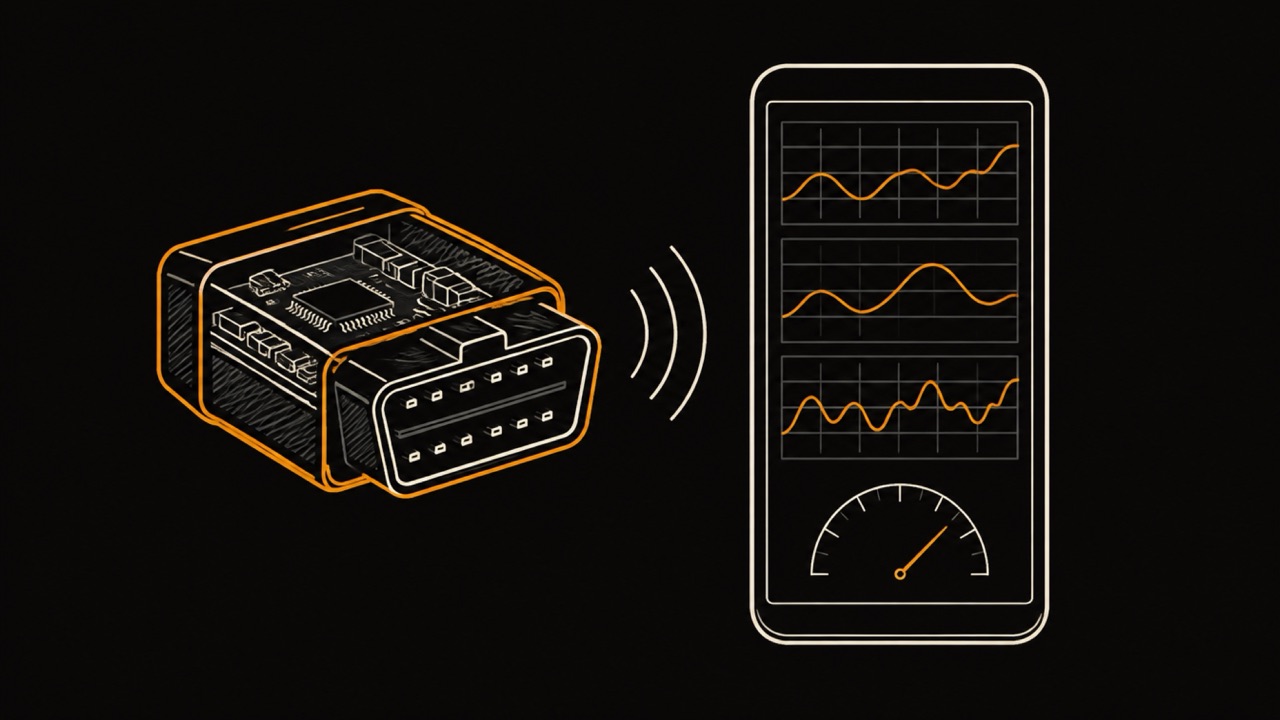
Your own engine's warm-up is easy to measure with a Bluetooth OBD-II adapter, because coolant temperature is a standard OBD-II reading. WrenchTime, an iPhone app for car and motorcycle logs, reads it from a BLE ELM327-compatible adapter or the OBDLink MX+, and also reads oil temperature where the car declares it.
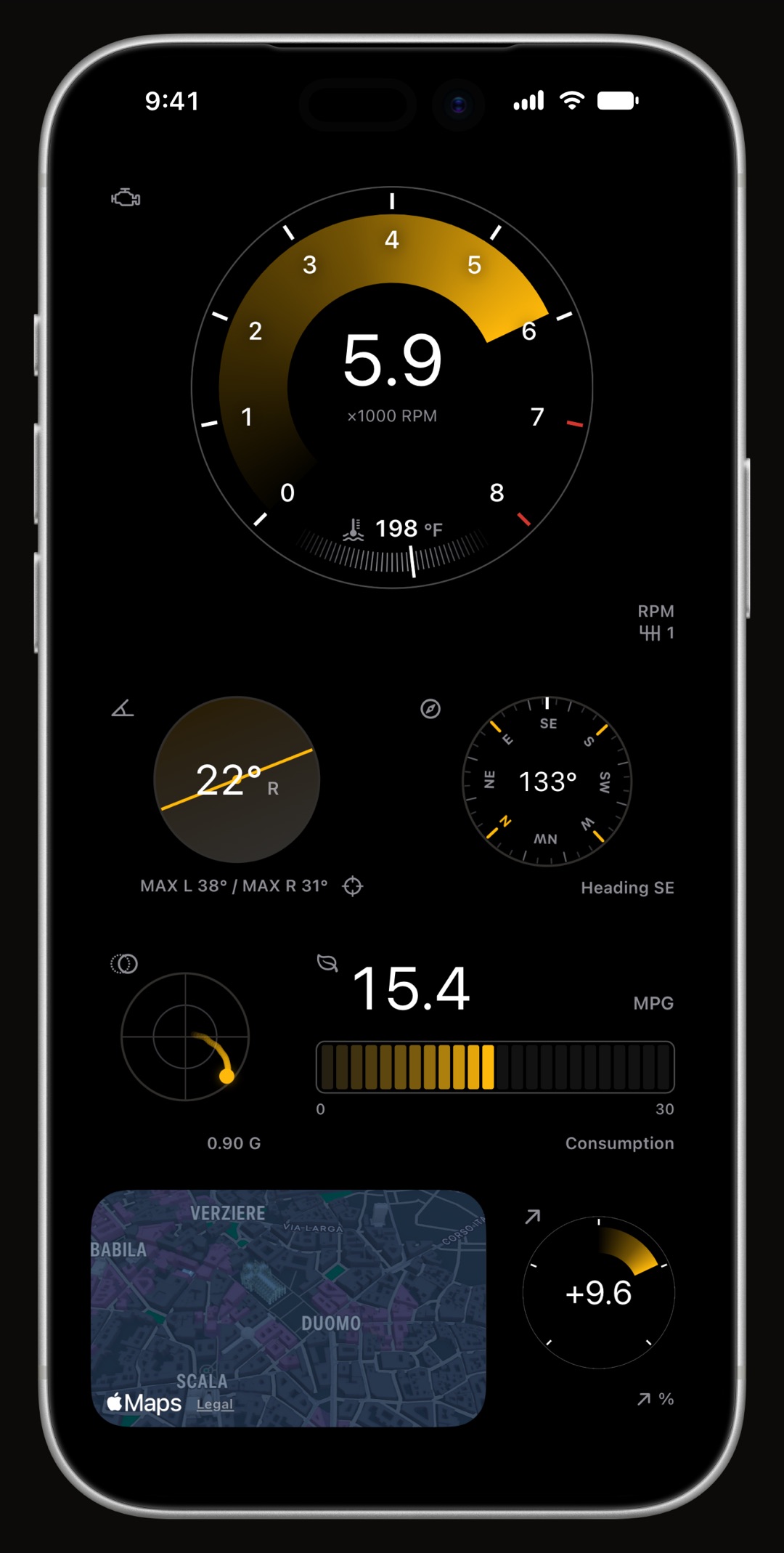
Put coolant temperature on a signal card of the full-screen Live dashboard and you watch the warm-up as you drive; the free version gives you 3 instruments on the first page, and OBD-II live data is free. Each recorded trip also keeps every reading at one sample per second, so the curve can be read afterwards, the same way an OBD2 data logger works. The car dashboard app guide shows the board.
Idling for 20 minutes wastes fuel and warms the engine more slowly than driving. Using fueleconomy.gov's quarter to half US gallon per hour (about 0.9 to 1.9 litres), it burns about 0.3 to 0.6 litres. On a Toyota Etios in the carOBD logs, idling took about 50% longer to reach 80 °C than driving.
Below -18 °C (0 °F), give it a little longer. The US National Park Service's idle-free guidance allows one to three minutes below -18 °C, because the oil is thicker and the windows take longer to clear. Between -18 °C and 0 °C it allows up to 30 seconds, and above 0 °C no idling at all.
Yes. Idling gets 0 mpg, says fueleconomy.gov, and a petrol car's city fuel economy is about 15% lower at -7 °C (20 °F) than at 25 °C (77 °F), up to 24% lower on 3- to 4-mile trips, because the engine spends longer below its efficient temperature.
Yes, if you drive gently. Consumer Reports says the engine is fully lubricated within 20 to 30 seconds and the fastest way to warm it is to drive, without revving hard for the first few minutes. In the KIT logs the car warmed up on the road on every trip.
Only for about 30 seconds, plus the time it takes to clear the windows. A fuel-injected engine does not need a long idle; AAA reserves two to three minutes for older cars without fuel injection. Real warm-up happens on the road and takes 10 minutes or more in cold weather.
More from the blog
Engine oil
Follow the manual or the oil life monitor: often 7,500 to 10,000 miles or 6 to 12 months, whichever comes first, with Toyota, Subaru, Ford, GM, Honda and Hyundai side by side.
Winter
Before the first freeze, test the battery, fit winter tyres below 7°C (45°F), check the antifreeze, wipers and oil, then wash road salt off the underbody all season.
OBD2
What an OBD2 data logger records, the kinds there are, how often to sample, which signals to keep on every trip and how to read the log afterwards.
Free to download. One vehicle, real features, no ads. Your garage will thank you.
Download WrenchTime on the App Store