CarPlay
CarPlay gauges: live OBD2 data on your car screen
How to see live OBD2 readings such as RPM, boost and coolant temperature on CarPlay, why most apps show a list, which apps draw gauges, and which adapters work with iPhone.
Gauges
Aftermarket car gauges are add-on instruments, often 52 mm (2-1/16 in.) dials, that read a sensor of their own: an oil pressure sender, a temperature sender or a wideband oxygen sensor wired to the gauge. Buy them for a reading your car's computer does not report, such as oil pressure, which has no standard OBD-II PID. For what it does report, coolant temperature, intake manifold pressure, voltage and, on some cars, oil temperature, an OBD2 adapter and an app show the same reading with no drilling. A triple gauge kit was $52.99 (a US price) at Summit Racing in November 2026.
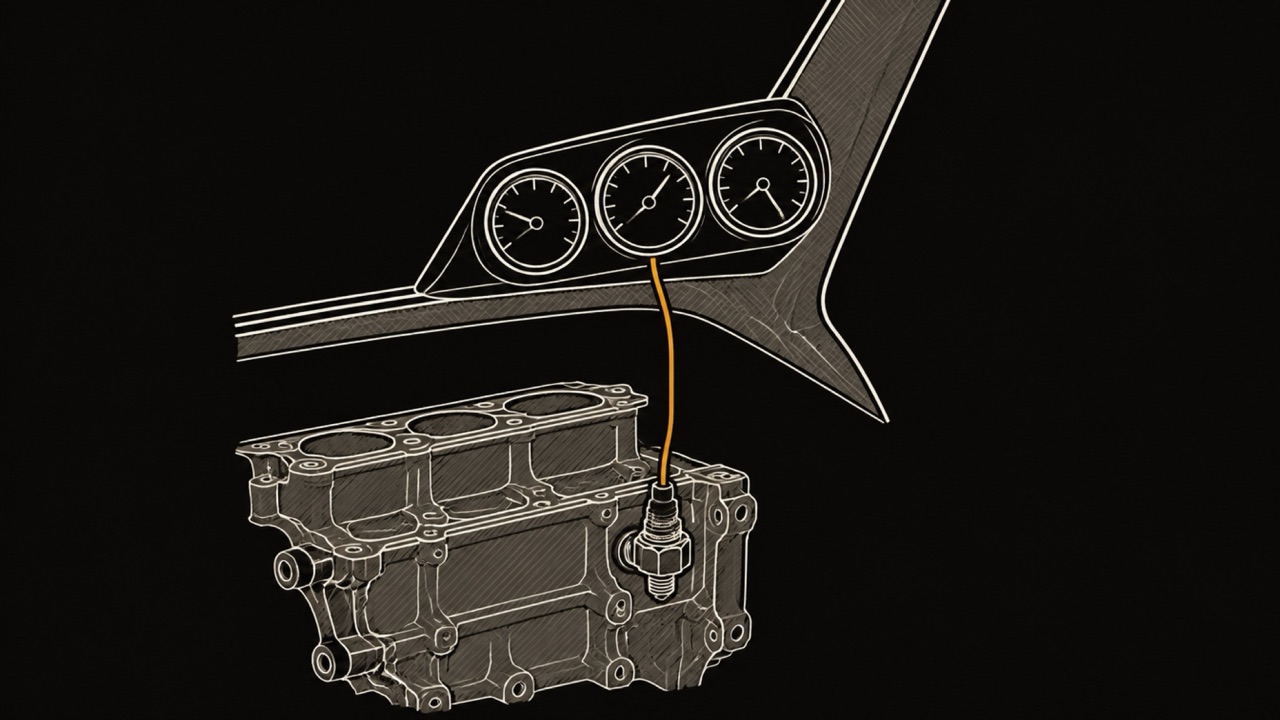
Aftermarket car gauges are instruments added to a car beside or below the factory cluster, each reading one quantity: oil pressure, coolant temperature, boost, voltage or air-fuel ratio. Most are round dials. According to Speedhut's size chart, common sizes include a 52 mm hole, for 2-1/16 in. gauges, and a 67 mm hole, for 2-5/8 in. gauges.
A sender is the sensor an aftermarket gauge reads: a small threaded part screwed into the engine whose resistance or voltage changes with pressure or temperature. An electric gauge reads the sender through a wire. A mechanical gauge reads the pressure itself through a tube into a Bourdon tube, a curved metal tube that straightens under pressure and moves the needle; Summit Racing lists the Equus 6000 Series triple kit with a solid brass Bourdon tube movement.
The defining trait of an aftermarket gauge is independence: it measures with its own hardware rather than asking the car's engine computer. That is its strength for readings the computer never shares, and its cost: every gauge brings a sender to fit, a fitting to find and wires to route.
An electric aftermarket gauge needs a sender, a mount and four connections. The ProSport installation sheet for its oil pressure and water temperature gauges calls for an eighth-inch NPT sender in the engine, an 18-gauge signal wire from the sender to the gauge, switched 12 V accessory power, a chassis earth and an illumination wire to a 12 V headlight source.
The Equus 8200 instructions describe the same steps for a gauge kit: the gauge goes through a panel or dash hole and is held by a U-bracket, power comes from a point that is hot only with the ignition on, earth goes to bare metal, and the light wire is spliced into an instrument lamp circuit controlled by the headlight switch.
Finding a port for the sender is the hard part on a modern engine. Equus tells installers to use a T-fitting when the port is already taken, because some vehicles use their temperature and pressure sensors for engine control and those must stay connected. Equus also warns that a temperature gauge on a T-fitting reads lower than the actual water temperature.
Aftermarket car gauges range from about $50 for a budget triple kit to about $300 for a single wideband gauge, before fittings and labour. The prices below are US prices, listed by US retailers on 22 November 2026, and change often. A single premium dial such as the AutoMeter Z-Series sells for about $120 at Summit Racing, and a pressure or temperature dial also needs its sender bought separately.
Example calculation: a car owner who wants oil pressure, water temperature and voltage plus an air-fuel ratio reading would pay $52.99 for the Equus E5200 triple set and $230.95 for the AEM 30-0300 wideband kit, $283.94 in parts, before a pod, fittings and the time to fit two senders and run the wiring.
| Product | Type | Size | Price (US) | Why it matters |
|---|---|---|---|---|
| Equus 5000 Series E5200 | Electric triple set: oil pressure, voltage, water temperature | 51 mm (2.0 in.) | $52.99 | The cheapest way to add the three classic readings |
| Equus 6000 Series E6100 | Mechanical triple set, Bourdon tube movement | 38 mm (1-1/2 in.) | $49.99 | Reads oil pressure directly, with no electronics in between |
| AutoMeter Z-Series 2632 | Single premium dial (a clock), no sender | 52 mm | $122.39 | Shows the price level of one premium dial before its sender |
| AEM X-Series 30-0300 | Wideband AFR gauge with its own Bosch 4.9LSU sensor | 52 mm | $230.95 | The air-fuel ratio a factory narrowband sensor cannot give |
| AEM X-Series 30-0334 | Wideband AFR gauge with OBDII connectivity | 52 mm | $299.95 | Sends the reading onto the car's network for tuning software |
| Holley EFI 553-130 | CAN vacuum and boost gauge for Holley EFI, needs gauge module 554-130 sold separately | 52 mm (2-1/16 in.) | $249.95 | Reads the aftermarket ECU instead of a second sender |
| ScanGauge 3 | Plug-in OBD-II display, up to nine gauges | Separate unit | $269.95 | Shows the car's own readings with no sender and no phone |
Sources: Summit Racing (E5200, E6100, 2632), SDPC (30-0300, 30-0334, 553-130), Camping World (ScanGauge 3).
Every petrol car and light truck sold in the US since the 1996 model year has OBD-II, and diesels since 1997, according to the California Air Resources Board. Beyond trouble codes, the port answers live readings called PIDs, parameter IDs defined by the SAE J1979 standard, as the CSS Electronics PID table explains.
Many readings people buy gauges for are standard PIDs. The OBD-II PID reference lists coolant temperature, intake manifold absolute pressure from 0 to 255 kPa, engine RPM, vehicle speed, barometric pressure, control module voltage, engine oil temperature and the measured and commanded lambda, where the car reports them. A guide to what a normal coolant temperature is covers the first of those.
Oil pressure is the gap: no service 01 PID is defined for engine oil pressure. Manufacturers add PIDs of their own, and not every car supports every standard one; PIDs 00, 20 and 40 are bitmasks in which the car declares which PIDs it answers. A car that does not support oil temperature will not report it, however good the app.
Boost is not a PID by itself. A MAP sensor reads absolute pressure, so boost is the manifold pressure minus atmospheric pressure, about 100 kPa at sea level, as the MAP sensor entry puts it. An app that reads both manifold and barometric pressure from the port can show boost without a boost gauge's vacuum line.
| Reading | Standard OBD-II PID | Aftermarket gauge needed? | Why it matters |
|---|---|---|---|
| Coolant temperature | 05 | No, where the car declares it | The reading behind most temperature gauges is already on the port |
| Intake manifold pressure and boost | 0B, with 33 for barometric pressure | No, if the car reports both | Boost is manifold pressure minus atmospheric pressure |
| Engine RPM | 0C | No | A tachometer reading is a standard PID |
| Vehicle speed | 0D | No | The car's own speed signal, independent of GPS |
| Control module voltage | 42 | No, where the car declares it | Shows the charging system without a voltmeter |
| Engine oil temperature | 5C, where supported | Only if the car does not declare it | Supported on some cars, missing on others |
| Air-fuel ratio (lambda) | 34 to 3B and 44, where supported | Yes, if the car does not report it | Tuning needs a wideband sensor the car may not have |
| Fuel pressure | 0A, where supported | Only if the car does not declare it | Not to be confused with oil pressure |
| Engine oil pressure | None | Yes | No standard PID exists, so a sender and gauge are the usual route |
Source: OBD-II PIDs, service 01 table, seen 22 November 2026.
A sender-based gauge kit is the right choice when the reading you want is not on the port. Oil pressure is the common case: it has no standard OBD-II PID, so a sender in the oil gallery and a gauge are how most owners see it. A mechanical oil pressure gauge also keeps working with no electronics in between.
A gauge kit is also the only option on a car built before OBD-II, which CARB dates to the 1996 model year for petrol vehicles. Classic and project cars, race cars with the factory computer removed and engines swapped into older bodies all fall here. The trade-off is installation: a port for each sender, a T-fitting where one is taken, and wiring behind the dash.
A wideband air-fuel ratio gauge is the right choice when you tune an engine and need the air-fuel ratio across the whole range. A wideband oxygen sensor measures how rich or lean the mixture is over a wide span, where a factory narrowband sensor only reports rich or lean around the ideal ratio. SDPC lists the AEM X-Series 30-0300 with its own Bosch 4.9LSU sensor, reading 8.0:1 to 20.0:1 on petrol.
The OBDII version of that gauge, the AEM 30-0334, plugs into the port and simulates an auxiliary ECU signal, so tuning software sees the air-fuel ratio on the car's network. An app can show lambda only when the car itself carries a wideband sensor and reports it. The conversion between the two scales is in the guide to lambda to AFR.
A plug-in OBD2 gauge display is the right choice when you want the car's own readings on a small screen that stays in the car, with no phone and no app. Camping World lists the ScanGauge 3 at $269.95: it plugs into the OBD-II connector on a 1.8 m (6 ft) cord, shows up to nine gauges at once, reads and clears trouble codes, and works with 1996 and newer cars.
A plug-in display reads the same PIDs an app reads, so it has the same gap: no oil pressure unless the car reports it some other way. Its predecessor, the ScanGauge II, which showed four of twelve possible gauges at a time, is listed by ScanTool.net as no longer available.
An OBD2 app is the right choice when your car is 1996 or newer and the readings you want are among the standard PIDs it declares. A Bluetooth adapter plugs into the port under the dash, the app reads the engine computer, and nothing is drilled, spliced or screwed into the engine. The adapter comes out in seconds when you sell the car.
WrenchTime, a maintenance, fuel and trip log for iPhone, reads over fifty standard OBD-II parameters through a Bluetooth LE adapter or the OBDLink MX+, asking only for the ones the car declares. It draws them as gauges on WrenchTime Live, a full-screen dashboard of gauges you build from 23 instrument types, with your own range, caution and critical bands for each reading, per vehicle.
An app has limits a sender does not. It shows what the car's computer reports and nothing else, so no standard oil pressure; it needs an adapter that works with an iPhone, covered in which OBD2 adapters work with an iPhone; and readings refresh as fast as the car answers, up to eight times a second on the WrenchTime Live dashboard. A reading the car reports outside the standard list can be added as a custom PID.
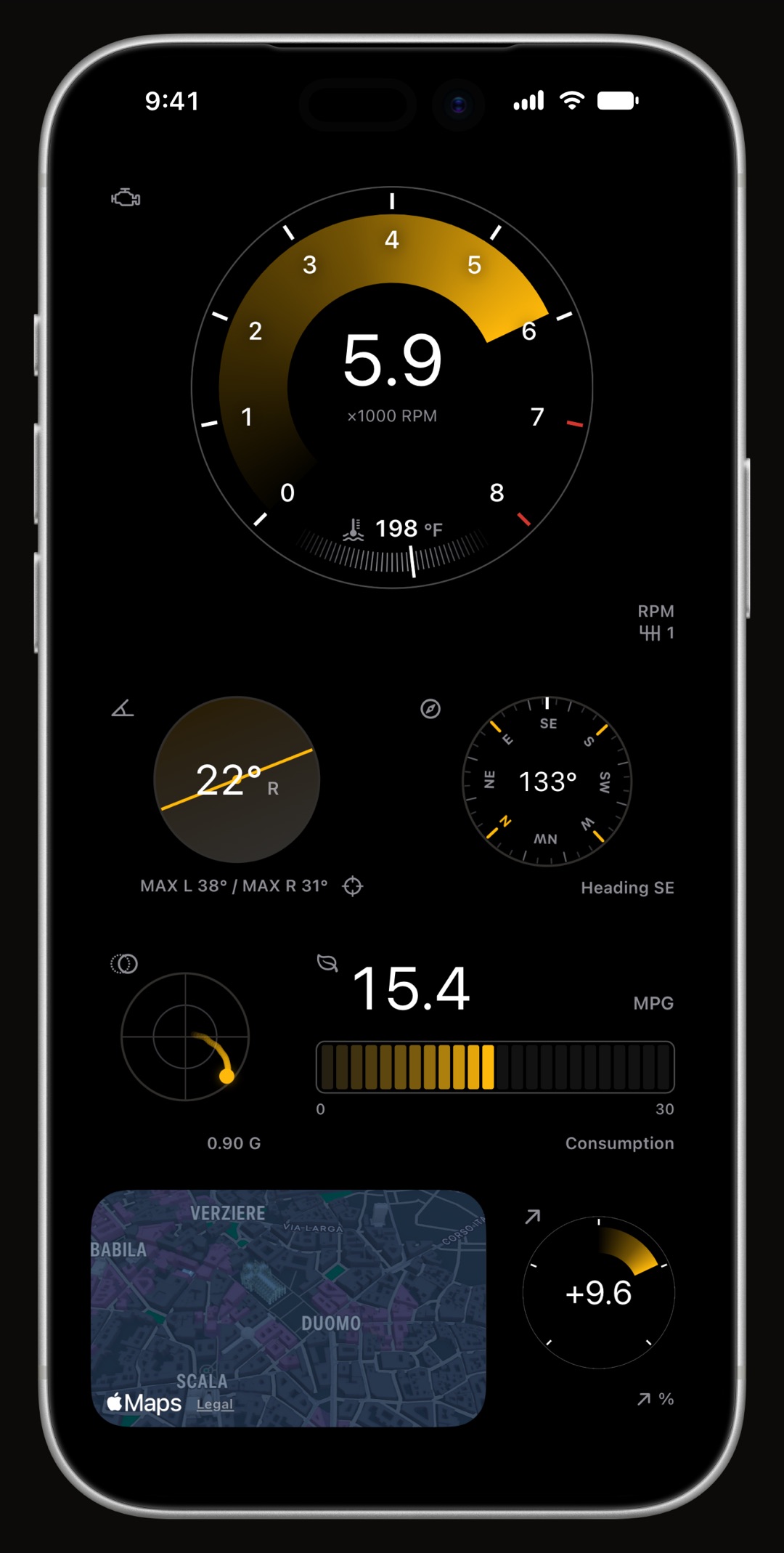
Digital gauges for a car are not more accurate than analogue ones by themselves: the source of the reading decides accuracy, and the display only decides how it is shown. An analogue needle shows a trend at a glance, a digital readout shows the exact figure, and many digital gauges draw both.
The bigger difference is where a digital gauge gets its data. Some read a sender like any analogue gauge, while others read a computer: SDPC lists the Holley EFI 553-130 boost gauge as reading a Holley EFI ECU, with no duplicate sending units required. An OBD2 app and a plug-in display belong to that second group, reading the car's own sensors through the port.
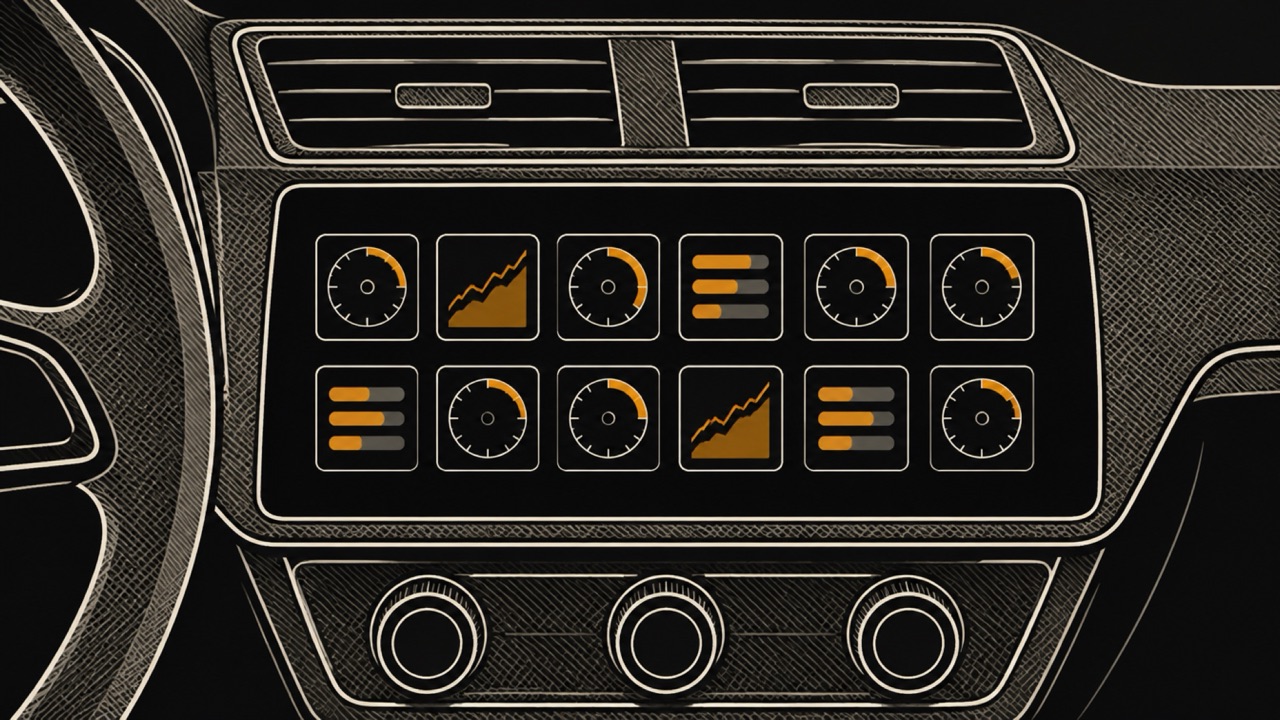
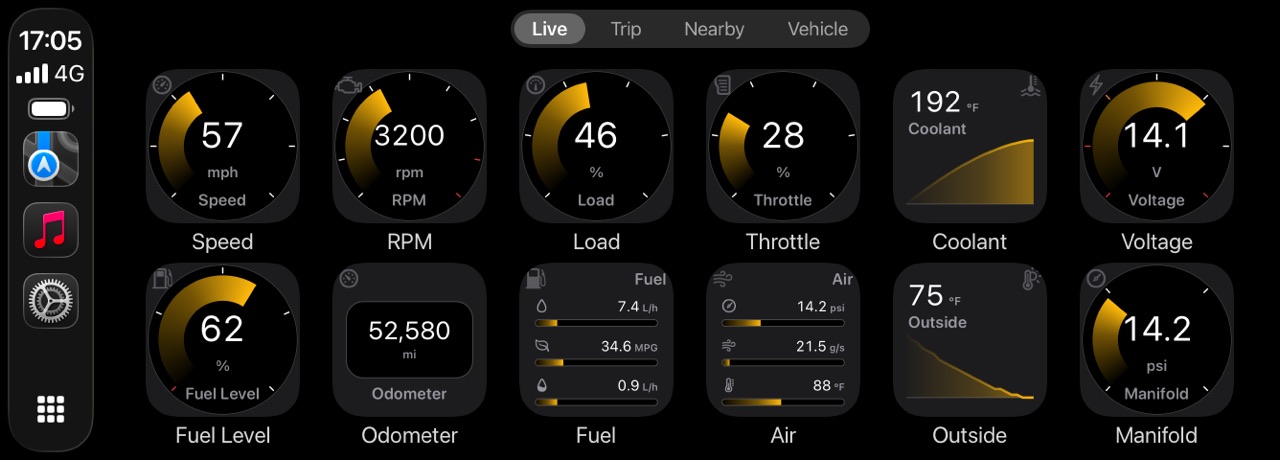
If the readings you want are coolant temperature, boost, RPM, voltage or the others your car declares, try them on the iPhone before buying gauges. OBD-II live data is free in WrenchTime, and the first WrenchTime Live page holds 3 instruments at no cost. With WrenchTime Pro the same readings sit on a CarPlay grid of ring gauges, drawn on the scale you set for that vehicle.
Equus, AutoMeter, AEM, Holley, ScanGauge, ProSport, Speedhut, Bosch, OBDLink, Apple, iPhone and CarPlay are trademarks of their respective owners. WrenchTime is not affiliated with them, and the prices quoted are retailer listings seen on 22 November 2026.
Only for readings the car's computer does not report. Coolant temperature, intake manifold pressure, RPM, speed and module voltage are standard OBD-II PIDs that most 1996 and newer cars report, so an adapter and an app can show them. Oil pressure has no standard PID and usually needs a sender and gauge.
Not through a standard PID: the SAE J1979 service 01 list includes engine oil temperature but no oil pressure. Some manufacturers expose it through PIDs of their own, which differ by make, so most owners who want an oil pressure reading fit a sender and a gauge.
In November 2026 an Equus E5200 triple set was $52.99 (US prices) at Summit Racing, an AEM X-Series wideband kit $230.95 at SDPC and a ScanGauge 3 plug-in display $269.95 at Camping World. Sender-based gauges also need fittings, wiring and time to install.
Common add-on car gauge sizes include a 52 mm hole, for 2-1/16 in. gauges, and a 67 mm hole, for 2-5/8 in. gauges, according to Speedhut's size chart. The same chart lists larger dials too, such as 3-3/8 in. (about 86 mm) and 4 in. (about 102 mm).
An electric gauge reads a sender whose resistance or voltage changes with pressure or temperature, wired to the gauge. A mechanical gauge reads pressure directly through a tube into a Bourdon movement. An OBD2 app reads the value the engine computer has already measured with the car's own sensors.
OBD2 gauges show what the car's own sensors measure, the same values the engine computer uses, refreshed as fast as the car answers. A separate sender can read differently: Equus warns that a temperature gauge mounted on a T-fitting reads lower than the actual coolant temperature.
More from the blog
CarPlay
How to see live OBD2 readings such as RPM, boost and coolant temperature on CarPlay, why most apps show a list, which apps draw gauges, and which adapters work with iPhone.
OBD2 scanners
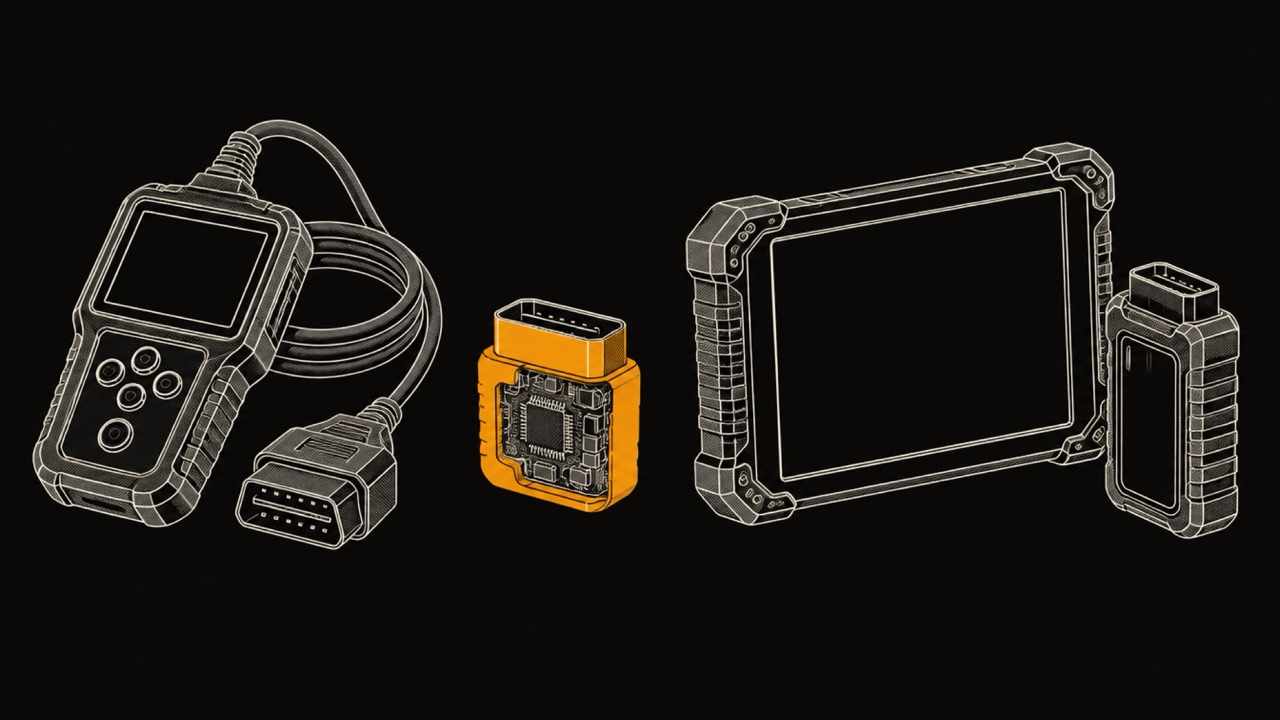
Which OBD2 scanner works with an iPhone, and which type to buy: a handheld code reader, a Bluetooth LE adapter and an app, an MFi adapter, or a scan tool.
Cooling system
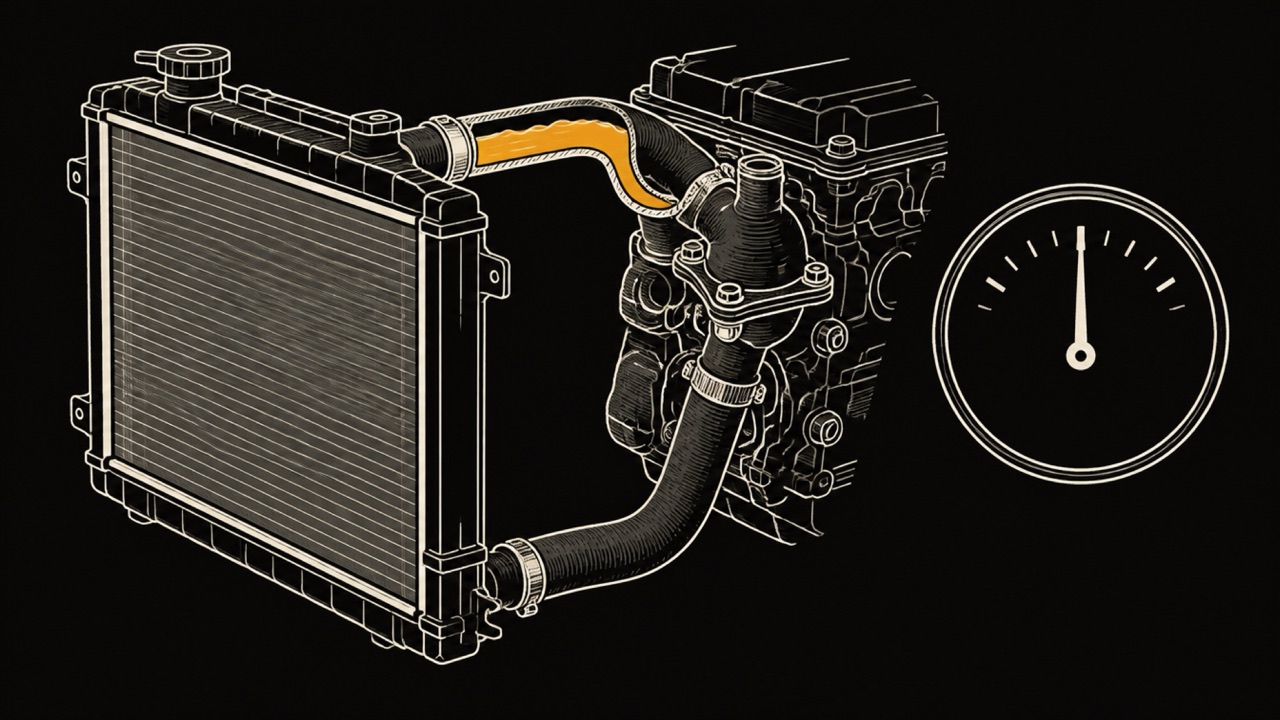
The normal coolant temperature range in °C and °F, why the gauge needle sits still, how hot is too hot and what a low reading means.
Free to download. One vehicle, real features, no ads. Your garage will thank you.
Download WrenchTime on the App Store