Winter storage
How to winterize a motorcycle: the 10-step storage checklist
To winterize a motorcycle, fill the tank and add fuel stabilizer, ride home so the treated fuel reaches the fuel system, change the oil and filter, then wash, dry and lubricate the motorcycle. Keep the battery on an automatic maintainer, or remove it and keep it charged indoors if the storage space drops below freezing, set the tires to the recommended pressure, lift the motorcycle on stands, and store it indoors under a breathable cover. The storage procedure in your owner's manual comes first: Harley-Davidson Insurance (2025) calls the manual the first reference for storage.
When should you winterize your motorcycle?
Winterize a motorcycle before it will stand unridden for a month or more, ideally before the first hard freeze and before road salt goes down. To winterize a motorcycle means preparing it so the fuel, battery, engine, tires and finish survive weeks or months without riding. No single outdoor temperature makes storage mandatory: the trigger is how long the motorcycle will stand, and how cold and damp the place it stands in gets.
The one-month mark comes from the fuel. The Maine Department of Environmental Protection (2019) advises against storing gasoline for more than 30 days without a stabilizer, so a motorcycle parked for a month or longer needs treated fuel. The same steps apply, whatever the season, to a motorcycle left at home during a long trip or a second motorcycle that stands most of the year.
What do you need to winterize a motorcycle?
Winterizing a motorcycle takes a short list of supplies, all sold at motorcycle shops and auto parts stores. Buy the engine oil and filter your owner's manual specifies, and check that the chain products are safe for O-ring and X-ring chains.
- Fuel stabilizer labeled compatible with gasoline containing ethanol. A fuel stabilizer is an additive that slows the aging of gasoline left standing in a tank.
- Engine oil and an oil filter in the grade and quantity of your owner's manual.
- An automatic battery maintainer also called a battery tender: a low-current charger built to stay connected for months and keep the battery charged without overcharging it.
- A voltmeter to read the battery's resting voltage during storage.
- A tire pressure gauge an accurate one, since the tires will sit at that pressure for months.
- Chain cleaner and chain lube both O-ring safe, or nothing extra on a belt or shaft drive.
- Wash and wax supplies with lint-free rags to dry the motorcycle completely.
- Stands a rear paddock stand, and a front stand if you have one, or the motorcycle's own center stand.
- A breathable cover made for indoor storage, not a plastic tarp.
- Exhaust and intake covers purpose-made plugs that keep animals out of the openings.
How to winterize a motorcycle: the 10-step checklist
Winterizing a motorcycle takes one afternoon in a garage. The 10-step checklist below runs in working order: the motorcycle is washed before the short ride to the pump, the oil is changed and the chain lubed while the ride has left them warm, and the cover goes on last. Each step has its own section further down with the reasons and the sources.
- Wash, dry and wax the motorcycle. Road salt, grime and bugs damage the finish over months of storage (Harley-Davidson Insurance, 2025). Dry it completely.
- Fill the tank and add fuel stabilizer at the pump. A full tank leaves less room for condensation; dose the stabilizer by its label.
- Ride home so the treated fuel circulates. On a carbureted motorcycle, drain the float bowls afterwards (AMA, 2020).
- Change the oil and filter while warm. Used oil holds contaminants that can damage bearings over the winter.
- Check brake fluid, clutch fluid and coolant. Replace fluid that is old or as dark as motor oil.
- Clean and lube the chain, or inspect the belt. The chain is still warm from the ride, which helps the lube work in.
- Protect the battery. Connect an automatic maintainer, or remove the battery and keep it charged indoors if the space drops below freezing.
- Set the tire pressure and lift the motorcycle on stands. Weight off the tires prevents flat spots.
- Block the exhaust and other openings. Purpose-made covers keep animals out; hang a reminder on the handlebar.
- Store it indoors under a breathable cover. Away from fertilizers and chemicals, in a ventilated space.
How to use fuel stabilizer when you winterize a motorcycle
Store a motorcycle with a full tank of stabilized fuel, not an empty one. Harley-Davidson Insurance (2025) says not to drain the tank: an empty tank invites corrosion and dried-out seals, and untreated fuel can harden and clog carburetors and fuel injectors. The American Motorcyclist Association (AMA, 2020) adds that filling the tank to capacity helps reduce condensation.
Add the fuel stabilizer at the pump, then ride home so the treated fuel circulates through the fuel system, as the AMA advises. Dose it by the label of the product you buy: the AMA gives about 1 ounce of stabilizer per 2 gallons of gasoline (roughly 30 mL per 7.6 liters) as the usual ratio. Pick a stabilizer labeled compatible with gasoline containing ethanol, which the Maine Department of Environmental Protection (2019) recommends.
On a carbureted motorcycle, also drain the float bowls. A float bowl is the small fuel reservoir in each carburetor; fuel left standing in it can leave varnish-like deposits, and the AMA calls draining the bowls the best way to prevent them. A fuel-injected motorcycle has no float bowls: with a full tank of stabilized fuel, in the AMA's words, "your job is done."
Should you change the oil before or after winter storage?
Change the motorcycle oil and filter before winter storage. Harley-Davidson Insurance (2025) warns that months in oil contaminated with solvents and sediments can damage bearings, and the AMA (2020) says to drain the old lubricant to remove acids and contaminants and to replace the oil filter too. Do the oil change right after the ride home from the pump, while the oil is warm and drains fully.
If the motorcycle stands for more than four months, Honda Canada suggests changing the oil again in spring. Mileage and time intervals for the rest of the year are covered in how often to change motorcycle oil.
Which fluids should you check before storing a motorcycle?
Check the brake fluid, the clutch fluid on a hydraulic clutch, and the coolant on a liquid-cooled motorcycle before storage. Brake fluid absorbs water over time: Harley-Davidson Insurance (2025) says DOT 4 brake fluid should be replaced every two years, and the AMA (2020) says brake or clutch fluid as dark as motor oil should be changed before storage.
For the coolant, the AMA (2020) recommends a floating-ball antifreeze tester, an inexpensive hydrometer that shows how much freeze protection the mix still gives, and replacing coolant that looks dirty. Coolant intervals for the rest of the year are covered in how often to change coolant.
How to prepare a motorcycle chain or belt for winter storage
Clean and lube a motorcycle chain just before storage, while it is warm. Harley-Davidson Insurance (2025) recommends cleaning and lubricating the chain every 500 miles of street riding, warming it first with about 5 miles of riding so the lube works into an O-ring chain. The ride home from the pump does that warming. The full chain cleaning and lubing routine covers the products and the steps.
A belt-drive motorcycle needs an inspection instead: Harley-Davidson Insurance says to check the belt for chips, cuts, fraying or missing teeth, and to confirm its tension against the specification in the owner's manual.
How to store a motorcycle battery over winter
Keep a motorcycle battery on an automatic maintainer for the whole storage period, or remove it and keep it charged indoors. Harley-Davidson Insurance (2025) recommends cleaning the terminals and leaving a tender or trickle charger connected all winter, or taking the battery inside on a tender if that is not possible. The AMA (2020) says to remove the battery if the storage space will likely fall below freezing, and to use a charger that keeps it above 12 V or a weekly low-amperage trickle charge.
A motorcycle battery stored without a maintainer needs checking. The Yuasa powersports battery technical manual (2014) says to disconnect the battery cable on a stored motorcycle to stop the current drain from its electrical equipment, to check a conventional battery every month and an AGM battery every three months, and to charge it when the resting voltage shows a low state of charge. Temperatures below 60°F (16°C) or above 80°F (27°C), it adds, may require more frequent checks or charging.
An AGM (absorbed glass mat) battery is a sealed lead-acid battery whose electrolyte is held in glass-fiber mats; it never takes water, and Yuasa checks it less often than a conventional battery. Heat hurts a stored battery as much as cold: in Yuasa's own example, an AGM battery stored at 32°F (0°C) holds 90% of its capacity for about six months, while the same battery stored at 104°F (40°C) loses 50% in four months.
The resting voltage of a 12-volt motorcycle battery tells its state of charge. On Yuasa's scale for a conventional battery, 12.6 V is a full charge and 12.4 V is already down to 75%, so a stored battery reading 12.4 V has lost a quarter of its charge and belongs on the charger before it falls further.
| State of charge | Resting voltage | Specific gravity |
|---|---|---|
| 100% | 12.60 V | 1.265 |
| 75% | 12.40 V | 1.210 |
| 50% | 12.10 V | 1.160 |
| 25% | 11.90 V | 1.120 |
| 0% | Under 11.80 V | Under 1.100 |
Source: Yuasa Technical Manual, Powersports Batteries (2014). Accessed October 15, 2026.
Can a motorcycle battery freeze in a cold garage?
A charged motorcycle battery will not freeze in an ordinary cold garage, but a discharged one can. The Yuasa technical manual (2014) explains that as a battery discharges, its electrolyte turns into mostly water: a fully charged battery does not freeze until about -75°F (-59°C), while a dead one freezes at 27°F (-3°C). Freezing can crack the case and buckle the plates, permanently damaging the battery.
That is why the state of charge of a stored motorcycle battery matters more than the temperature of the storage space. A battery kept on a maintainer, or brought indoors, stays far from its freezing point; a battery left disconnected and forgotten in an unheated garage slowly discharges toward it. Specific gravity, the density of the electrolyte measured with a hydrometer, is 1.265 on a fully charged conventional battery and falls as it discharges.
| Specific gravity | Freezing point (°F) | Freezing point (°C) |
|---|---|---|
| 1.265 (fully charged) | -75 | -59 |
| 1.225 | -35 | -37 |
| 1.200 | -17 | -27 |
| 1.150 | +5 | -15 |
| 1.100 | +18 | -8 |
| 1.050 | +27 | -3 |
Source: Yuasa Technical Manual, Powersports Batteries (2014), °F figures; °C converted and rounded. Accessed October 15, 2026.
How to prevent flat spots on motorcycle tires during storage
Inflate the tires to the manufacturer's recommended pressure and take the weight off them. Michelin (updated 2026) says a center stand or paddock stand removes weight from the tires and helps prevent flat spots, and that without a stand, rotating the tires periodically to change the contact area reduces the risk. A flat spot is a section of tread that deforms after carrying the motorcycle's weight in one position for weeks.
The AMA (2020) suggests a couple of extra pounds of air pressure against flat spots, and raising the motorcycle off its tires if you have front and rear stands. If you add pressure, reset it to the owner's manual figure in spring: Michelin says to recheck the pressure before the first ride of the season. Michelin also recommends a cool, dry place with limited UV exposure for tire condition.
How to cover a stored motorcycle and keep pests out
Store a motorcycle indoors under a breathable cover made for indoor use, never a plastic cover or a tarp, which Harley-Davidson Insurance (2025) says traps moisture. Keep the motorcycle in a well-ventilated space, away from fertilizers and chemicals that can corrode metal.
Block the exhaust and other openings so animals cannot nest in them, using purpose-made muffler covers rather than plastic bags, and remove them before riding, as Harley-Davidson Insurance advises. A bright tag on the handlebar is a simple reminder that the plugs are still in. If the motorcycle has a key fob, keep a spare fob battery: Harley-Davidson Insurance notes that the fob battery drains over winter.
Should you start your motorcycle during winter storage?
No, not for a few minutes at a time. Harley-Davidson Insurance (2025) calls starting a stored motorcycle every week "not a good idea": an engine that never reaches full operating temperature lets water condense where it does not belong. Honda Canada recommends the opposite, running the vehicle regularly to keep parts from sticking with rust and to remove moisture.
The two positions meet in one rule: either leave the engine off for the whole storage period, or ride or run the motorcycle long enough to reach full operating temperature every time. A short idle in a cold garage puts moisture in without getting the engine warm enough to drive it out. The table below sums up the other storage decisions riders argue about.
| Question | Do this | Why | Source |
|---|---|---|---|
| Full or empty tank? | Full, with fuel stabilizer | Less room for condensation; untreated fuel can clog carburetors and injectors | Harley-Davidson Insurance (2025), AMA (2020) |
| Start it every week? | No, unless it reaches full operating temperature | Short runs let water condense in the engine | Harley-Davidson Insurance (2025); Honda Canada recommends regular running |
| Battery in or out? | In, on a maintainer, if the space stays above freezing; out and charged indoors if not | Batteries self-discharge, and a discharged battery can freeze | AMA (2020), Yuasa (2014) |
| Plastic tarp or breathable cover? | Breathable indoor cover | Plastic traps moisture | Harley-Davidson Insurance (2025) |
| Cancel the insurance? | Check the rules first | Theft risk, and many states require continuous coverage | Harley-Davidson Insurance (2025), citing NICB |
Sources: Harley-Davidson Insurance, American Motorcyclist Association, Honda Canada, Yuasa. Accessed October 15, 2026.
Should you cancel motorcycle insurance over the winter?
Check before you cancel. Harley-Davidson Insurance (2025) points out that many states require continuous coverage and suggests checking with your DMV first, and it cites the National Insurance Crime Bureau (NICB): 25% of all motorcycle thefts occur in winter. A stored motorcycle is still worth stealing, so lock it, and ask your insurer what coverage it offers while the motorcycle is laid up before you drop a policy. Harley-Davidson Insurance is itself an insurer, which is worth keeping in mind; the NICB figure is the part that stands on its own.
How to store a motorcycle in an unheated garage or outside
In an unheated garage, the battery is the weak point of a stored motorcycle. Keep it on a maintainer or take it indoors, as the AMA (2020) advises when the space may fall below freezing, and check it more often: the Yuasa technical manual (2014) says storage below 60°F (16°C) may require more frequent inspections and charging. Stands and a breathable cover protect the tires and the finish just as they do in a heated space.
Store a motorcycle outside only when there is no alternative. Use a cover made for outdoor use, and keep in mind Honda Canada's warning that waterproof covers tend to be poorly ventilated: after rain or snow, remove the cover and let the motorcycle dry. Lock the motorcycle to something solid and keep it insured, since Harley-Davidson Insurance (2025) cites NICB data that 25% of motorcycle thefts happen in winter.
Carbureted vs fuel-injected motorcycles: what changes for winter storage?
A carbureted motorcycle needs one extra winter storage step: draining the float bowls, because fuel left standing in them can leave varnish-like deposits (AMA, 2020). A fuel-injected motorcycle has no float bowls, so a full tank of stabilized fuel is enough. Both kinds should be stored with a full, treated tank, because untreated fuel can harden and clog carburetors and fuel injectors alike (Harley-Davidson Insurance, 2025).
Stale fuel, not water, is the first problem. A Department of Energy study at the National Renewable Energy Laboratory, as reported by the Renewable Fuels Association (an ethanol industry group) in 2016, stored ethanol-blended gasoline in a chamber replicating hot, humid climates such as Houston and Orlando. The fuel became unfit for use in an engine long before its ethanol took up enough water to separate, which often took more than three months. Phase separation is water absorbed by the ethanol settling out of the gasoline as a separate layer.
| Step | Carbureted | Fuel-injected |
|---|---|---|
| Fill the tank and add stabilizer | Yes | Yes |
| Ride home so treated fuel circulates | Yes | Yes |
| Drain the float bowls | Yes | No float bowls |
| Main risk from untreated fuel | Varnish-like deposits in the float bowls | Deposits that clog the injectors |
Sources: American Motorcyclist Association (2020), Harley-Davidson Insurance (2025). Accessed October 15, 2026.
How to de-winterize a motorcycle in spring
De-winterizing a motorcycle reverses the storage steps and checks what the months of standing did to it. Work through this list before the first ride of the season.
- Remove the plugs. Take the exhaust and intake covers out, and the handlebar reminder with them.
- Reconnect the battery. Reinstall it or unplug the maintainer, clean the terminals with a wire brush and coat them with dielectric grease (Honda Canada).
- Check the tires. Reset the pressure to the owner's manual figure (Michelin) and look for cracks or splits on the sidewalls (Honda Canada).
- Lube the chain. Lubricate the drive chain before riding (Honda Canada).
- Look for rust. Check for rust that built up during storage (Honda Canada).
- Change the oil again if needed. Honda Canada suggests a fresh oil change if the motorcycle stood for more than four months.
- Test the brakes. Squeeze the lever and press the pedal before moving, then test both brakes at walking pace.
- Replace the key fob battery if it drained over the winter.
How to keep track of winter storage and spring tasks
Write down the storage date, the odometer reading and what you did before storing the motorcycle: oil and filter, fluids, chain, battery charge. In spring that record answers the oil question at once, since the four-month mark Honda Canada uses for a second oil change counts from the storage date. Schedule the spring jobs by date when you park the motorcycle, so the reminder arrives before the first riding weekend. A dated service record also supports the price when you sell; keeping maintenance records covers what a useful record holds, for cars and motorcycles alike.
Key takeaways: how to winterize a motorcycle
The whole routine in six lines.
- Fuel: a full tank with a stabilizer labeled for ethanol blends, added at the pump; drain the float bowls on a carbureted motorcycle.
- Oil: change oil and filter before storage, and again in spring after more than four months.
- Battery: on a maintainer all winter, or out and charged indoors if the space freezes; 12.4 V means only 75% charge.
- Tires: the manufacturer's pressure, and the weight off them on stands.
- Storage: indoors, under a breathable cover, openings plugged, and no short weekly starts.
- Spring: plugs out, battery reconnected, pressure reset, chain lubed and brakes tested before the first ride.
Plan winter storage and spring jobs for your motorcycle in WrenchTime
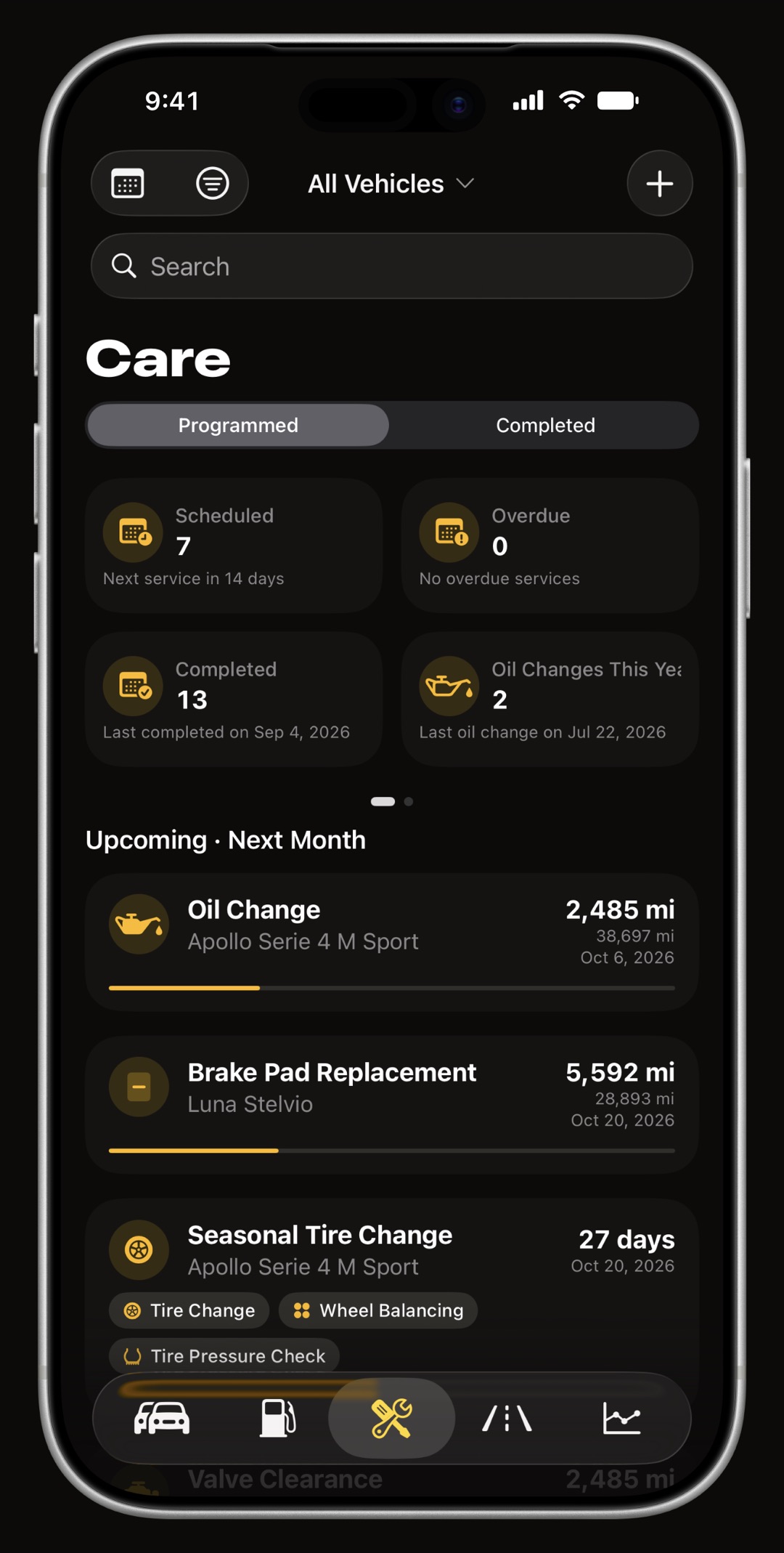
WrenchTime, an iPhone app for maintenance, fuel and mileage on cars and motorcycles, treats motorcycles as a first-class case: chain maintenance, fork service and valve clearance are built-in procedures among its 56, next to oil change, oil filter, brake fluid, coolant flush, battery check, tire pressure check and wash, and a Motorcycle Service kit logs oil, filters, chain and inspection as one entry with a checklist. Log what you did before storage with the date, the odometer and the cost, then schedule the spring jobs by date, by distance or both, with a reminder that arrives as a notification. A recurring series repeats any job every year, so next autumn's storage routine is already queued. WrenchTime keeps the record and the reminders; it does not monitor the battery or the fuel.
The free version covers 1 vehicle with 2 maintenance entries and 3 fuel entries per month, and WrenchTime Pro removes the limits. The motorcycle maintenance app guide covers everything WrenchTime does for motorcycles. Download WrenchTime on the App Store.
Frequently asked questions
Should I start my motorcycle during winter storage?
No, not for short runs. Harley-Davidson Insurance (2025) warns that a weekly start that never brings the engine to full operating temperature lets water condense inside it. Honda Canada recommends running the vehicle regularly instead, so the rule that satisfies both is simple: leave it off, or run or ride it until fully warm every time.
Should I store my motorcycle with a full or empty tank?
Full, with fuel stabilizer. Harley-Davidson Insurance (2025) says not to drain the tank, because an empty tank invites corrosion and dried-out seals and untreated fuel can clog carburetors and injectors. The AMA (2020) adds that a full tank reduces condensation. On a carbureted motorcycle, drain the float bowls as well.
Can I store a motorcycle outside for the winter?
Yes, if there is no alternative. Use a quality outdoor cover, and because waterproof covers tend to be poorly ventilated, Honda Canada advises removing the cover after rain or snow and letting the motorcycle dry. Lock it, keep it insured, and keep the battery on a maintainer or charged indoors.
Do I need to remove the battery for winter?
Not if the storage space stays above freezing and the battery sits on an automatic maintainer all winter. The AMA (2020) says to remove it if temperatures will likely fall below freezing. According to Yuasa, a discharged battery can freeze at 27°F (-3°C), while a fully charged one holds to about -75°F (-59°C).
Should I change the oil before or after winter storage?
Before. Harley-Davidson Insurance (2025) warns that months in used oil contaminated with solvents and sediments can damage bearings, so change the oil and filter before the motorcycle goes into storage. Honda Canada also suggests changing it again in spring if the motorcycle stood for more than four months.
Should I cancel my motorcycle insurance over the winter?
Check first. Many states require continuous coverage, and Harley-Davidson Insurance (2025) cites National Insurance Crime Bureau data that 25% of all motorcycle thefts occur in winter. Ask your DMV and your insurer about the rules and your options before you cancel, and keep the stored motorcycle locked.
